
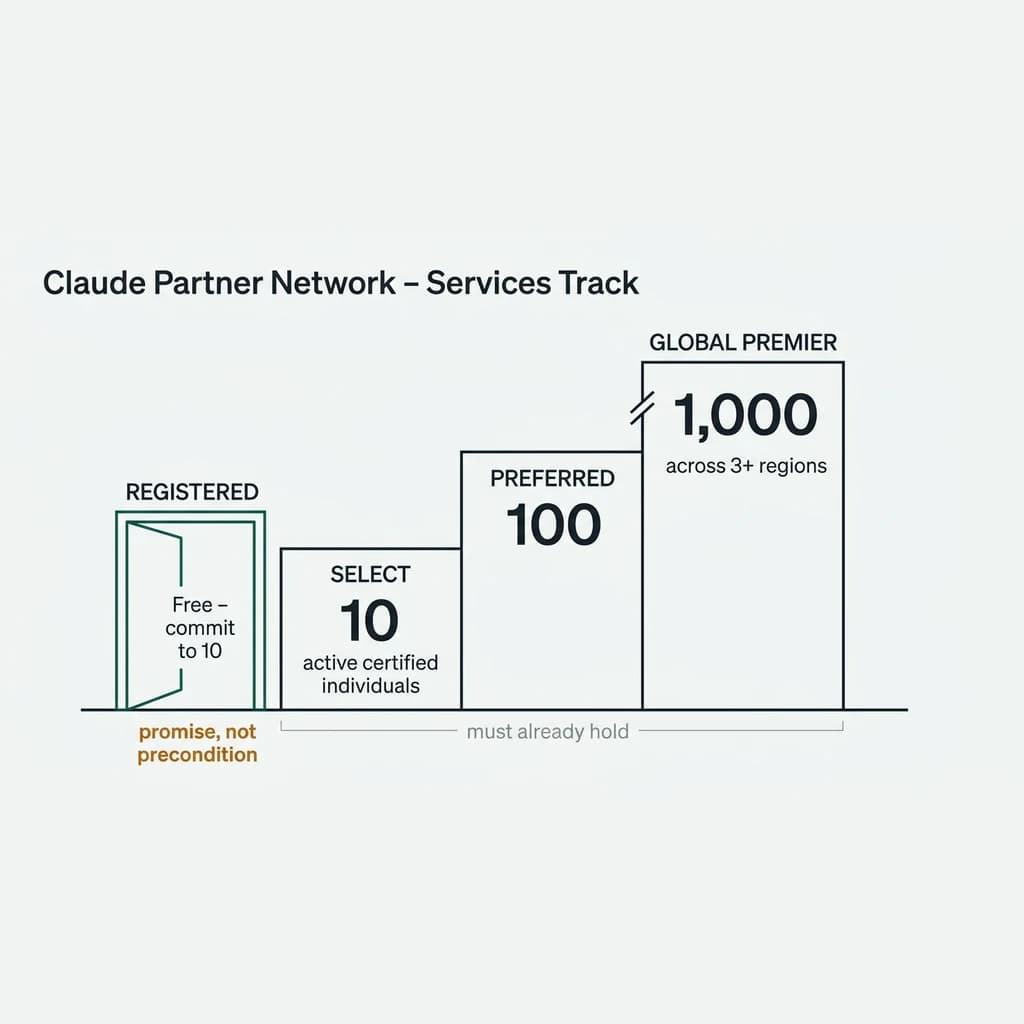
- ✓Anthropic's Claude Partner Network Services Track gates every partner tier on a count of certified people: 10 for Select, 100 for Preferred, 1,000 for Global Premier. Read cold, that looks circular - but membership is free, and new applicants join at Registered with only a commitment to 10 certified practitioners, not a precondition. A certification only counts toward the number while its holder has used Claude in the past 90 days, so the credential comes with maintenance attached. No exam price is stated here - the 2026 sources give none, deliberately.
- ✓The Services Track counts headcount across all four certifications, not just one. This hub breaks down audience, format, and domains for each.
- ✓Step 3 below is picking the right foundation exam. This is the decision guide for that exact question.
- ✓Once you've picked a certification, this hub covers format, domains, and study plans for sitting it.
Quick answer
Every tier of Anthropic's new Services Track is gated on a count of certified people - 10 for Select, 100 for Preferred, 1,000 for Global Premier. It reads like a closed loop: you need certified people to be a partner, and you seem to need to be a partner to certify. It isn't closed. Partner Network membership is free, and new applicants join at Registered with a commitment to 10 certified practitioners - not a precondition. Nobody has to be certified on the day they apply.
Anthropic has published the tier requirements for the Services Track of the Claude Partner Network. Read them as a partner-program announcement and they are unremarkable. Read them as a candidate for one of the four Claude certifications, and one thing stands out: the entry requirement for every tier is a count of certified people.
The thresholds
Select, where partnership formally begins, requires at least 10 active certified individuals, at least 2 joint customers deployed in production in the trailing 12 months, and at least 1 public customer story.
Preferred requires at least 100 active certified individuals, at least 15 deployed joint customers, and at least 3 public stories.
Global Premier requires at least 1,000 active certified individuals, at least 100 deployed joint customers across three or more regions, at least 15 public customer stories, and a joint business plan with named executive sponsors (first-hand: anthropic.com/news/services-track-partner-hub).
New applicants do not start at Select. They start at Registered, the program's entry level, with a minimum commitment to 10 certified practitioners (first-hand: anthropic.com/news/services-track-partner-hub).
Three dimensions, one of which is you
Anthropic measures every tier on the same three things: certified practitioners, customers running Claude in production, and public endorsements of the firm's work.
Two of those are outcomes a consulting firm can only earn slowly. Deployments take quarters. Public references take a customer's legal team. The third, certified headcount, is the one a firm can move deliberately and quickly, by putting people through an exam.
That makes it the lever firms will reach for first when they are short of a tier. It is also the only one of the three that depends on individuals choosing to sit something.
The word doing the work is "active"
Anthropic's definition is narrow and worth reading twice: how many of the firm's people hold a current Anthropic certification and have used Claude in the past 90 days (first-hand: anthropic.com/news/services-track-partner-hub).
Both halves must be true at once. A certificate on its own does not count. Heavy Claude use by uncertified staff does not count either. The metric only counts people who are credentialed and currently working in the product.
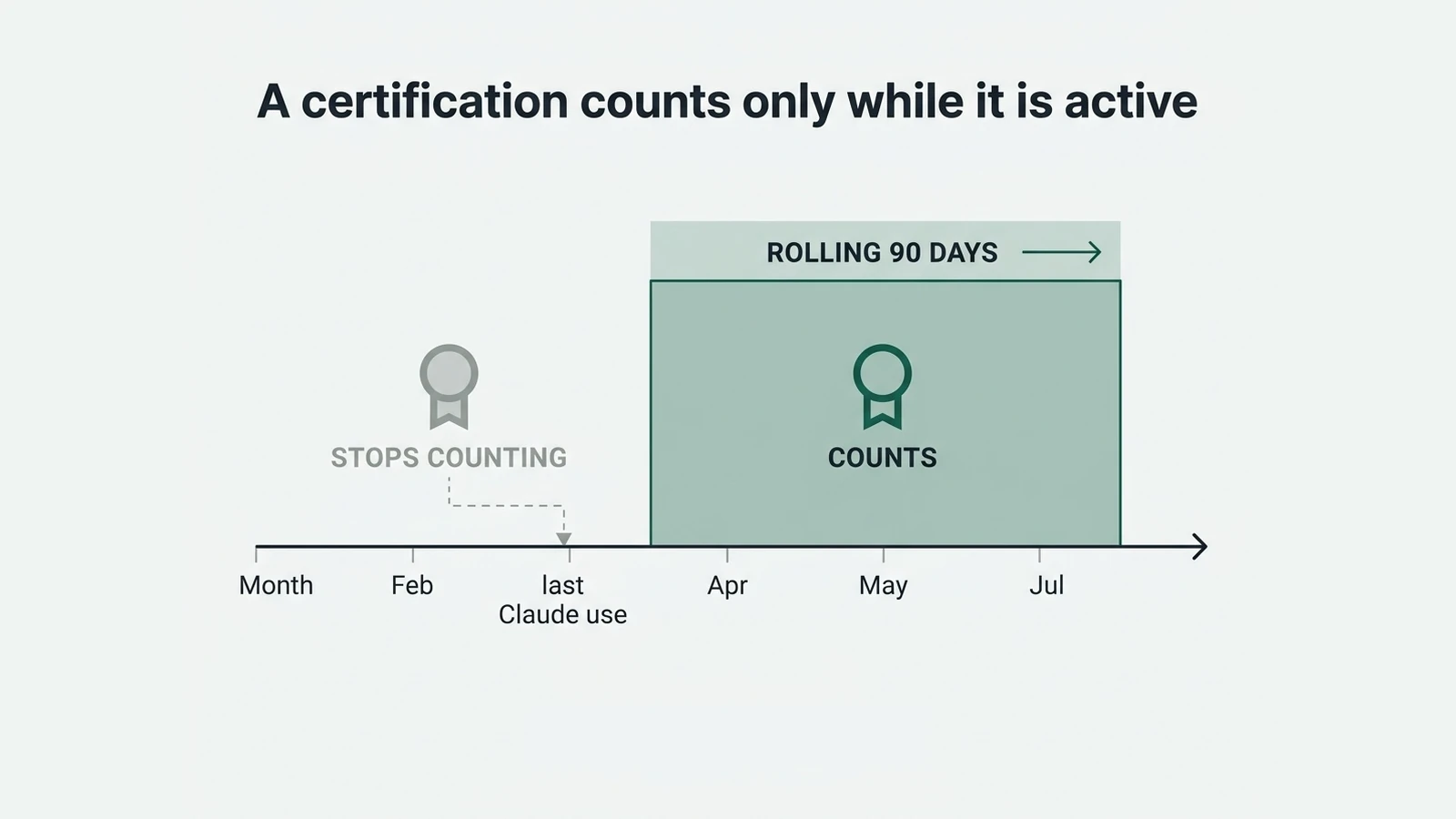
This is a rolling window, not an annual one. Someone who certifies in March, then spends the summer on a project that does not use Claude, has quietly stopped counting toward their employer's tier by autumn. None of the four sources describe a renewal date or an expiry notice for this - the window simply keeps rolling, and the number reflects it in real time.
Why the dates matter more than they look
Promotions are processed twice a year, on January 1 and July 1, with an additional review on October 1, 2026, in this first year. Downward reviews happen only at the annual December 31 review, and are preceded by 90 days' notice (first-hand: anthropic.com/news/services-track-partner-hub).
That asymmetry is deliberate and it shapes behavior. Moving up is checked frequently. Moving down is checked once, with warning. A firm that is close to a threshold has two or three dated opportunities a year to clear it, and each one is a budget conversation with a deadline attached.
The Partner Hub makes those conversations concrete. Partners see their standing against the published requirements refreshed daily, and can query it through a new MCP connector, including how many of their consultants hold an active certification. A partner lead can now ask that question on a Tuesday and get a number, rather than waiting for a quarterly report.
The chicken and egg, and why it is not one
Read the tier table on its own and it looks like a closed loop. A firm needs 10 certified people to reach Select. A person needs access to sit the exam. If access came from being a partner, nobody could ever start.
It does not. Registration runs through the Claude Partner Network, and membership is free (first-hand: claude.com/blog/four-role-based-claude-certifications). New applicants join at Registered, the entry level, with a commitment to 10 certified practitioners - a commitment, not a precondition (first-hand: anthropic.com/news/services-track-partner-hub). Nobody has to be certified on the day they apply.
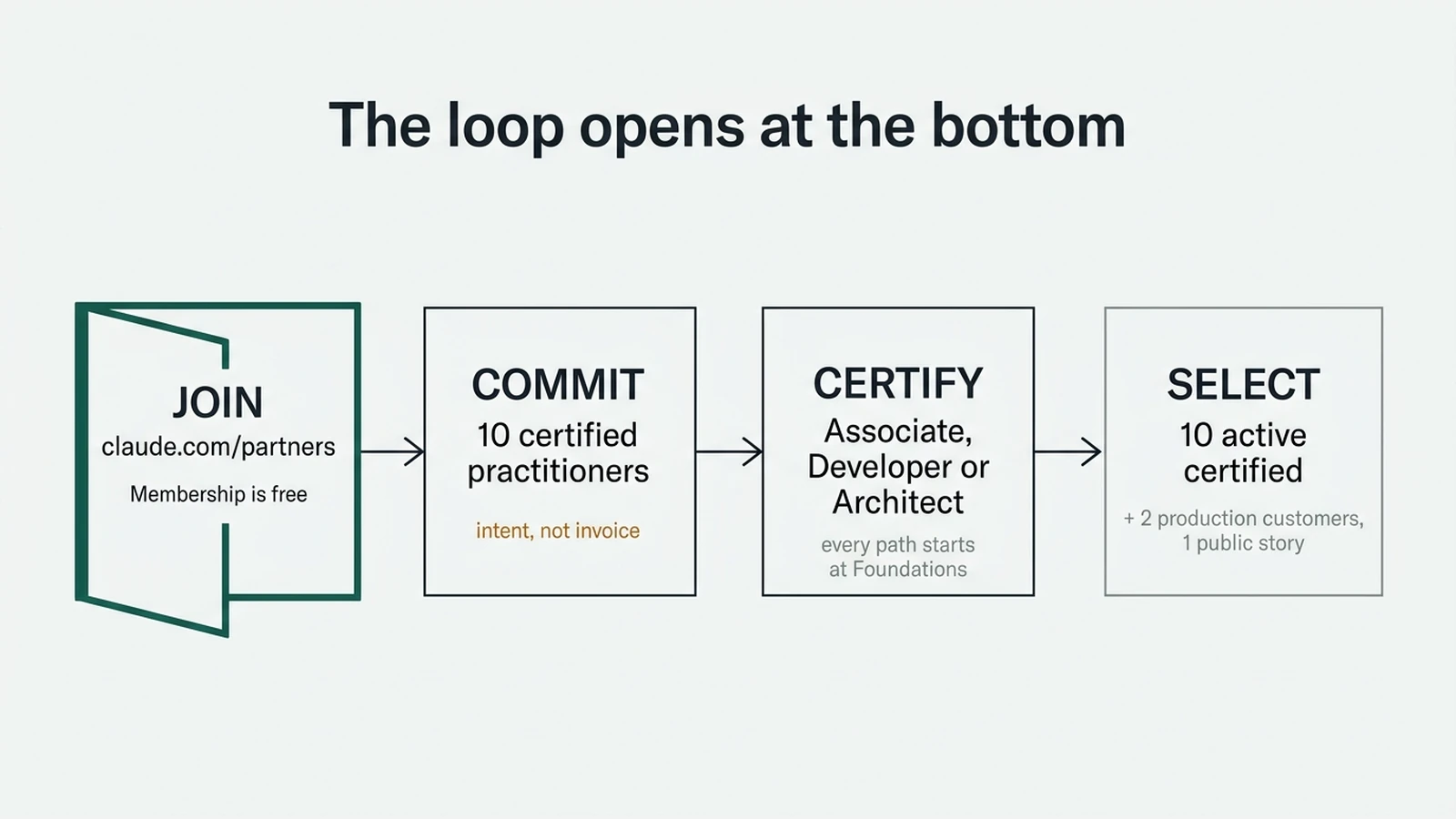
The gate is real. It is just much lower than it looks.
Five steps to sitting the exam
-
Check whether your employer is already in. Many large services firms joined when the network launched. If yours has, the internal route already exists and someone in learning and development or the Anthropic alliance team owns it. This is the fastest path and most people skip straight past it.
-
If not, get the company registered. Membership at claude.com/partners is free. The commitment is to 10 certified practitioners, which is a statement of intent rather than a bill. For a firm of any size this is a small ask, and the Services Track gives whoever signs it a concrete reason to say yes.
-
Pick the right foundation exam. There are four certifications, and every path starts at foundation level (first-hand: claude.com/blog/four-role-based-claude-certifications). Associate: Foundations is the broad one - for anyone working on Claude-related projects, consultants and project leads included, covering both business and technical expertise. Developer: Foundations is for engineers building applications. Architect: Foundations is for solution architects designing agent systems. Architect: Professional is the advanced credential, and it sits on top of a foundation, not instead of one.
-
Expect a proctored, identity-checked exam. Every exam is proctored, supervised, and delivered through Pearson Professional Assessments, and test takers must validate their identity before beginning (first-hand: claude.com/blog/four-role-based-claude-certifications). None of the four sources describe a company-email requirement for the exam itself - if your employer's own registration process asks for one, that is your firm's process, not a rule stated in the certification announcement.
-
Sit it, then keep using Claude. You receive a digital badge through Credly by Pearson. Then the 90-day clock described above starts mattering, because the credential only counts toward your firm's tier while you are still active in the product.
If you have no employer to route through
The honest answer is that this is the hard case, and the announcement does not describe a self-serve individual path. Three routes are worth trying, in order: ask a client whose firm is already a partner whether they will register you as one of their certified practitioners; register your own consultancy, since the entry commitment is free and a small company is still a company; or wait, because a program that added four certifications and a Pearson delivery partner in five months is a program still expanding its front door.
What you need before you apply
Short list, because the barrier is genuinely low.
A company. The programme is open to "any organization that is bringing Claude to market" - management consultancies, professional services firms, specialist AI firms, agencies. No size floor is published (first-hand: anthropic.com/news/claude-partner-network).
Nothing else that is published. No revenue threshold, no existing Claude spend, no prior certification, no named reference customer. Anthropic's own wording was "Membership is free of charge, and applications open today" (first-hand: anthropic.com/news/claude-partner-network).
What is not public: the application form's questions. It sits at claude.com/form/cpn-partner-application behind a submit, and the criteria used to review it are not published anywhere. Anyone telling you exactly what the form asks is guessing. Plan for the ordinary set - company, domain, region, size, what you intend to build - and expect a review step, not an instant approval.
What you are signing up for
This is the part worth reading before you click apply, because a partner programme is a set of obligations as well as a set of benefits.
A commitment to 10 certified practitioners. The entry commitment at Registered. A statement of intent about the future, not a bill and not a precondition.
Being measured, publicly, on three numbers. Certified practitioners, customers running Claude in production, and public endorsements of your work. Your standing against the published requirements is visible in the Partner Hub, refreshed daily, and customers use that same hub to choose firms.
A review calendar you do not control. Promotions on January 1 and July 1, with an extra review on October 1, 2026 this first year. Downward reviews only at the annual December 31 review, with 90 days' notice first.
Ongoing activity, not a one-time push. The certified-practitioner count only includes people who have used Claude in the past 90 days, so the number decays if the work moves elsewhere.
What you get for it
Free. That is the headline and it is worth repeating, because most partner programmes are not.
Beyond that: a Partner Portal carrying Anthropic Academy training materials, sales playbooks, and co-marketing documentation. Qualified partners are listed in the Services Partner Directory. Deals can draw on dedicated Applied AI engineers, and complex implementations on technical architects. Anthropic committed an initial $100 million for 2026 covering partner training, sales enablement, market development, customer deployment success, co-marketing campaigns, and events (first-hand: anthropic.com/news/claude-partner-network). Partners who joined immediately were promised priority access to new certifications as they rolled out.
The named launch partners were Accenture, Deloitte, Cognizant, and Infosys, which tells you the programme was built with large firms in mind. The entry requirements were not.
An example, to make the sequence concrete
Illustrative - not a real firm
Priya and her consultancy are invented, to show the sequence. The thresholds, dates, and mechanics inside this example are real and traced to the sources above; the firm and the person are not.
Priya runs a 40-person data consultancy in Bangalore. Three of her engineers use Claude Code daily. She has no certification and her firm is not a partner.
Week 1. She checks whether the firm is already registered. It is not. She reads the tier table, sees "10 active certified individuals" for Select, and assumes she is two years away.
Week 2. She applies at claude.com/form/cpn-partner-application. Free. The firm enters at Registered with the commitment to 10 practitioners. Nobody at the firm is certified yet, and that is fine, because the commitment is forward-looking.
Weeks 3 to 8. Six people sit foundation exams. Her three engineers take Developer: Foundations. Her two solution leads take Architect: Foundations. Her delivery manager takes Associate: Foundations, which is explicitly for consultants and project leads and covers business as well as technical ground. All six are proctored through Pearson and get Credly badges.
Month 4. Four more certify. The firm is at 10. It also needs 2 joint customers deployed in production in the trailing 12 months and 1 public customer story for Select, so the constraint moves from people to references - the normal order.
Month 9. The customer story lands. The firm clears Select at the January 1 review.
Continuously. Priya now watches the 90-day clock. When a certified engineer moves to a non-Claude project, the count drops by one. That is the maintenance nobody reads about in the announcement.
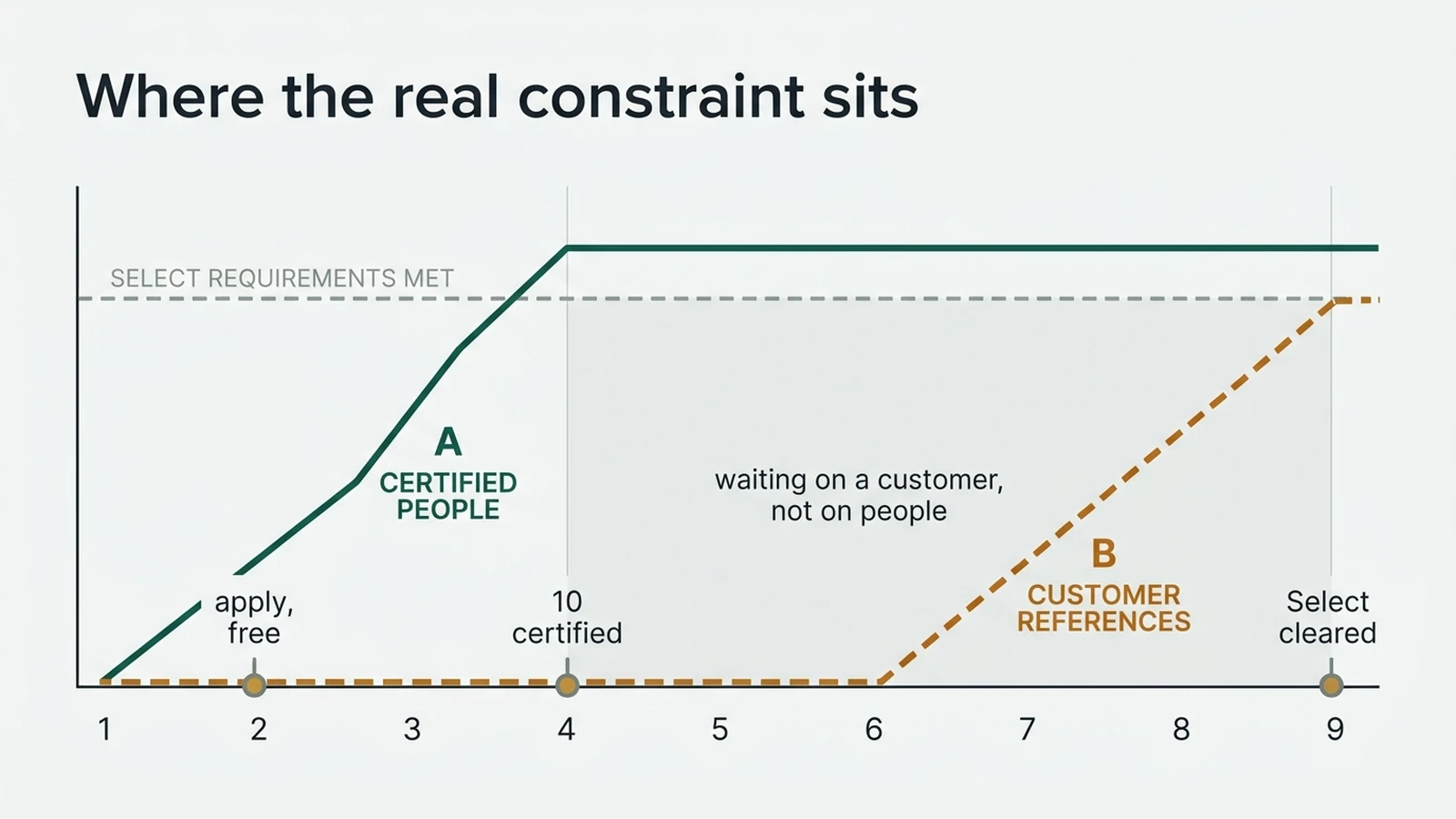
The sequence took nine months and cost nothing at the entry point. The binding constraint was never the certification count.
What to do with this
If your employer is in the partner network, ask now. A firm sitting at 80 certified staff and wanting Preferred needs 20 more people by a fixed date. That is a gap with a number on it, which is a far easier internal case than "professional development." Anthropic has also put $100 million into training, technical support, and marketing funds attached to the program.
If you are already certified, keep using Claude. The 90-day rule turns certification from an achievement into something with maintenance attached. It costs nothing to stay inside the window. It costs your firm a headcount unit to fall out of it.
If you are choosing when to sit the exam, the review dates give you a target. Certifying in November counts toward a January 1 review. Certifying in January means waiting until July.
Anthropic has also previewed specializations for specific industries and use cases, without naming any yet (first-hand: anthropic.com/news/services-track-partner-hub). If those follow the same pattern, the count of certified people in a named domain becomes the next thing firms need. Worth watching.
The links, in the order you need them
- The programme: claude.com/partners
- The application: claude.com/form/cpn-partner-application
- What the network is, and the $100M: anthropic.com/news/claude-partner-network
- The tier requirements: anthropic.com/news/services-track-partner-hub
- The four certifications: claude.com/blog/four-role-based-claude-certifications
4 direct routes into the scored material.
- exam-guideThe Services Track counts headcount across all four certifications, not just one. This hub breaks down audience, format, and domains for each.
- exam-guideStep 3 below is picking the right foundation exam. This is the decision guide for that exact question.
- exam-guideOnce you've picked a certification, this hub covers format, domains, and study plans for sitting it.
- practiceThe cheapest way to find out if you're ready before you route a certification toward your employer's tier count.
- claude.com/partners· claude.com
- claude.com/form/cpn-partner-application· claude.com
- anthropic.com/news/claude-partner-network· anthropic.com
- anthropic.com/news/services-track-partner-hub· anthropic.com
- claude.com/blog/four-role-based-claude-certifications· claude.com
Share this post.
One share is one less person stuck on the same question.