
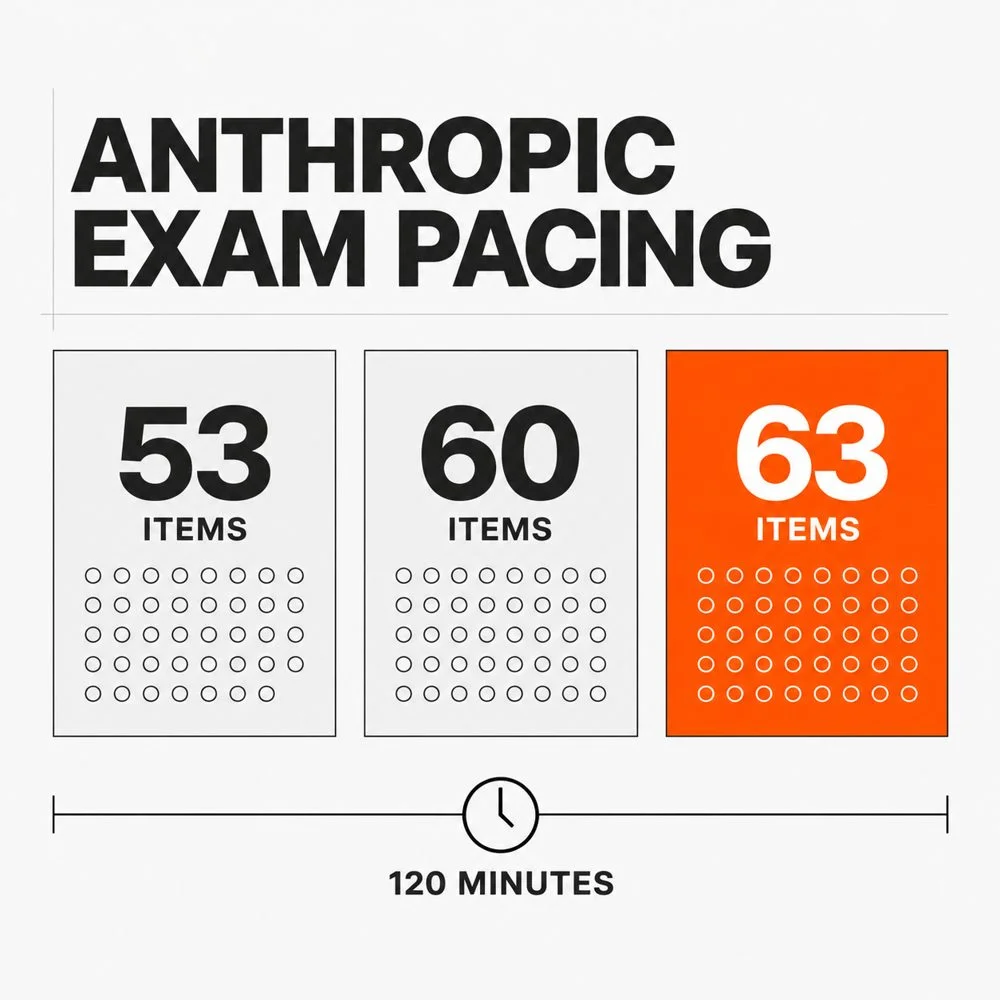
- ✓Using this site's four exam blueprints, compare 53, 60 and 63 items in 120 minutes, plan a suggested 15-minute review reserve, and budget for scenario reading on CCA-F.
- ✓Item counts, formats and domains for each of the four exams, side by side.
- ✓Explore the five domains and their weights in this site's Architect - Foundations blueprint.
- ✓This site's Architect - Professional blueprint: 63 items, seven domains and the shortest first-pass budget per item.
Open the 60-question CCA-F mock →
Anthropic exam pacing starts with one shared fact and one hidden trap. In this site's four exam blueprints, every Claude certification has a 120-minute window, but the item count is not the same across the four exams.
That means there is no single correct rhythm called "Claude certification timing." In those blueprints, Developer - Foundations has 53 items. Architect - Foundations and Associate - Foundations have 60. Architect - Professional has 63. The clock is the same; the pressure per item is not.
Anthropic offers four role-based Claude certifications, granted through supervised, identity-verified exams delivered with Pearson through Pearson Professional Assessments. (Source: claude.com) The item counts and time windows in this article come from this site's blueprint for each of the four exams.
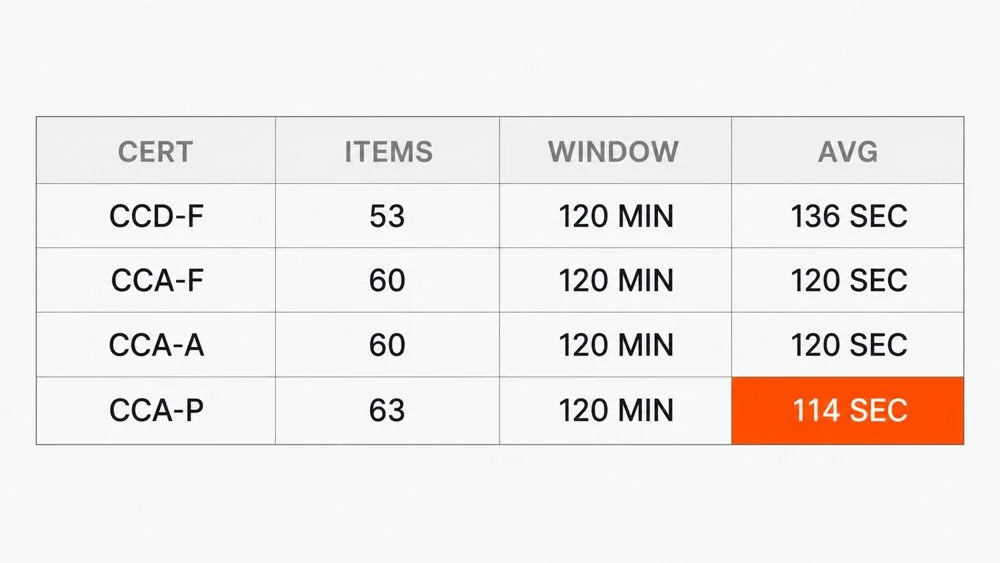
The pacing math
Use the math as a planning floor, not as a promise about how every question feels.
- Claude Certified Developer - Foundations (CCD-F): 53 items in 120 minutes. That is about 136 seconds per item.
- Claude Certified Architect - Foundations (CCA-F): 60 items in 120 minutes. That is exactly 120 seconds per item.
- Claude Certified Associate - Foundations (CCA-A): 60 items in 120 minutes. That is also 120 seconds per item.
- Claude Certified Architect - Professional (CCA-P): 63 items in 120 minutes. That is about 114 seconds per item.
This site keeps the four blueprints separately rather than copying one exam's shape onto the others.
The first trap is treating the average as a rule. It is only a budget. A simple recall-style item may take less than a minute. A dense architecture scenario may take three. Your plan needs a reserve.
The reserve rule
The 105/15 split below is a suggested practice strategy. Use it on exam day only if the exam rules and interface let you mark questions and return to them.
Aim to finish a first pass with 15 minutes left. That reserve is not for rereading everything. It is for marked questions, arithmetic mistakes, and the one item where two options still feel defensible.
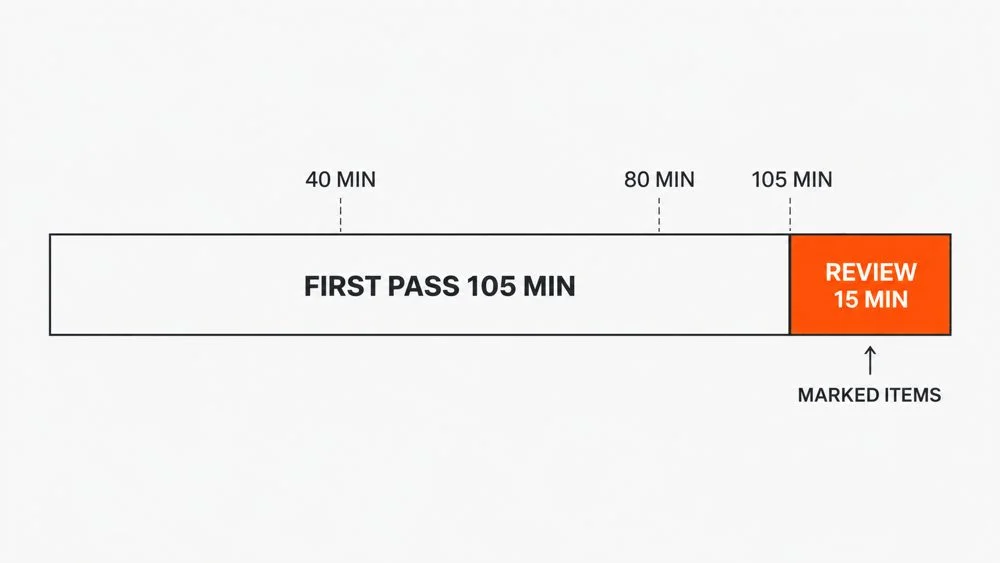
Here is the practical pacing target for every one of the four exams: a first pass in roughly 105 minutes, leaving 15 minutes for review.
That makes the suggested first-pass budget tighter than the full-window average calculated from this site's blueprints:
- 53 items: about 119 seconds per item.
- 60 items: about 105 seconds per item.
- 63 items: about 100 seconds per item.
Architect - Professional gives you the least first-pass slack, even before you account for its senior architecture content.
CCA-F needs a different clock
Do not generalise the CCA-F format to the other three certifications. This site's blueprint records Architect - Foundations as scenario based (four scenarios drawn from a bank of six) and the other three as non-scenario exams.
That matters. With 60 items across four scenarios, each scenario's opening context serves several items. If you rush the scenario setup, you may pay for it across several questions. The better rhythm is front-loaded: read the scenario carefully once, underline the operating constraint, then move faster through the individual items.
For CCA-F, the pacing question is not "two minutes per question." It is "how much setup time does this scenario deserve before the individual answers become cheaper?" If you spend the first pass pretending every item is independent, you lose the main advantage of a scenario block.
A worked timing plan
For a 60-item CCA-F attempt, use three checkpoints:
- At 40 minutes, aim to have completed about 23 items.
- At 80 minutes, aim to have completed about 46 items.
- At 105 minutes, aim to finish all 60 items and begin review.
These checkpoints average 105 seconds per item, including scenario-reading time. Adjust individual item times around shared scenario context.
For a 63-item Architect - Professional attempt, tighten the same plan. The midpoint is not item 30; it is item 31 or 32, and the first-pass target gives you only about 100 seconds per item. This site's Architect - Professional blueprint has seven domains, with Integration carrying the largest weight at 19%; its Architect - Foundations blueprint has five domains.
For a 53-item Developer - Foundations attempt, do not spend the extra seconds casually. That exam's heaviest domain in this site's blueprint is Applications & Integration at 33.1%. Use the additional time to slow down on API mechanics, tool-call boundaries, and software-engineering constraints. Those are not bonus seconds; they are where the exam's weight sits.
What to practise before exam day
Practise with a visible timer, but do not train yourself to race. Train the handoff between three modes: answer, mark, move.
Answer when the deciding constraint is clear. Mark when two options remain plausible after one full read. Move when you catch yourself rereading the same sentence without producing new information.
The trap is heroic certainty. A candidate can lose five minutes trying to force one item to confess. The better behaviour is calmer: make the best current call, mark it, and buy the answer back with the reserve at the end.
Where the facts come from
The facts about the certification programme come from Anthropic's public certification post: role-based certifications, supervised identity-verified exams, Pearson delivery, and Credly badges. The item counts, time windows, formats and domain weights come from this site's blueprint for each of the four exams. No certification price is stated here because current cost should be checked at the source, not copied into a pacing article.
3 direct routes into the scored material.
- exam-guideItem counts, formats and domains for each of the four exams, side by side.
- exam-guideExplore the five domains and their weights in this site's Architect - Foundations blueprint.
- exam-guideThis site's Architect - Professional blueprint: 63 items, seven domains and the shortest first-pass budget per item.
- claude.com· claude.com
Share this post.
One share is one less person stuck on the same question.