
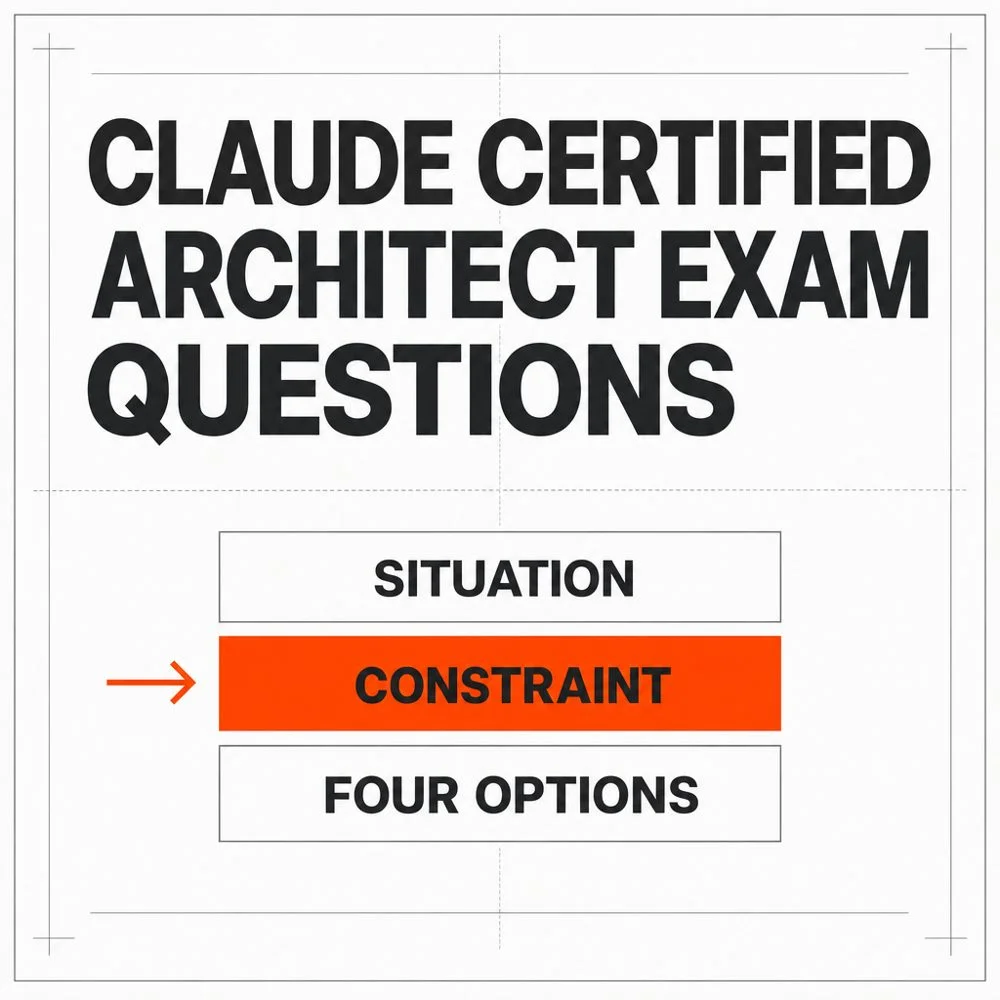
- ✓For Claude Certified Architect exam preparation, this site teaches a scenario-reading framework: a situation, a constraint and four plausible options. The distractors illustrate choices that miss the stated constraint. Learn four distractor shapes through five original worked items, one per domain in this site's Foundations blueprint, with reasoning for every option.
- ✓The five domains and their weightings live here. The worked items below take one question from each.
- ✓The D1 item turns on one rule: known steps in a known order are a workflow, not an agent.
- ✓The D4 item turns on the difference between asking for a shape in a prompt and enforcing it with a schema.
Open the 60-question CCA-F mock →
Claude Certified Architect exam questions are scenario questions. You are given a situation, a constraint, and four options that all describe something a competent architect might really do. Three of them are correct answers to a question you were not asked.
That single sentence is the whole skill. Below is how the items are built, the four shapes a wrong answer takes, and five original worked examples with the reasoning for every option.
First, the frame. This site's Foundations blueprint treats the exam as scenario based. Anthropic says every Claude certification exam is proctored and identity verified, delivered through Pearson Professional Assessments, with a digital badge issued through Credly by Pearson to those who pass. Exams are available to members of the Claude Partner Network. (Source: claude.com)
The question anatomy and the four distractor shapes below are this site's teaching framework, not Anthropic's published item-writing rules.
How one question is put together
Every scenario item has three parts, and only one of them decides the answer.
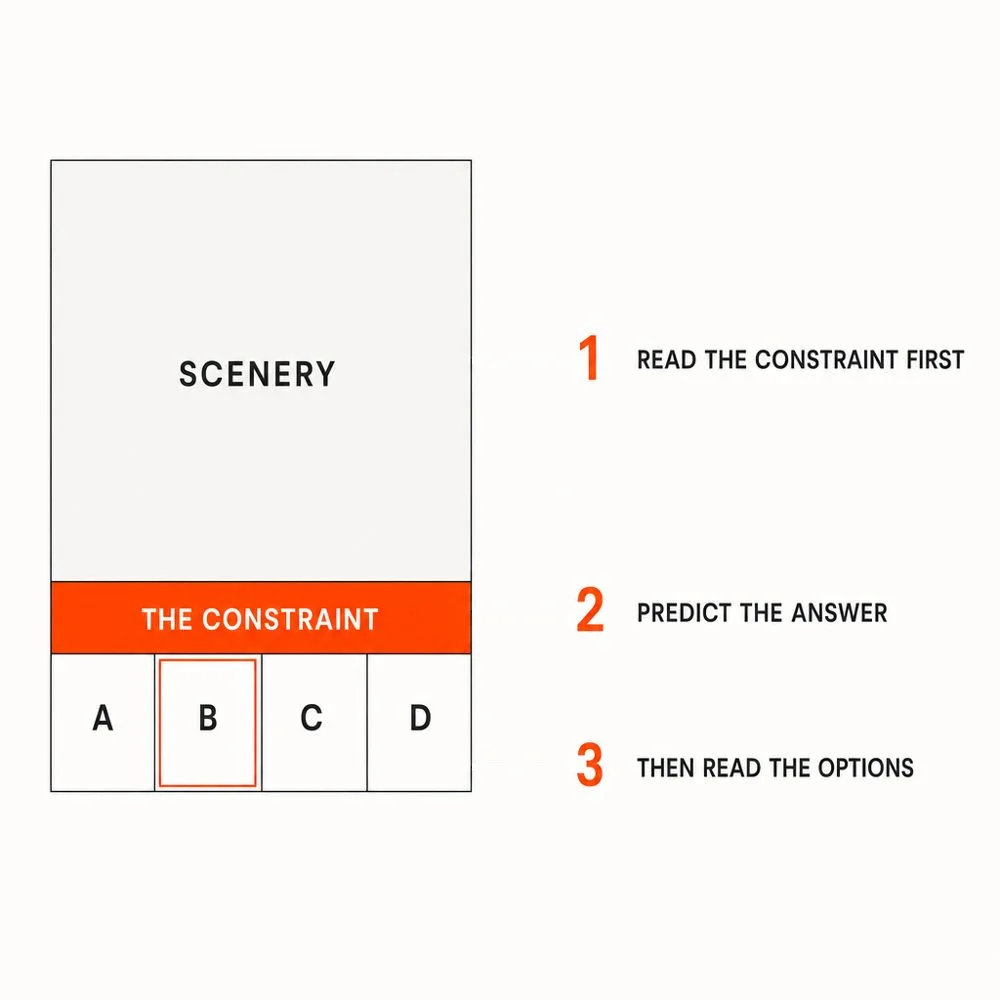
The situation. Two or three sentences of context. A team, a system, a volume. This part is scenery. It makes the question readable. It rarely decides anything.
The constraint. Usually the last sentence before the options. "Every step must be auditable." "Without each engineer configuring it." "The loader fails." This is the whole question. Find it before you read a single option.
Four options. One satisfies the constraint. The other three are real practices that satisfy a different constraint.
That last point is the part candidates miss. The wrong answers are not wrong. They are answers to a question that was not asked.
The four shapes a wrong answer takes
Once you have seen a few dozen items, the distractors stop being surprising. They come in four shapes.
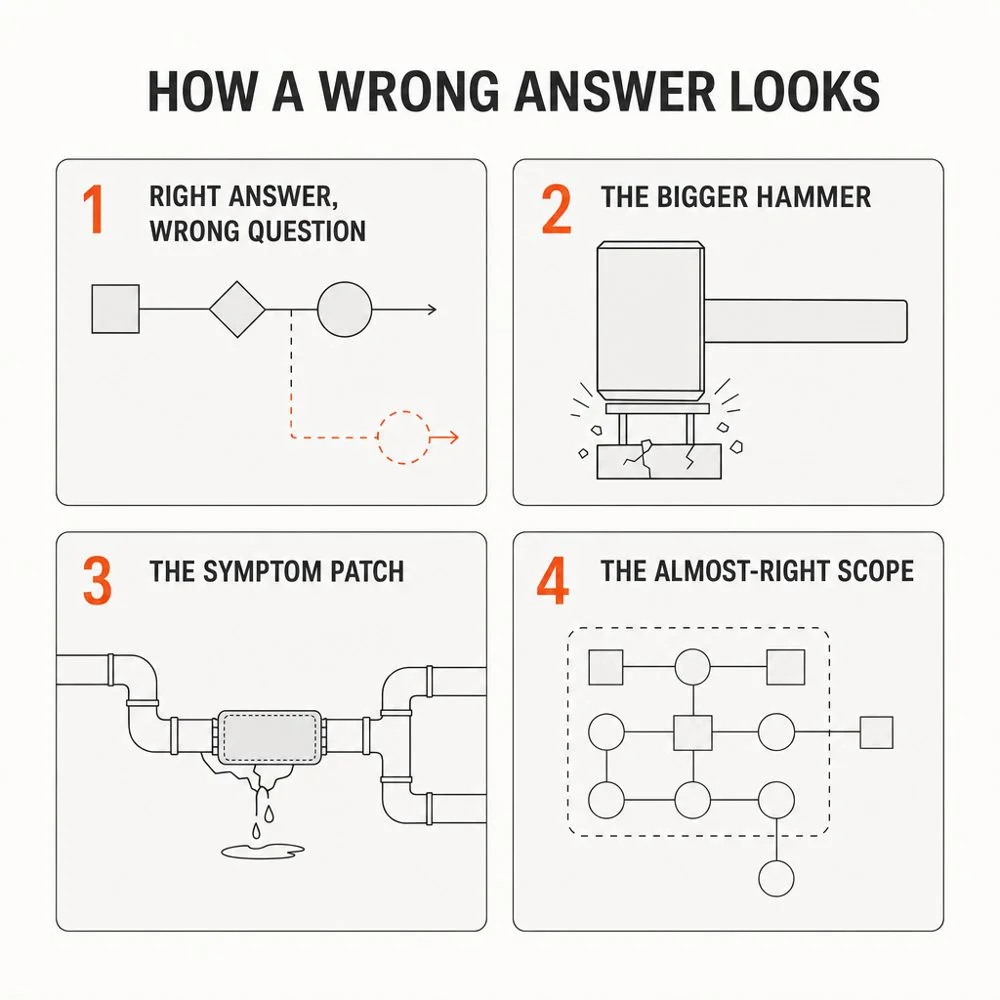
- Right answer, different question. A genuine best practice that solves a problem the stem never raised. Multi-agent orchestration is a fine pattern. It is the wrong pattern when the stem already told you the steps and their order.
- The bigger hammer. Move to a larger model. Buy a longer context window. Add more agents. These options feel safe. They add cost, latency or complexity, and they are the wrong answer whenever they leave the stated constraint unresolved.
- The symptom patch. A regex that extracts the JSON. A retry on failure. Truncating to the last twenty turns. Each one makes the error message go away and leaves the cause in place. Watch for options that would still be running when the underlying problem recurs.
- The almost-right scope. The correct mechanism applied at the wrong level. Personal settings where the requirement said everyone. A per-call fix where the requirement said every call. Scope errors are the hardest to spot because the vocabulary matches.
Five worked items, one per domain
These five questions are original, written for this page to show the reasoning. They are not exam items and they are not drawn from any question pool. They follow the five-domain split this site uses for the Foundations exam, so you can feel the difference in how each domain frames a problem.
D1. Agentic architecture and orchestration
A claims team wants Claude to handle intake. Each claim needs document extraction, a policy lookup, a fraud check, and a written decision. The four steps must run in a fixed order and every step must be individually auditable. Volume is about 4,000 claims a day. Which design fits?
- A. One agent holding all four tools, allowed to choose the order it calls them.
- B. A deterministic workflow that calls Claude at each of the four steps and persists the output of each step.
- C. A planner agent that delegates to three specialist sub-agents.
- D. A single prompt that performs all four steps in one call.
Answer: B. The constraints are "fixed order" and "individually auditable". B supplies both explicitly. A does not enforce the required order, although its tool calls could be logged. C adds planning without a stated need. D does not persist separate steps, which makes failures harder to isolate and resume.
The rule: when the steps and their order are known in advance, that is a workflow, not an agent. Agentic control is for when the path is genuinely unknown.
D2. Tool design and MCP integration
An internal MCP server exposes 40 tools from a legacy ERP. Architects report Claude selects the wrong tool roughly a third of the time. The tool names are the ERP's own, for example ZFI_POST_DOC_V2. What should be changed first?
- A. Move the workload to a higher model tier.
- B. Add a system prompt that lists all 40 tools and when to use each.
- C. Split the MCP server into four servers by business domain.
- D. Rewrite the tool names and descriptions in task language, and cut the exposed surface to the tools this workflow actually needs.
Answer: D. Clear names and descriptions help Claude tell tools apart, and exposing only the relevant tools reduces selection ambiguity. ZFI_POST_DOC_V2 describes nothing. A changes model capability before fixing the unclear interface. B may help, but it creates a second place to maintain usage guidance. C alone does not clarify the names or reduce the tools Claude sees. Measure selection accuracy after the change.
The rule: check tool names, descriptions and the exposed tool set before you blame the model.
D3. Claude Code configuration and workflows
A platform team wants every engineer working in one repository to run the same lint and test command before Claude Code proposes a commit. Engineers should not have to configure anything themselves. Where does the rule belong?
- A. In the repository's checked-in project files (
CLAUDE.md, with any hooks in the shared.claude/settings.json), committed to version control. - B. In each engineer's personal user settings.
- C. In a prompt template the team pastes at the start of a session.
- D. In the continuous integration pipeline.
Answer: A. "Everyone in this repo" and "without configuring anything" both point at repo-scoped, version-controlled configuration. B is per machine and drifts the moment someone joins. C depends on a human remembering. D is the almost-right scope trap: CI catches the problem after the commit exists, and the requirement was before it is proposed.
The rule: "everyone in this repo" means version-controlled project files. "Just me, every project" means user scope; "just me, this repo" means local project settings. Read the scope words in the stem.
D4. Prompt engineering and structured output
A pipeline needs a product record with 12 fields for a downstream database. About 4% of responses arrive with a field missing or a stray sentence before the JSON, and the loader fails. What fixes it?
- A. Add "return only valid JSON, no preamble" to the prompt and retry on failure.
- B. Set temperature to zero.
- C. Define all 12 fields as required in a tool input schema with strict mode on, require that tool, and pass its input object to the loader, so the shape is enforced rather than requested.
- D. Extract the first JSON object from the response with a regular expression.
Answer: C. The constraint is that the shape must hold every time. Strict tool use enforces the declared schema; a schema without strict mode is still only a strong request. A is the strongest prompt-only option and is still a request, so it still fails sometimes. B reduces variation and guarantees nothing about structure. D is the symptom patch: it hides the preamble and cannot supply a missing field. Handle unsuccessful responses before a record reaches the loader.
The rule: prompts ask, strict schemas enforce. If the shape matters downstream, constrain it with a strict schema and handle failures explicitly.
D5. Context management and reliability
A support assistant handles conversations that run past 60 turns. Users report that after about turn 40 it forgets the account ID given in the first message, and cost per conversation has roughly tripled. What is the right change?
- A. Move to a model with a larger context window.
- B. Extract the durable facts, such as account ID and entitlements, into a compact state object carried on every turn, and summarise the older turns.
- C. Truncate the history to the last 20 turns.
- D. Cache the system prompt.
Answer: B. B addresses both symptoms: it preserves the durable facts and reduces repeated history. Check that the extraction and the summaries keep what is required. A alone does not keep the account ID salient or reduce token use. C discards the account ID from the first message, which is precisely the thing being lost. D can cut repeated system-prompt cost but does nothing about the forgotten fact, so it answers half the question.
The rule: a long conversation needs a memory design, not a bigger window. Preserve essential state explicitly, compress older context, and measure recall and token use.
How to practise this
Reading answers teaches you very little. The transferable skill is finding the constraint, and you only build it by doing it out loud.
Try this on any scenario question you meet, including the five above.
- Read the stem and cover the options. Say the deciding constraint in one sentence. If you cannot, read again. You have not found it yet.
- Predict the answer before you look. Commit to it.
- Read the four options and label each one: correct, right answer to a different question, bigger hammer, symptom patch, or wrong scope.
- For every option you rejected, write the one-line scenario where it would be correct. This is the step people skip, and it is the step that makes the next question easier.
Step four is the whole exercise. An option you can place is an option you will never be fooled by again.
What this does not tell you
Two honest limits.
The five-domain split above comes from this site's own blueprint of the Claude Certified Architect: Foundations exam. Anthropic's announcements describe the certifications and their scope; they do not establish the question anatomy taught here. These worked items are original practice material. Treat any site claiming to reproduce live exam questions with caution.
The other three certifications cover different roles, and this site keeps a separate domain blueprint for each, so nothing above transfers line by line. What does transfer is the reading method. Anthropic says each certification was designed by subject matter experts to reflect real work. (Source: claude.com)
3 direct routes into the scored material.
- exam-guideThe five domains and their weightings live here. The worked items below take one question from each.
- conceptsThe D1 item turns on one rule: known steps in a known order are a workflow, not an agent.
- conceptsThe D4 item turns on the difference between asking for a shape in a prompt and enforcing it with a schema.
- claude.com· claude.com
Share this post.
One share is one less person stuck on the same question.