CCARP-D1.3 · Domain 1 · Solution Design & Architecture · 17% of CCA-P

Workflow vs Agent: Choosing the Right Architecture.

6 min read·9 sections·Tier A

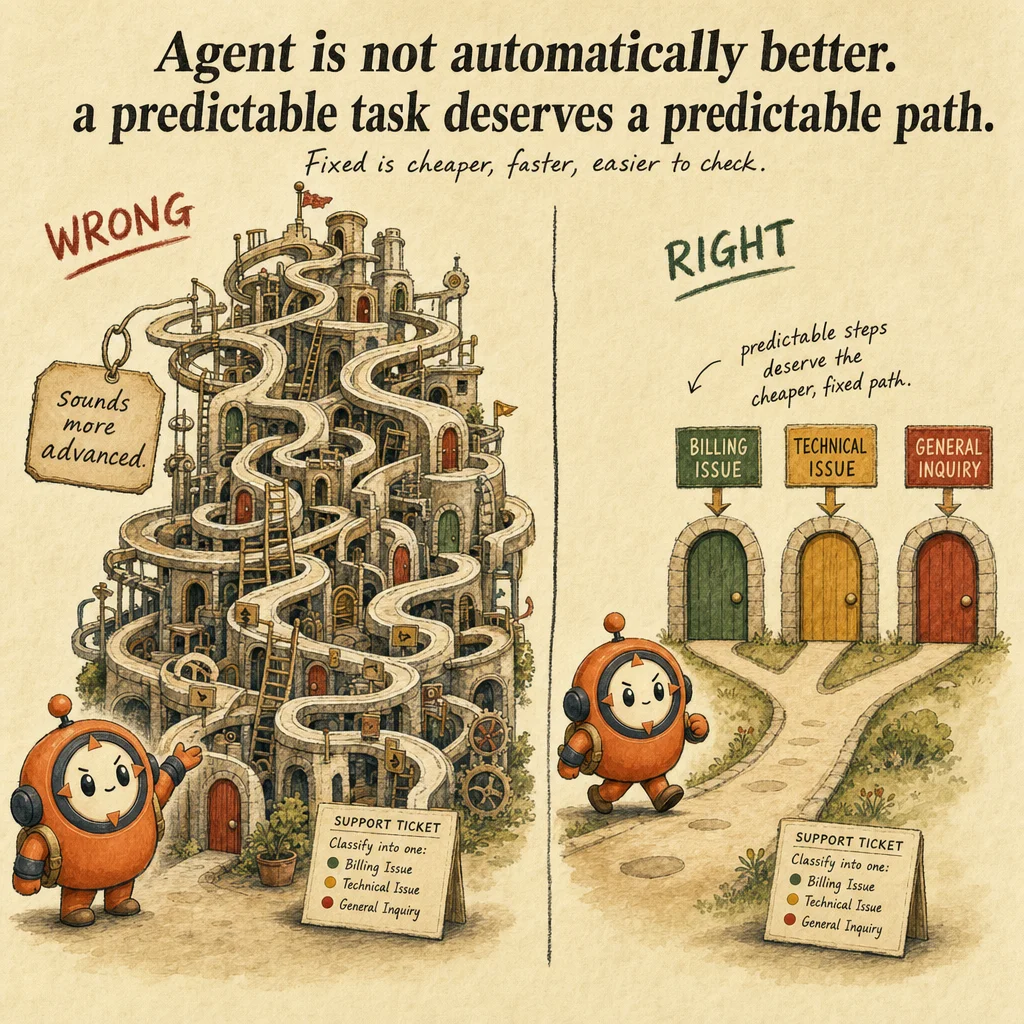
Pick the cheapest tier that actually satisfies the task: an augmented LLM call for a single unaided prompt, a workflow when the steps are known in advance, an agent only when the model must dynamically decide its own path. Anthropic: Building Effective Agents The exam trap is treating "agent" as strictly more advanced - it's a tradeoff, not an upgrade.

Official Anthropic guidanceCCA-P Domain 1CCA-P + CCD-F
Workflow vs Agent: Choosing the Right Architecture, hero illustration featuring Loop mascot in a warm gallery scene.
Domain CCARP-D1Solution Design & Architecture · 17%
On this page
01 · Summary

TLDR

Pick the cheapest tier that actually satisfies the task: an augmented LLM call for a single unaided prompt, a workflow when the steps are known in advance, an agent only when the model must dynamically decide its own path. Anthropic: Building Effective Agents The exam trap is treating "agent" as strictly more advanced - it's a tradeoff, not an upgrade.

3
Architecture tiers
5
Named workflow patterns
CCA-P D1
Exam domain
CCD-F D1
Also tested in
Dec 2024
Canonical source
02 · Definition

What it is

Anthropic's own canonical taxonomy ("Building Effective Agents", Dec 2024 - still the reference doc for this objective) names three tiers of increasing autonomy. An augmented LLM is a single call enhanced with retrieval, tools, or memory but no orchestration layer. A workflow is LLMs and tools orchestrated through predefined code paths - the sequence is fixed by the architect, not the model. An agent is a system where models dynamically direct their own process and tool use, maintaining control over how they accomplish a task - the number and order of steps can't be predetermined.

The architect's job is picking the cheapest, most predictable tier that satisfies the requirement, not defaulting to the most autonomous option available. Anthropic states this directly: "Success in the LLM space isn't about building the most sophisticated system. It's about building the right system for your needs. Start with the simplest solution possible, and only increase complexity when needed." The enterprise framing sharpens this further - the choice is justified by task unpredictability and value at stake, not technical preference.

03 · Mechanics

How it works

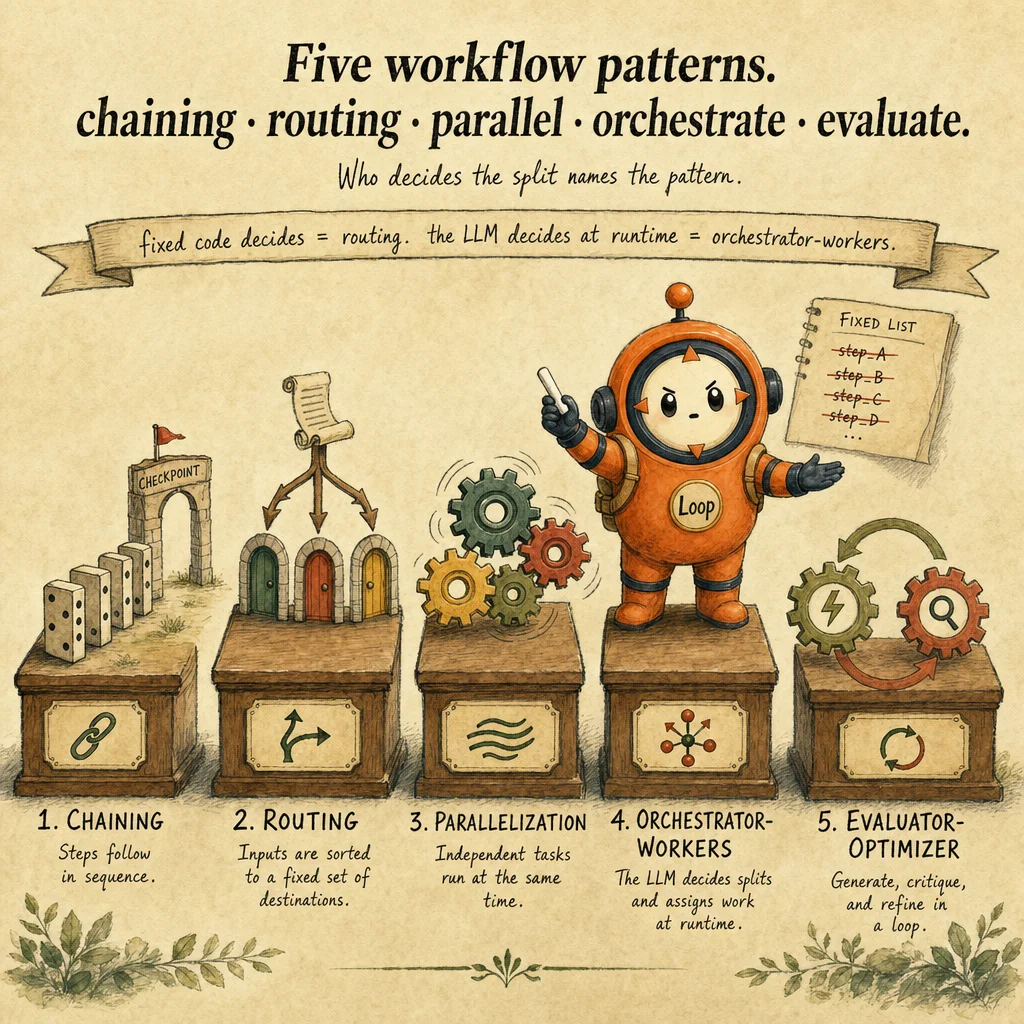
Within the workflow tier, Anthropic names five specific patterns. Prompt chaining runs sequential steps, optionally with a programmatic checkpoint between them. Routing classifies the input first, then dispatches to a specialized downstream path. Parallelization runs simultaneous LLM calls, either sectioning a task into independent pieces or voting across redundant attempts. Orchestrator-workers has a central LLM decompose a task and delegate pieces to workers, then synthesizes their results. Evaluator-optimizer pairs a generator with a critic in an iterative refine loop.

Agents differ structurally, not just in degree: "as agents gain complexity, they begin to make more autonomous decisions... their control flow is directed by the LLM itself" rather than by predefined code. That single fact drives the tradeoff - a workflow's fixed path is cheaper, faster, and easier to evaluate for a genuinely predictable task; an agent earns its cost only when the task is open-ended enough that no fixed path could cover it.

A manager/supervisor architecture - one coordinator LLM that decomposes work and dispatches it to subagents - looks like orchestrator-workers on the surface, but which pattern it actually is depends on who decides the decomposition, not on whether subagents are involved. If the split is fixed code ("always send billing questions to worker A, technical to worker B"), it's a workflow using the routing pattern - the branches are predetermined, so this is not orchestrator-workers even though it dispatches to "workers." Orchestrator-workers specifically requires the manager LLM to decide, at run time, how to split and re-split the work as it learns more; only that dynamic-decomposition case earns the orchestrator-workers name (and, if the re-planning is genuinely open-ended, may cross into agentic territory). Either way, subagents improve task execution by giving each worker a clean, narrow context window focused on one piece of the problem - the tradeoff is that subagents do not inherit the coordinator's conversation history, so the manager must pass every fact a worker needs explicitly in its task string.

Because the three tiers share primitives (an LLM call, optional tool use, optional multi-step orchestration), a single production system routinely mixes them: an agent's one tool call can itself trigger a fixed workflow, and a workflow step can be an augmented LLM call with no further orchestration. The decision is per-component, not a single label for the whole system.
Workflow vs Agent: Choosing the Right Architecture mechanics, painterly diagram featuring Loop mascot.
04 · In production

Where you'll see it

Support ticket routing

Classify into billing/technical/sales, then run a fixed downstream prompt per category - a workflow (routing pattern), not an agent, because the paths are known in advance.

Autonomous coding agent

Explores an unfamiliar codebase, decides which files matter, and iterates on a fix - an agent, because the step count and order can't be fixed ahead of time; may delegate file-level investigation to narrowly-scoped subagents.

05 · Compare

Side-by-side

TierControl flowPredictabilityBest for
Augmented LLMNone - single call, optional tools/retrievalHighestOne-off task, no orchestration needed
WorkflowPredefined code path (one of 5 named patterns)High - fixed stepsTask steps are known in advance
AgentLLM directs its own process and tool useLower - open-endedSteps can't be predetermined; task needs exploration or iteration
06 · When to use

Decision tree

01

Does the task need zero orchestration - one prompt, maybe with retrieved context, no chained tool calls?

YesAugmented LLM - no orchestration layer needed at all.
NoCheck the axes below; they combine.
02

Is the sequence of steps, and their order, knowable and fixed in advance?

YesWorkflow - implement as one of the 5 named patterns; the predefined path is cheaper and more debuggable.
NoLean toward an agent, but confirm with the next question.
03

Can the number and order of tool calls NOT be predetermined (the task is exploratory or open-ended)?

YesAgent - let the LLM direct its own process and tool use.
NoA workflow's fixed path likely suffices even if it feels more complex.
04

Does the task need to be decomposed across a manager and multiple subagents?

YesScope each subagent narrowly and pass it every fact it needs explicitly - it does not inherit the manager's conversation history. Naming the pattern still depends on who decides the decomposition: fixed, hand-written dispatch is the routing pattern (a workflow); the manager LLM deciding the split at run time is orchestrator-workers.
NoA single LLM path is enough - no manager/subagent split needed.
07 · Per certification

How each cert tests this

CCA-P

Practitioner (D1 · Solution Design & Architecture): tests the business-facing decision of which tier to propose to a client - justifying workflow-vs-agent by task predictability and value at stake, not technical preference.

CCD-F

Developer (D1 · Agents & Workflows): tests the implementation-facing decision criteria plus manager/supervisor hierarchy structure and how subagents improve task execution, including their context-isolation tradeoff.

08 · On the exam

Question patterns

Workflow vs Agent: Choosing the Right Architecture exam trap, painterly cautionary scene featuring Loop mascot.
A support system must classify a ticket as billing, technical, or sales, then run one fixed prompt per category. Which architecture fits?
A workflow, using the routing pattern - the categories and downstream prompts are known in advance. The distractor is "an agent, since classification requires judgment" - classification into a fixed set of known categories is exactly what a predefined routing path handles, no dynamic control flow needed.
A coding assistant must explore an unfamiliar repo, decide which files matter, run tests, and iterate on a fix without a human specifying the exact steps. Which architecture fits?
An agent - the number and order of tool calls cannot be predetermined. The distractor is "a prompt-chaining workflow with a generous number of steps" - no fixed step count can cover an exploratory, iterative investigation.
A one-off tool summarizes a single uploaded document with no tool calls and no follow-up steps. Which architecture fits?
An augmented LLM - a single call is sufficient, no orchestration layer is needed. The distractor is "a workflow with exactly one step" - a workflow implies an orchestration layer that this task doesn't need at all.
A manager LLM splits a research task across five specialized subagents by a fixed, hand-written dispatch rule, then synthesizes their results. What tier is this system?
A workflow using the routing pattern, NOT orchestrator-workers - the split is fixed code (hand-written dispatch to predetermined workers), and orchestrator-workers specifically requires a central LLM to dynamically decide the decomposition at run time. The distractor is "orchestrator-workers, since a manager LLM decomposes a task and delegates to workers" - it names the right-sounding pattern but ignores that orchestrator-workers is defined by run-time, LLM-decided decomposition; a fixed, hand-written split is routing to known branches, whether or not those branches happen to be "workers." A second distractor, "an agent, since multiple LLMs and subagents are involved", is also wrong - using subagents doesn't by itself make a system agentic; who decides the split does.
A subagent given a customer-support task returns an answer that contradicts a fact the coordinator clearly established earlier in the conversation. What was missed?
The manager forgot that subagents do not inherit the coordinator's conversation history - every needed fact must be passed explicitly in the subagent's task string. The distractor is "subagents automatically inherit the full conversation history from the manager" - they don't; that's the exact gap that caused the wrong answer.
09 · FAQ

Frequently asked

Is an agent always the more "advanced" or better choice?
No. Anthropic explicitly frames sophistication as not the goal - the right system is the simplest one that satisfies the requirement. A fixed-path workflow beats an agent on cost, latency, and evaluability whenever the steps are genuinely predictable.
Can workflow patterns and agents be combined in one system?
Yes. An agent's single tool call can trigger a fixed workflow internally, and a workflow step can itself be an evaluator-optimizer loop. The tier decision applies per-component, not as one label for the entire system.
10 · Practice with AI

Work this with your AI

Work this concept hands-on with Claude Code, Codex, or claude.ai. Copy a prompt, paste it into your assistant, and practise in tandem. Each one keeps you active (explain it back, get drilled, or build) rather than just reading.

  • Drill it like the exam (scenario MCQs)
    Practice in the exam's scenario-MCQ format with trap awareness.
  • Explain it back (Feynman)
    Build durable, transferable understanding of a concept you can half-state.
  • Test me, adapting the difficulty
    Active recall practice on a concept you think you know.
  • Check my prerequisites first
    Before studying a concept that keeps not sticking.
  • Find the high-leverage 20%
    When a domain feels too big and you are short on time.
Self-check

Test yourself

Three diagnostic questions on this primitive. Reveal each answer when you have a guess. Want a full 60-question mock? Open the mock hub →

Q1A support system must classify a ticket as billing, technical, or sales, then run one fixed prompt per category. Which architecture fits?
A workflow, using the routing pattern - the categories and downstream prompts are known in advance. The distractor is "an agent, since classification requires judgment" - classification into a fixed set of known categories is exactly what a predefined routing path handles, no dynamic control flow needed.
Q2A coding assistant must explore an unfamiliar repo, decide which files matter, run tests, and iterate on a fix without a human specifying the exact steps. Which architecture fits?
An agent - the number and order of tool calls cannot be predetermined. The distractor is "a prompt-chaining workflow with a generous number of steps" - no fixed step count can cover an exploratory, iterative investigation.
Q3A one-off tool summarizes a single uploaded document with no tool calls and no follow-up steps. Which architecture fits?
An augmented LLM - a single call is sufficient, no orchestration layer is needed. The distractor is "a workflow with exactly one step" - a workflow implies an orchestration layer that this task doesn't need at all.
Last reviewed: 2026-05-04·Refresh cadence: monthly
CCARP-D1.3 · CCARP-D1 · Solution Design & Architecture

Workflow vs Agent: Choosing the Right Architecture, complete.

You've covered the full ten-section breakdown for this primitive, definition, mechanics, code, false positives, comparison, decision tree, exam patterns, and FAQ. One technical primitive down on the path to CCA-F.

More platforms →