

On this page
TLDR
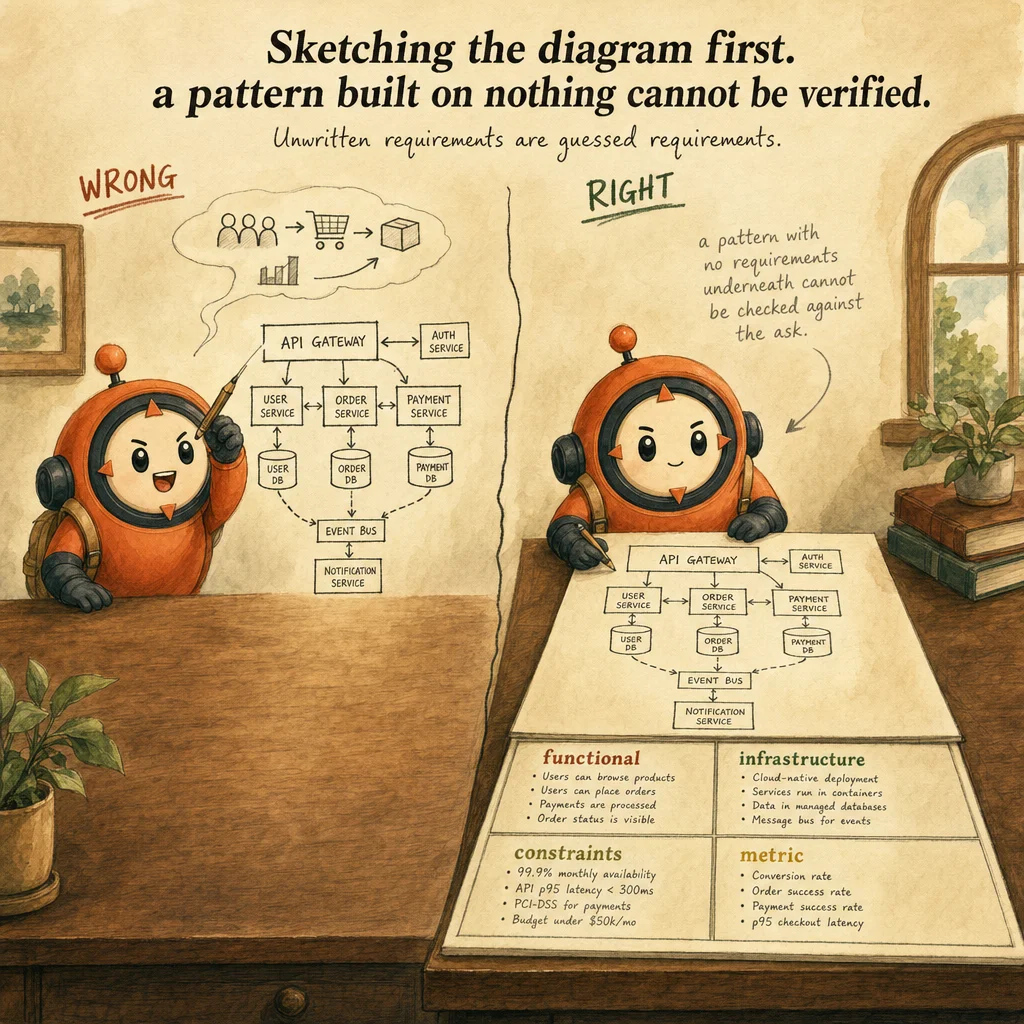
Translating a business problem into a Claude solution means producing a build-ready requirements spec, not picking an architecture pattern. The spec has four parts: functional requirements (what the system must do), infrastructure requirements (what it must run on or integrate with), constraints (cost, latency, compliance, risk tolerance), and a measurable success metric. Only once that spec exists does the separate workflow-vs-agent-vs-augmented-LLM decision (see that concept page) have anything concrete to be applied to.
What you are deciding
A solution design is sound when every component traces back to a requirement and forward to an acceptance test. A component with no requirement is an orphan, and a requirement with no test is only a wish.
Which requirement justifies this component, and which acceptance test would show it works?
What it is
This is the first move a Claude Certified Architect - Professional has to make correctly: taking a stated business problem (reduce support-ticket handle time, automate contract review, speed up research synthesis) and translating it into a concrete, buildable requirements spec - not just "add AI," and not yet a pattern choice. Anthropic's enterprise guidance frames the whole exercise as decision-first, outcome-anchored work: before any architecture gets sketched, an architect needs to know what the system must do, what it must connect to, what constraints bound it, and how success will be measured.
Getting this translation wrong most often means skipping it entirely - jumping straight from a one-line business ask ("automate contract review") to a pattern or a prototype with no written functional requirements, infrastructure requirements, constraints, or success metric to build against or evaluate later. This step is deliberately upstream of, and distinct from, choosing workflow vs. agent vs. augmented LLM - that pattern-selection decision is a separate concept (see "Workflow vs Agent: Choosing the Right Architecture") that consumes this spec as its input, it does not replace it.
How each certification frames it
CCD-F: How CCD-F tests requirements to design
CCDVF-D2-O1Understanding Requirements: functional and infrastructure requirements based on business requirements and solution architecture
The Developer guide lists understanding functional and infrastructure requirements based on business requirements and the solution architecture (PDF page 6, Domain 2). Look for items where the option that picks a technology first is wrong because the requirement was never clarified.
Anthropic advises finding the simplest solution that works and adding complexity only when needed, and asks for success criteria that are specific and measurable. Both support a design that only contains parts a requirement can justify.
How it works
Functional requirements: what the system must do. Specify the input shape (what arrives, in what format), the required transformation or task (extract which fields, answer which question, generate what artifact), and the output contract (structured JSON, a summary, a routed decision) - concretely enough that two different engineers would build compatible systems from the same brief. This is also where an architect identifies what augmentations the task needs beyond the base model - retrieval over a specific corpus, a specific external tool, persistent memory across turns - since those are functional needs, not architecture choices.
Infrastructure requirements: what it must run on or integrate with. Name the systems the solution touches (a claims database, a CRM, an internal MCP server), what auth or data-access scope each integration needs, and where the solution has to live (embedded in an existing app, a standalone service, a chat interface). This is the CCD-F-facing half of the same translation: turning a business ask into requirements a solution architecture can actually be built against, not left implicit until implementation surfaces the gap.
Constraints: what bounds the design before any pattern is chosen. Cost ceiling per unit of work, a latency or accuracy SLA, compliance or data-residency rules, and how much judgment can run unattended versus needing a human in the loop are all constraints the requirements step should surface explicitly - each one narrows, sometimes decisively, which architecture pattern the next step can pick from.
A measurable success metric, tied to a narrow pilot. Anthropic's enterprise transformation materials frame the translation step as tied to success metrics defined up front - enterprises that succeed define a metric and a narrow pilot scope before expanding, rather than translating a vague mandate ("use AI more") directly into a system design.
Treat the requirements spec as a hypothesis, not a one-shot document. Anthropic's planning-to-production guidance stresses that implementation is iterative: the first translation of a business problem into functional requirements, infrastructure requirements, constraints, and a metric is expected to be revised against real usage data, not treated as final the moment it's written down.

Worked example: a traceability matrix for a document assistant
Authored teaching example, not a bank question.
A company wants an assistant that answers staff questions from internal policy documents. A draft design already includes retrieval, a second model that debates answers, and a streaming interface.
| Requirement | Component | Acceptance test |
|---|---|---|
| Answers can be verified | Retrieval that returns source identifiers | Each test answer names a section that contains the claim |
| Restricted documents stay restricted | Permission filter before retrieval | A restricted document never appears for an unprivileged test user |
| Answers start quickly | Streaming interface | Time to first output meets the agreed target |
| None found | Second model that debates answers | No test, so remove it |
Every retained component has a requirement behind it and a test in front of it. Check afterwards that no row is blank in either direction.
How this decision goes wrong
Selecting architecture before clarifying requirements
Looks right: A multi-agent design looks modern, so start there.
Why it fails: The design then drives the requirements, and parts are justified by fashion, not need.
Instead: Capture functional and infrastructure requirements first, then choose the simplest design that meets them.
Vague acceptance criteria
Looks right: The assistant should give accurate, helpful answers.
Why it fails: Nobody can say when the criterion is met, so the design cannot be verified or compared.
Instead: Write specific, measurable pass conditions tied to a requirement.
Orphan components
Looks right: An extra reviewer model can only help quality.
Why it fails: It adds cost, latency and failure modes with nothing to show it earns them.
Instead: Trace every component to a requirement, and remove or justify any that does not trace.
Where you'll see it
Claims re-keying automation
Functional: extract a defined field set from PDFs into a structured schema with a validation loop. Infrastructure: reads from the existing document-intake system, writes via the claims system's existing API. Constraint: no PII stored beyond the existing retention policy. Success metric: re-keying time reduced by a stated %. The pattern choice (a workflow, once these are pinned down) is a separate, later step.
Enterprise AI pilot scoping
A vague "use AI more" mandate translated into a narrow pilot with a defined success metric and named constraints (department, data scope, budget ceiling) before any department-wide rollout or pattern gets chosen.
Decision tree
Can you state the input shape, the required transformation, and the output contract in one paragraph?
Have you named every system this solution touches and what auth/data-access scope each integration needs?
Are there stated constraints (cost ceiling, latency/accuracy SLA, compliance, human-in-the-loop threshold)?
Is there a clear, quantifiable success metric you can pilot narrowly before scaling?
How each cert tests this
CCA-P
CCARP-D1-O1 (Solution Design & Architecture, 17%): tests the translation move itself - reading a stated business problem and producing functional requirements, infrastructure requirements, constraints, and a success metric, before any pattern or implementation detail.
CCA-A
CCAOF-D4-O1 (Workflow Integration and Solution Design, 16%): tests applying Claude to analyze requirements and use cases at the associate level - recognizing what a business requirement implies for how Claude should be used, without necessarily architecting the system.
CCD-F
CCDVF-D2-O1 (Applications and Integration, 33.1%): tests turning business requirements into concrete functional and infrastructure requirements a solution architecture can be built against, the developer-facing half of the same translation.
The exam trap
The trap is treating "translate business problem into a Claude solution" as equivalent to picking a pattern (workflow vs. agent vs. augmented LLM) and skipping the requirements spec entirely. The objective rewards producing an explicit, written functional/infrastructure/constraints/success-metric brief first - a technically correct pattern choice built on an unstated requirement is still a translation failure, because nobody can verify what was built against what was actually asked for.
Question patterns
CCD-F practice questions
3 approved CCD-F questions for this topic. Tap an answer to check it, then read the rationale for every option.
A VP says "our claims team spends 40% of their time re-keying PDF data into our claims system, fix it with AI." What is the correct FIRST step in translating this into a Claude-based solution?
CCA-P practice questions
3 approved CCA-P questions for this topic. Tap an answer to check it, then read the rationale for every option.
A subscription company has agreed on the goal "cut new-customer onboarding time from two days to four hours without increasing manual review errors." Which design artifact best preserves that intent as the Claude solution is specified?
CCA-A practice questions
No approved public CCA-A sample question is published for this topic yet. The worked example above is an authored teaching example.
Frequently asked
Showing 4 of 4 questions
Sources and next steps
- Claude Certified Developer - Foundations Exam Guide v1.0 (July 2026), PDF page 6, section: Domain 2: Applications and Integration (Understanding Requirements). Checked 2026-10-16.
- Building effective agents (Anthropic engineering), section: Prompt chaining; Parallelization; Orchestrator-workers; Agents. Checked 2026-10-16.
- Create strong empirical evaluations (Claude API docs), section: Define your success criteria; Eval design principles. Checked 2026-10-16.