CCARP-D6.1 · Domain 6 · Stakeholder Communication & Lifecycle · 14% of CCA-P

Structured Stakeholder Discovery.

6 min read·7 sections·Tier A

Discovery for a Claude-based solution has to surface things traditional SDLC discovery skips: whether the task even fits a nondeterministic system, what "good enough" output looks like, and which architecture pattern the problem needs - before any model or design decision gets made. Anthropic frames the whole motion as "start small, evaluate thoroughly, and scale gradually", not a big-bang requirements document. Anthropic: Planning to production The trap is running discovery as a tools-and-models conversation instead of a business-and-eval one.

Official Anthropic guidanceCCA-P Domain 6CCA-P only
Structured Stakeholder Discovery, hero illustration featuring Loop mascot in a warm gallery scene.
Domain CCARP-D6Stakeholder Communication & Lifecycle · 14%
On this page
01 · Summary

TLDR

Discovery for a Claude-based solution has to surface things traditional SDLC discovery skips: whether the task even fits a nondeterministic system, what "good enough" output looks like, and which architecture pattern the problem needs - before any model or design decision gets made. Anthropic frames the whole motion as "start small, evaluate thoroughly, and scale gradually", not a big-bang requirements document. Anthropic: Planning to production The trap is running discovery as a tools-and-models conversation instead of a business-and-eval one.

Start small
Discovery philosophy
CCA-P D6 (14%)
Exam domain
3
Model-selection levers to surface
99.99% uptime
Coinbase proof point
Before pilots
Governance sequencing
02 · Definition

What it is

Discovery for a Claude-based solution is not a generic software requirements pass. It has to surface things traditional SDLC discovery skips entirely: whether the task is a fit for a nondeterministic system at all, what "good enough" output looks like (eval criteria), and which of the workflow/agent architecture patterns the problem actually needs. This is deliberately the STAKEHOLDER-FACING elicitation motion, not the written output that comes out of it - producing the actual requirements spec (functional requirements, infrastructure requirements, constraints, a success metric) is a separate, later step (see "Translating Business Requirements into Claude Solutions"). This concept is about how an architect runs the sessions, in what sequence, and what an architect must not skip while running them.

Anthropic's own enterprise playbooks frame this as the first phase of a "start small, evaluate thoroughly, scale gradually" methodology, not a big-bang requirements document: "Successful implementation of AI is iterative. Enterprises that are leading the way in AI transformation start small, evaluate thoroughly, and scale gradually before achieving their best results." A senior architect runs discovery to convert a vague business ask into a scoped pilot with success criteria attached, before any model or architecture decision is made.

03 · Mechanics

How it works

Fit-for-nondeterminism is the first gate, not an afterthought. Anthropic's own planning guidance frames the right first use case as one "well suited to current generative AI capabilities, such as understanding text and sentiment, classifying intent, generating content, or solving a repetitive problem or task." If the stated ask doesn't clear that bar, that is a discovery finding to surface immediately, not a problem to discover later when the architecture doesn't work.

Discovery elicits the inputs that model and architecture selection will need, WITH the stakeholder - but the selection itself is a downstream, design-time activity, not something discovery decides. Anthropic names three levers a business stakeholder can reason about directly: Capabilities (does the task complexity fit), Cost and Speed, and Safety and Security. Discovery's job is surfacing which of these the stakeholder actually weighs most, so that the later architecture-selection step isn't an architect quietly picking a model tier alone and presenting it as a done deal. The weighting comes out of discovery; the actual pattern and model decision gets made afterward, once the elicited requirements and constraints are in hand.

Governance and stakeholder alignment come before pilots, not after. Anthropic's enterprise transformation guidance names "lay your AI foundation with clear governance and stakeholder alignment" (executive alignment plus an AI steering committee) as the first stage, ahead of launching targeted pilots. An architect who schedules executive buy-in only after a pilot already exists has the sequence backwards relative to Anthropic's own blueprint.

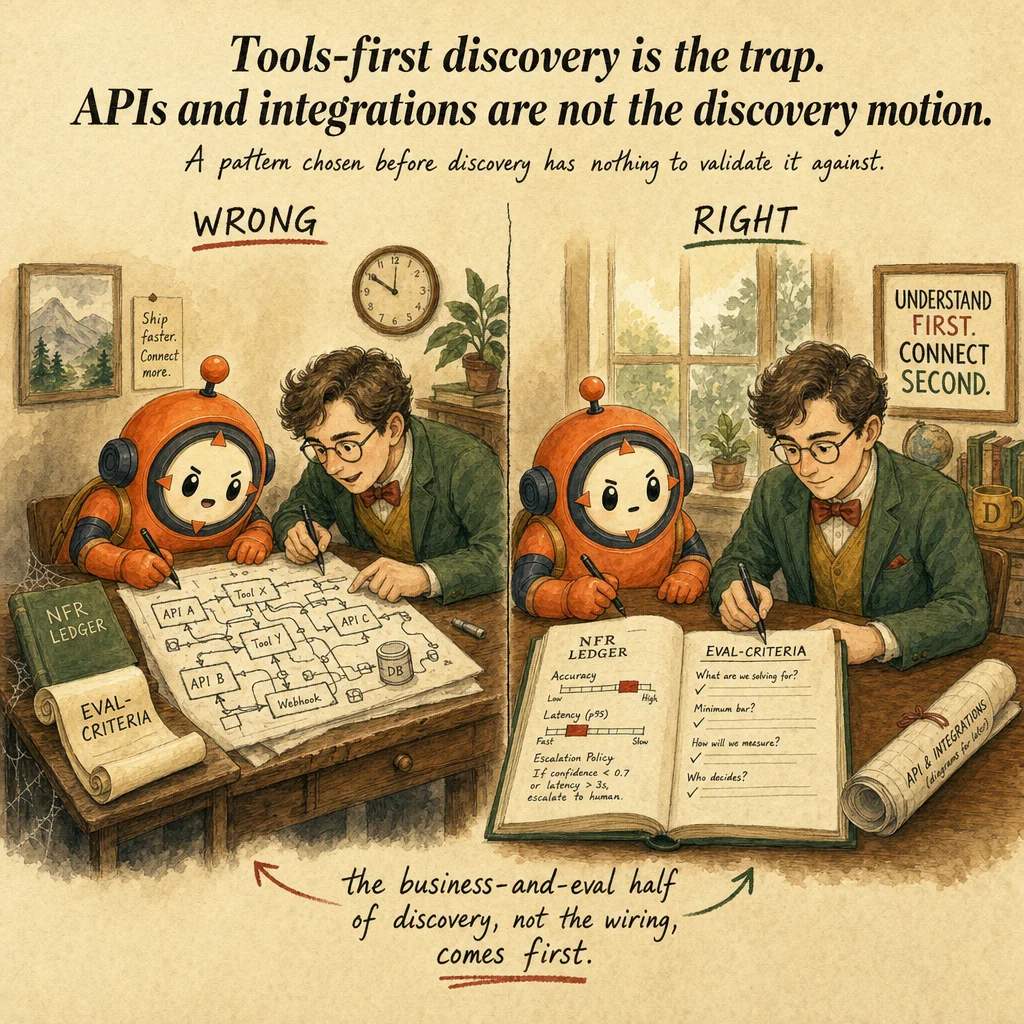
Discovery gathers non-functional requirements alongside the functional ask, not instead of it. Real deployments Anthropic cites (Coinbase's Claude-powered support handling thousands of messages per hour while maintaining 99.99% availability) show discovery outputs that include concrete NFR commitments - accuracy thresholds, latency, escalation policy - not just a functional "handle support" user story. A discovery session that only maps tool/API integrations has skipped this half.

Eval criteria get defined before build starts, not evaluated into existence afterward. Defining what "correct" output looks like up front is standard discipline for LLM applications, though the specific facilitation technique for eliciting it isn't itself a named, published Anthropic methodology - treat any specific elicitation script as something to verify against your own org's practice, while the principle (define success before you build) is well-grounded in Anthropic's own "establish specific, measurable success metrics" planning guidance.
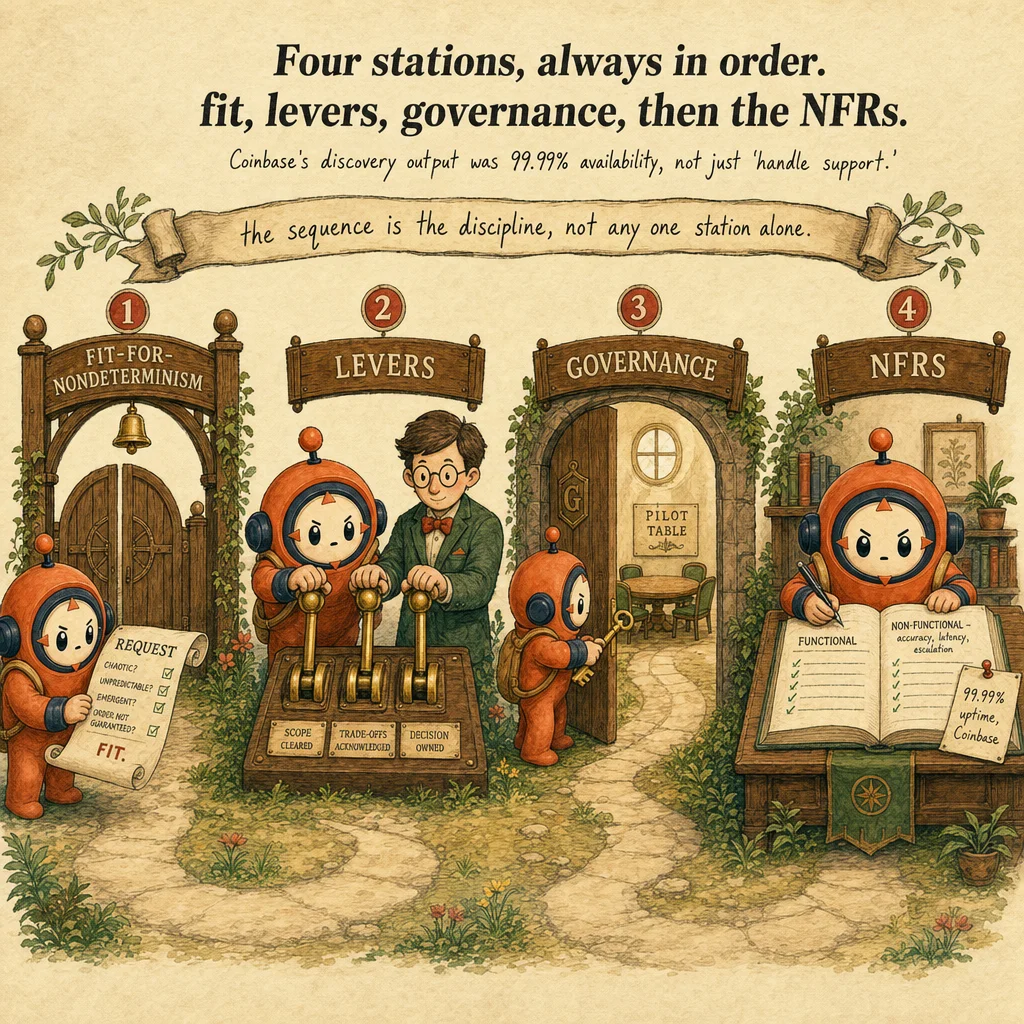
Structured Stakeholder Discovery mechanics, painterly diagram featuring Loop mascot.
04 · In production

Where you'll see it

Insurance claims intake

Structured discovery distinguishes a bounded workflow (extract fields, route by rule) from an autonomous-judgment agent (decide escalation paths), gathers the acceptable error rate before a human must review, and baselines against the current manual process - all before a pattern or model tier is chosen.

Coinbase support agents

Discovery output for Coinbase's Claude-powered support included a concrete availability commitment (thousands of messages per hour at 99.99% availability), not just a functional "handle support" ask - a sign discovery gathered NFRs, not only user stories.

05 · When to use

Decision tree

01

Is the stated task suited to current generative AI capabilities (understanding text/sentiment, classifying intent, generating content, a repetitive task)?

YesProceed to scope a pilot.
NoThis is a discovery finding in itself - do not proceed to architecture until this is resolved with the stakeholder.
02

Have Capabilities, Cost and Speed, and Safety been weighed together WITH the stakeholder during discovery, not decided internally afterward?

YesThe downstream model/architecture selection step has the business input it needs - selection itself still happens later, in design, not inside discovery.
NoThe architect is about to make a business decision unilaterally - loop the stakeholder in before proceeding.
03

Is executive alignment / governance secured before any pilot work starts?

YesSequencing matches Anthropic's own Stage 1 (foundation) before Stage 2 (pilots) blueprint.
NoStop and secure it first - seeking buy-in only after a pilot exists inverts the recommended sequence.
04

Were non-functional requirements (accuracy bar, latency, cost ceiling, escalation policy) elicited alongside the functional ask?

YesDiscovery output covers both halves needed downstream.
NoFunctional user stories alone are an incomplete discovery output - go back and ask the NFR questions.
06 · On the exam

Question patterns

Structured Stakeholder Discovery exam trap, painterly cautionary scene featuring Loop mascot.
An architect for a claims-intake project skips stakeholder discovery sessions and goes straight to sketching a workflow pattern based on the one-line ask. What is missing?
Structured discovery was never run - no determination of whether this is a bounded workflow or needs autonomous judgment, and no NFRs (acceptable error rate, escalation policy) gathered from the stakeholder. Named distractor: "the workflow pattern can be validated during implementation" - a pattern chosen before discovery has no gathered requirements to validate it against.
A stakeholder tells the architect to "make it as accurate as possible," and the architect proceeds straight to build. What discovery step was skipped?
Defining an explicit, measurable eval criterion. Named distractor: "maximum accuracy is itself a sufficient success criterion" - it is not measurable or actionable, and gives the architect nothing concrete to build or evaluate against.
An architect finishes discovery, builds a working pilot, and only then schedules time with the executive sponsor to secure buy-in. What sequencing error is this?
Governance and executive alignment belong in Anthropic's Stage 1 (foundation), ahead of Stage 2 (targeted pilots) - not after a pilot already exists. Named distractor: "seeking buy-in after a working pilot exists is stronger because there is something to show" - Anthropic's own enterprise blueprint places governance and stakeholder alignment before pilot work, not after.
A discovery session for a support-ticket triage system spends the entire hour on which APIs and tools to integrate. What category of requirement did it skip?
The business-and-eval half of discovery: success criteria and non-functional requirements (accuracy bar, escalation policy), not just integration questions. Named distractor: "tool and API integration is the core of discovery for an agentic system" - that is implementation detail properly surfaced downstream, not the discovery motion itself.
A retail company proposes "an AI that handles all customer emails end to end" as its very first pilot. What should discovery flag as a concern?
Whether the scope is narrow enough for a first pilot at all - "all customer emails end to end" does not fit a "start small, evaluate thoroughly, scale gradually" motion. Named distractor: "broad scope is fine as long as the underlying model is capable enough" - model capability does not substitute for a narrow, measurable first-pilot scope.
07 · FAQ

Frequently asked

Is this the same step as translating business requirements into a Claude solution spec?
No. "Translating Business Requirements into Claude Solutions" (CCARP-D1-O1) is the written output: a four-part spec of functional requirements, infrastructure requirements, constraints, and a success metric. This concept (CCARP-D6-O1) is the stakeholder-facing discovery process - the sessions and elicitation - that feeds that spec.
Does discovery decide the architecture pattern (workflow vs agent)?
No. Discovery ELICITS the inputs an architecture decision needs - whether the task fits Claude at all, the Capabilities/Cost-Speed/Safety weighting, NFRs, eval criteria, governance sign-off - working WITH the stakeholder. Architecture SELECTION (workflow vs agent, model tier) is a separate, downstream, design-time step that consumes discovery's output; it doesn't happen inside the discovery sessions themselves.
08 · Practice with AI

Work this with your AI

Work this concept hands-on with Claude Code, Codex, or claude.ai. Copy a prompt, paste it into your assistant, and practise in tandem. Each one keeps you active (explain it back, get drilled, or build) rather than just reading.

  • Drill it like the exam (scenario MCQs)
    Practice in the exam's scenario-MCQ format with trap awareness.
  • Explain it back (Feynman)
    Build durable, transferable understanding of a concept you can half-state.
  • Test me, adapting the difficulty
    Active recall practice on a concept you think you know.
  • Check my prerequisites first
    Before studying a concept that keeps not sticking.
  • Find the high-leverage 20%
    When a domain feels too big and you are short on time.
Self-check

Test yourself

Three diagnostic questions on this primitive. Reveal each answer when you have a guess. Want a full 60-question mock? Open the mock hub →

Q1An architect for a claims-intake project skips stakeholder discovery sessions and goes straight to sketching a workflow pattern based on the one-line ask. What is missing?
Structured discovery was never run - no determination of whether this is a bounded workflow or needs autonomous judgment, and no NFRs (acceptable error rate, escalation policy) gathered from the stakeholder. Named distractor: "the workflow pattern can be validated during implementation" - a pattern chosen before discovery has no gathered requirements to validate it against.
Q2A stakeholder tells the architect to "make it as accurate as possible," and the architect proceeds straight to build. What discovery step was skipped?
Defining an explicit, measurable eval criterion. Named distractor: "maximum accuracy is itself a sufficient success criterion" - it is not measurable or actionable, and gives the architect nothing concrete to build or evaluate against.
Q3An architect finishes discovery, builds a working pilot, and only then schedules time with the executive sponsor to secure buy-in. What sequencing error is this?
Governance and executive alignment belong in Anthropic's Stage 1 (foundation), ahead of Stage 2 (targeted pilots) - not after a pilot already exists. Named distractor: "seeking buy-in after a working pilot exists is stronger because there is something to show" - Anthropic's own enterprise blueprint places governance and stakeholder alignment before pilot work, not after.
Last reviewed: 2026-05-04·Refresh cadence: monthly
CCARP-D6.1 · CCARP-D6 · Stakeholder Communication & Lifecycle

Structured Stakeholder Discovery, complete.

You've covered the full ten-section breakdown for this primitive, definition, mechanics, code, false positives, comparison, decision tree, exam patterns, and FAQ. One technical primitive down on the path to CCA-F.

More platforms →