

TLDR
An architect's technical trade-offs (model tier, workflow vs agent, guardrail depth) are business decisions in disguise, and Anthropic names the exact vocabulary to present them in: Capabilities, Cost and Speed, and Safety. CCA-A tests the other half of this same skill at the associate level - communicating Claude's value AND limitations, not just the upside, so a stakeholder's expectations are calibrated rather than sold.
What it is
An architect's design choices are technical decisions with direct business consequences - cost, speed, risk - that a non-technical sponsor needs to understand in their own terms, not in token-budget language. This is a distinct skill from naming which business-value pillar a decision serves at design time (see "Aligning Solutions to Business Value Pillars"): that concept is the design-time analysis; this concept is the separate, later act of presenting that analysis to someone who was not in the design room, so they can say yes or no to the trade-off without needing to understand the underlying mechanics.
Anthropic's own enterprise materials give the exact vocabulary to reuse rather than inventing a new one: model selection is framed as a business decision along three named levers - Capabilities (does the task complexity fit), Cost and Speed, and Safety and Security. An architect presenting a model-tier decision upward should reuse this language directly, because it is the framework Anthropic itself designed for a non-technical sponsor to reason with.
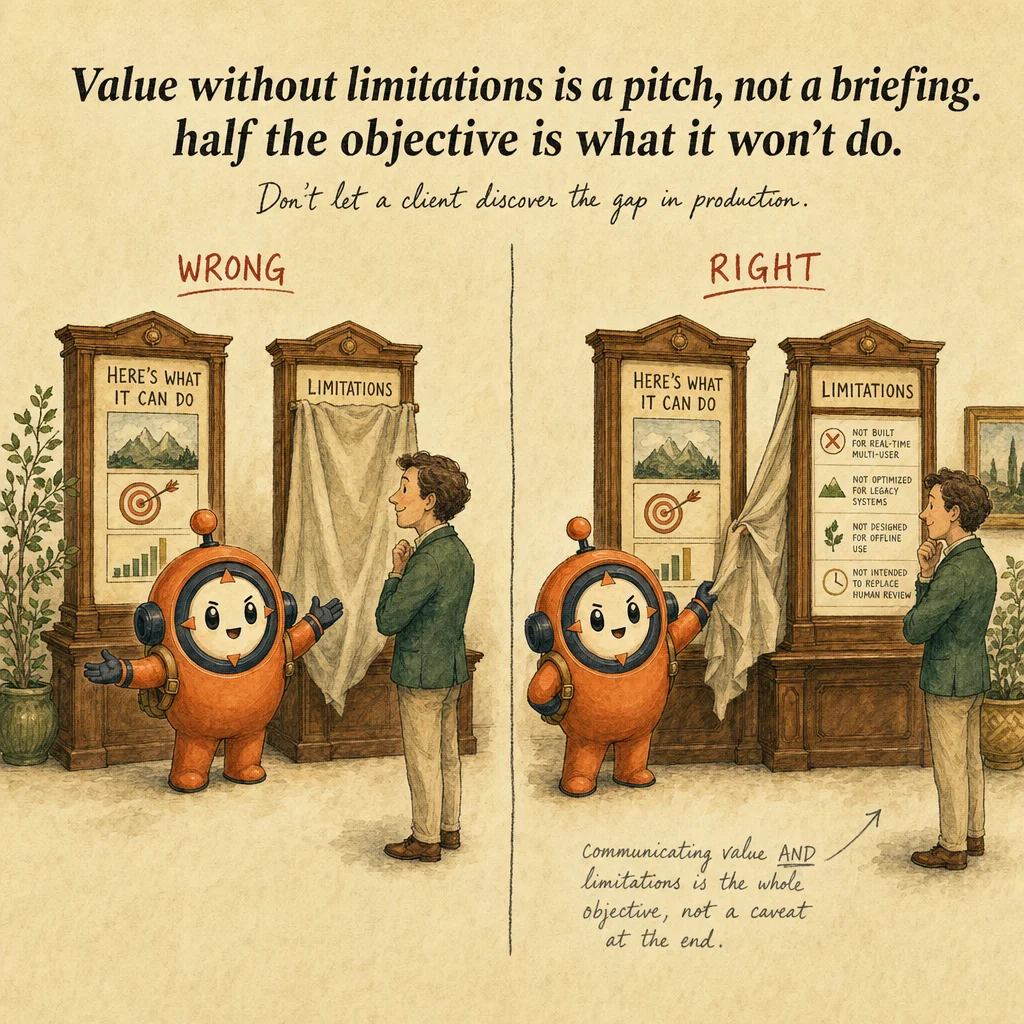
For CCA-A, the objective is narrower and explicitly double-sided: "communicate Claude's value AND limitations to stakeholders." The associate-level skill is honestly scoping what Claude can and cannot do for a given use case - not just its upside - so a client or internal stakeholder's expectations are calibrated before they discover a gap in production.
How it works
Reuse Anthropic's own three-lever vocabulary instead of a home-grown one. Capabilities, Cost and Speed, and Safety and Security are the exact terms a sponsor can decide against without understanding tokenization or inference mechanics - restating a trade-off in this language, rather than translating it into something else, keeps the presentation decision-ready.
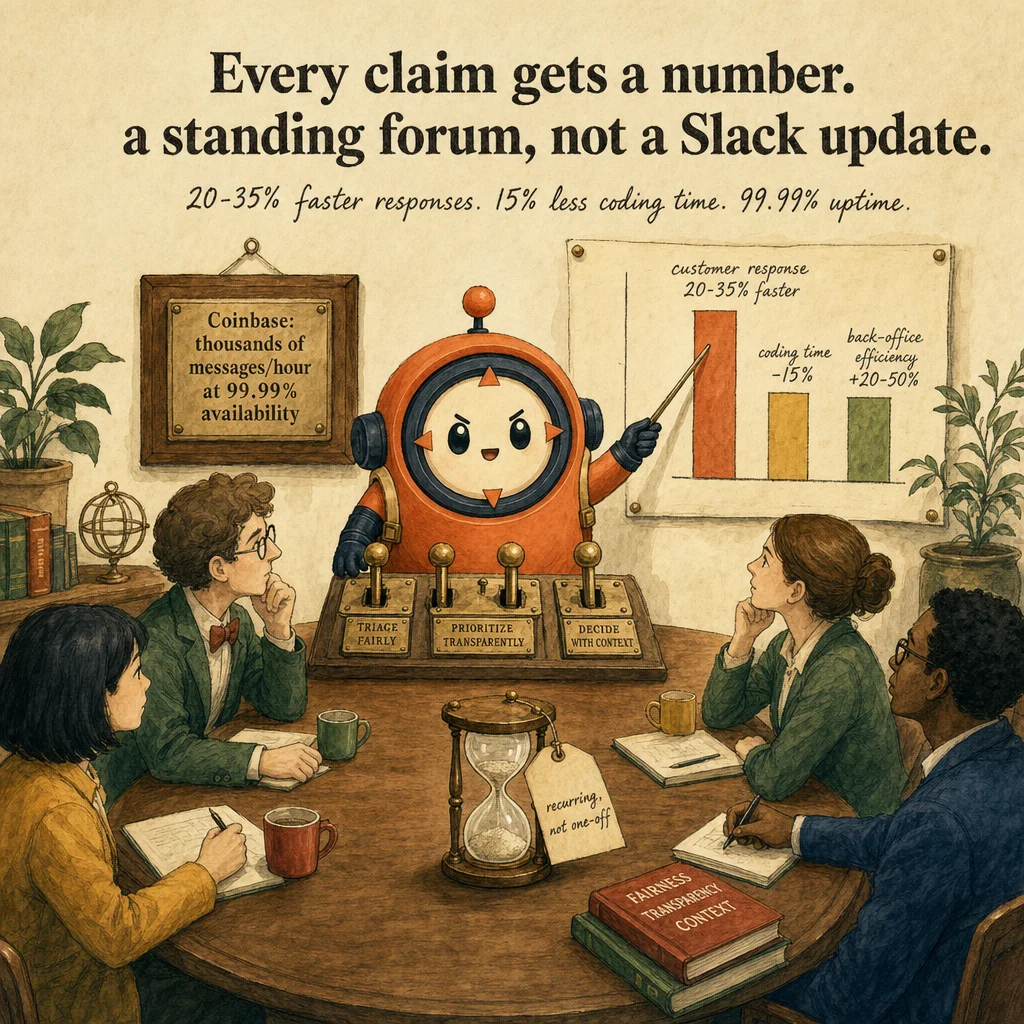
Give decisions a standing forum, not an ad hoc memo. Anthropic's enterprise transformation guidance recommends building executive alignment and assembling AI steering committees as a formal communication structure - architectural decisions get a recurring review, not a one-off Slack update that is easy to lose track of.
Tie every trade-off to a business metric the stakeholder already tracks. Anthropic's own materials quantify impact in terms sponsors track directly rather than technical metrics: customer support teams responding 20-35% faster to inquiries, engineering teams reducing coding time by 15%, and back-office operations running 20-50% more efficient. Modeling this pattern - pairing every architectural claim with a number like these - is the core communication technique, not a nice-to-have.
Use concrete production proof points to make an abstract architecture claim legible. Coinbase's Claude-powered support handling thousands of messages per hour at 99.99% availability is the kind of proof point Anthropic uses to turn "agentic system with structured escalation" into something a non-technical sponsor can actually picture and trust.
Communicating limitations is not optional - it is half the objective, not a caveat tacked on at the end. Honestly stating what a given configuration will NOT do (an accuracy ceiling on the hardest cases, tasks that still need human judgment) is exactly what CCAOF-D4-O5 tests. Architecture Decision Records - the general software-architecture practice of capturing what was decided, what was rejected, and why - are one way to keep both the accepted trade-off and its stated limitation on record after the meeting ends; the exact ADR template is not an Anthropic-published standard, so verify it against your own org's format.
The trap is presenting a trade-off as a purely technical fact ("we chose the smaller model for latency") without stating what the business gives up or gains, and, at the associate level, presenting only value while omitting limitations. CCA-P tests restating the decision in business-value terms a sponsor decides against; CCA-A tests whether limitations get communicated at all, not just capabilities.
Where you'll see it
Model-tier approval pitch
An architect reuses Anthropic's Capabilities / Cost and Speed / Safety vocabulary plus a concrete cost-per-ticket number to get executive sign-off on Sonnet over Opus for a high-volume support agent.
Coinbase proof point in a stakeholder deck
"Agentic system with structured escalation" gets translated into "thousands of messages per hour at 99.99% availability" so a non-technical audience can picture what the architecture actually delivers.
Side-by-side
| Decision | Technical framing | Stakeholder-ready framing | Lever(s) it maps to |
|---|---|---|---|
| Model tier (Sonnet vs Opus) | Lower latency and cost per token for this task profile | Keeps per-ticket AI cost under $X while staying fast enough that customers don't notice a delay | Cost and Speed |
| Workflow vs open-ended agent | Fixed control flow vs dynamic, LLM-directed steps | Predictable spend and no surprise escalations, for a task that never actually varies | Capabilities + Cost |
| Guardrail / escalation depth | An added evaluator pass plus a human-review branch | The hardest 5% of cases route to a human, so we're not trading away accuracy where it matters most | Safety |
| A known limitation (CCA-A angle) | Accuracy drops on out-of-distribution inputs for this model configuration | Tell the stakeholder up front which cases still need a human - don't let them discover it in production | Safety + Capabilities |
How each cert tests this
CCA-P
CCARP-D6-O2 (Stakeholder Communication & Lifecycle, 14%): tests restating an architectural decision or trade-off in business-legible terms (using Anthropic's own Capabilities / Cost and Speed / Safety vocabulary) that a non-technical sponsor can act on.
CCA-A
CCAOF-D4-O5 (Workflow Integration & Solution Design, 16%): tests the narrower, double-sided associate-level skill of communicating Claude's value AND limitations to a client or stakeholder - honestly scoping what the tool won't do, not only what it will.
Question patterns
6 V2 questions wired to this concept. Tap an answer to check it instantly - you'll see whether it's right and why - then expand the full breakdown for the mental model and all four rationales.
A finance executive asks whether an invoice-review assistant will eliminate manual review costs. Evidence supports reducing review for routine invoices, but exceptions still need specialists. What is the best response?
Frequently asked
Showing 2 of 2 questions