
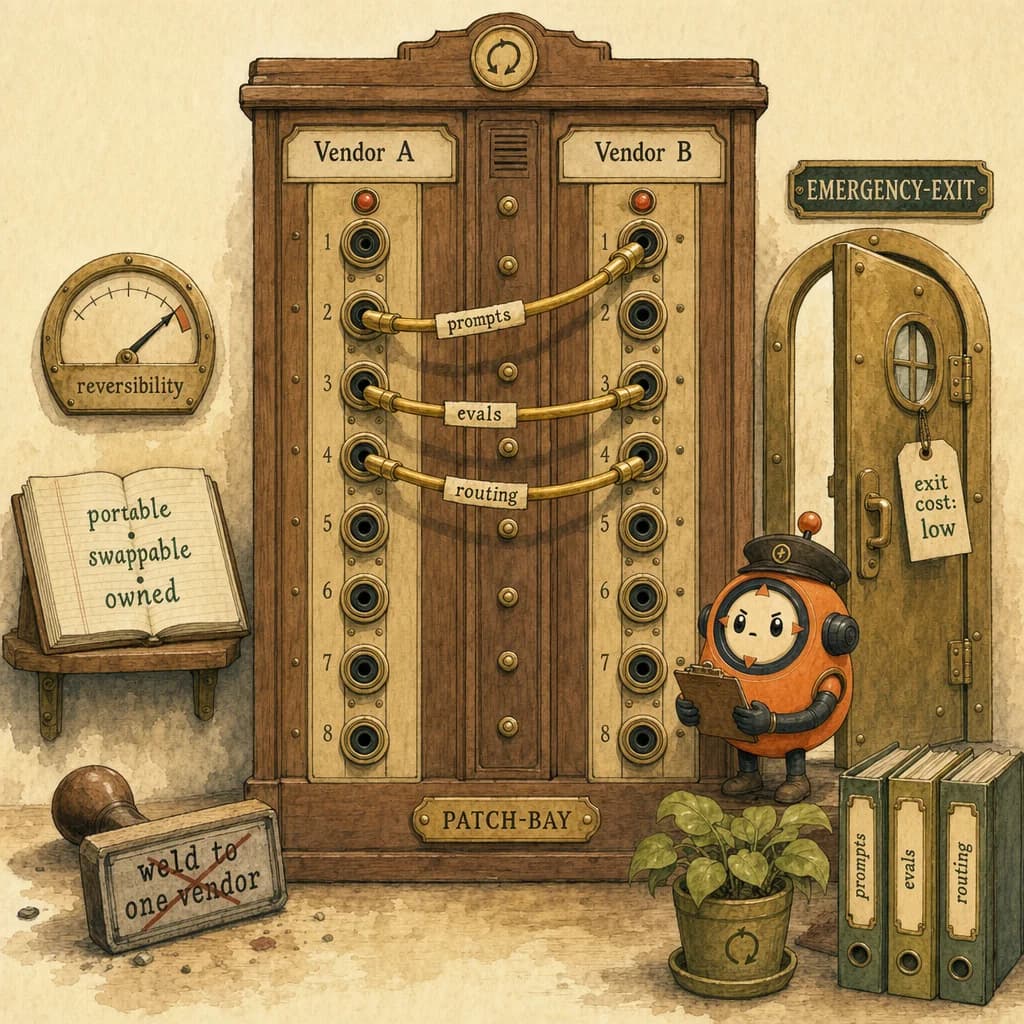
- ✓Score every model vendor on reversibility, not just capability. If your prompts, evals, and routing cannot move to another model without a rewrite, you do not own the agent, you rent it. Reversible agent architecture is a CCA-F D1 design skill.
- ✓The loop (plan, act, observe) is the thing you must keep portable. If the loop is wired to one vendor's quirks, it cannot move.
- ✓Clean handoffs in a documented format are what let you swap the model underneath without rewriting the orchestration.
- ✓Designing the workflow around the architecture, not one model's API, is what keeps the exit cheap.
Quick answer
Score every model vendor on reversibility, not just capability. If your prompts, evals, and routing cannot move to another model without a rewrite, you do not own the agent, you rent it from the permission layer. For CCA-F D1, reversible agent architecture is the skill: pick the best model and still keep a cheap exit.
What changed
Frontier model launches stopped being only product news. They now ship with terms: usage limits, distribution rules, and pricing that can move faster than your release cycle (inference: vendors increasingly bundle access policy with capability, so "best model" and "stable dependency" are no longer the same property).
Most teams still buy AI access like software procurement. Compare capability, latency, and price, then standardize on the winner. A closed stack looks safer on a slide: fewer vendors, cleaner governance, less chaos.
But that logic has a blind spot. The best model today can become the riskiest dependency tomorrow, and a stack welded to one vendor turns every term change into your emergency.
Capability-first vs reversibility-first
| Question | Capability-first buyer | Reversibility-first architect |
|---|---|---|
| How do you pick a model? | Strongest benchmark wins, standardize there | Strongest model that you can also leave cheaply |
| Where does the value live? | Inside the vendor's features | In your own loop, tools, and evals |
| A price or policy change hits | Roadmap emergency, possible rewrite | Swap the model, keep the product |
| Evals | Tuned to one model's quirks | Provider-agnostic, portable |
| What you actually own | A lease on the permission layer | The product |
How the reversibility test actually works
Stop scoring vendors on capability alone. Add one column: how cheaply can you leave?
- Prompts and evals move without a rewrite. Keep them in your own layer, written against a task, not a model's idiosyncrasies.
- Routing shifts without breaking the product. A model swap should be a config change behind a stable interface, not surgery.
- Value lives in your layer. The loop, the tool contracts, and the verification are yours. The model is an interchangeable ingredient.
Worked example - "your vendor tightens terms mid-quarter."
- Capability-first stack: prompts are tuned to one model, evals assume its output shape, tools call its proprietary features. The term change forces a rewrite, and you ship nothing else that month.
- Reversible stack: the loop and tool contracts are provider-agnostic, evals run against any model, routing is a config value. You point the router at a fallback model, re-run the evals, and keep moving.
- The difference is not model quality. Both used a frontier model. One designed an exit; the other did not.
That is the test: not "which model is strongest," but "if this vendor changes the rules, what does it cost me to walk?"
A name for it: the Reversibility Test
The Reversibility Test - before you standardize on a model, score how cheaply you can leave it: can prompts and evals move without a rewrite, can routing shift without breaking the product, and does the value live in your layer or the vendor's? A stack that fails the test is leased, not owned. Capability gets you live; reversibility keeps you in business when the terms change.
Why it matters for CCA-F
This sits in D1 - Agentic Architecture and Orchestration, which is 27% of the exam, the largest domain, and connects to agentic loops and subagent state handoff.
The proprietary read: D1 questions reward architecture that survives a vendor change, not the architecture that scores highest on one model today. Trust architecture is now part of technical architecture.
- Old instinct: pick the strongest model and consolidate there to move fast.
- D1 instinct: pick a strong model and design the loop, tools, and evals so the model stays swappable.
The distractor pattern to memorize. On D1 scenarios where a provider changes pricing, limits, or distribution terms, the trap answer is "standardize on the single strongest model." The architecturally correct move is one of:
- Keep prompts and evals provider-agnostic so they move without a rewrite, or
- Put routing behind a stable interface so a model swap is a config change (see architecture-aware agentic workflows), or
- Document the handoff format (a subagent state handoff) so orchestration does not depend on one model's behavior.
How to apply it
- Add a reversibility column to your vendor rubric, next to capability, latency, and price.
- Keep evals in your own layer, written against the task, runnable on any model.
- Put routing behind an interface, so the model is a config value, not a hard dependency.
- Use the best model anyway. Reversibility is not about avoiding strong vendors; it is about not welding yourself to one.
- Rehearse the exit. Once a quarter, point the router at a fallback model and re-run the evals. If that is hard, you found your lock-in before the vendor did.
The meta-skill, and the D1 exam skill, is the same: capability gets you live, but reversibility is what you actually own.
5 direct routes into the scored material.
- conceptsThe loop (plan, act, observe) is the thing you must keep portable. If the loop is wired to one vendor's quirks, it cannot move.
- conceptsClean handoffs in a documented format are what let you swap the model underneath without rewriting the orchestration.
- knowledgeDesigning the workflow around the architecture, not one model's API, is what keeps the exit cheap.
- knowledgeReversibility is a core agentic-architecture skill, which is what an agentic AI certification is meant to test.
- exam-guideD1 (Agentic Architecture and Orchestration) is 27% of the exam, the largest domain, and rewards portable design over single-vendor coupling.
Share this post.
One share is one less person stuck on the same question.