CCAOF-D3.1 · Domain 3 · Product & Model Selection · 12% of CCA-A

Selecting the Right Claude Product Feature.

6 min read·7 sections·Tier A

Claude.ai gives a business user four distinct surfaces, plain chat, Projects, Research, and Artifacts, and picking the right one is itself the skill this objective tests. They are not mutually exclusive - a Project can trigger Research internally and still produce an Artifact as its final output. Claude Support: use-research-on-claude Research is a paid-plan feature (Pro/Max/Team/Enterprise); Free accounts get chat, up to 5 Projects (with automatic RAG-scaled knowledge), and Artifacts, but not Research.

Official Claude Support + Anthropic blogCCA-A Domain 3 · Product SelectionCCA-A only
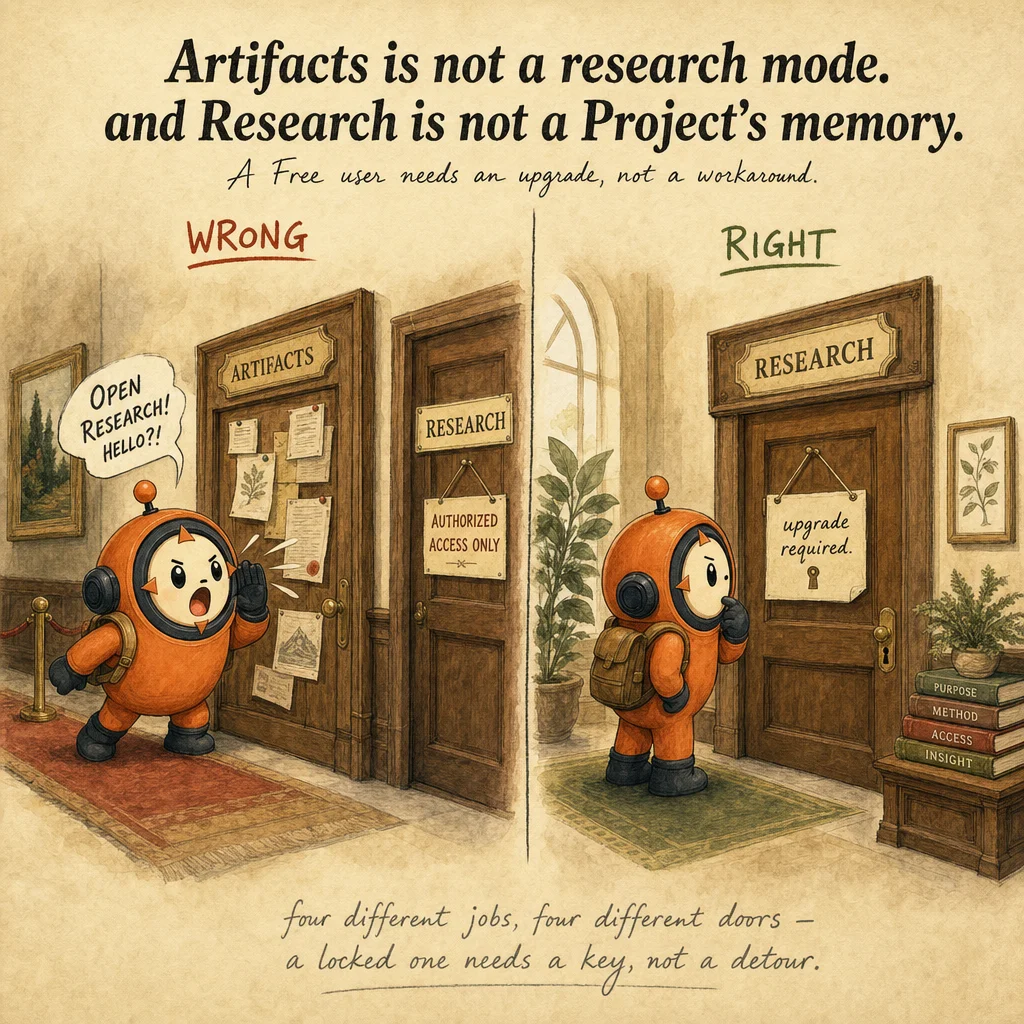
Selecting the Right Claude Product Feature, hero illustration featuring Loop mascot in a warm gallery scene.
Domain CCAOF-D3Product & Model Selection · 12%
On this page
01 · Summary

TLDR

Claude.ai gives a business user four distinct surfaces, plain chat, Projects, Research, and Artifacts, and picking the right one is itself the skill this objective tests. They are not mutually exclusive - a Project can trigger Research internally and still produce an Artifact as its final output. Claude Support: use-research-on-claude Research is a paid-plan feature (Pro/Max/Team/Enterprise); Free accounts get chat, up to 5 Projects (with automatic RAG-scaled knowledge), and Artifacts, but not Research.

4 (chat / Projects / Research / Artifacts)
Product surfaces
CCAOF-D3 (12%)
Exam domain
Pro / Max / Team / Enterprise
Research plan gating
5 projects
Free-plan Projects cap
up to 10x capacity
Projects RAG boost (all plans)
02 · Definition

What it is

Claude.ai gives a business user four distinct surfaces for getting work done, and picking the right one is itself a skill: plain chat for a single question or short task; Projects for recurring work that needs a persistent knowledge base and custom instructions; Research for open-ended, multi-step information-gathering; and Artifacts for producing a standalone, iterable work product rather than a chat reply. None of these are mutually exclusive - a Project can use Research internally and can produce Artifacts as its output - but each solves a different job, and defaulting to the wrong one wastes setup effort or under-delivers on reuse.

The selection logic follows the shape of the task, not a preference for the "most powerful"-sounding option: is this a one-off question, recurring work needing shared context, an open information-gathering job, or a deliverable meant to be edited and revisited? Each answer points to a different surface, and a single business workflow often chains through more than one.

03 · Mechanics

How it works

Chat is the default for one-off, self-contained questions. No setup, no persistent context - the right choice when there's no need to reuse the conversation's context later.

Projects are self-contained workspaces that hold multiple chats and a shared knowledge base. A user uploads documents and sets custom Project instructions (tone, role, industry perspective) that apply to every chat inside that Project, avoiding the "cold start" of re-explaining context each time. Free accounts get up to five Projects; on every plan, free through Enterprise, a Project's knowledge base auto-scales via Retrieval-Augmented Generation once it approaches the context window, expanding capacity by up to 10x, automatically and with no configuration required.

Research makes Claude operate agentically, on paid plans only. It runs multiple searches that build on each other, decides what to investigate next, and works across the open web plus connected sources like Gmail, Calendar, and Google Docs when connectors are enabled. It requires web search to be turned on, and answers ship with checkable citations. Internally, Research is a multi-agent system: a lead agent plans and spins up parallel subagents to search simultaneously rather than running one long sequential search.

Artifacts are an output-format decision, not a research or planning mode. They trigger when Claude's output is significant and self-contained (typically 15+ lines) and something the user is likely to edit, reuse, or reference later - rendered in a dedicated window beside the conversation rather than folded into chat text. Artifacts are available on Free, Pro, Max, Team, and Enterprise plans, and inside Claude Code, but require the Code execution and file creation capability to be enabled.

The four surfaces compose rather than compete. A single business workflow can move through all four: a quick chat question, a Project holding brand context reused weekly, a Research pass for fresh external data, and a final Artifact as the shareable deliverable. Choosing based on plan availability also matters in practice - Research requires a paid plan, so a Free-plan user's correct answer sometimes is "upgrade," not "pick a different feature that isn't gated." Project knowledge RAG-scaling, by contrast, is automatic on every plan including Free, so it is never the reason to recommend an upgrade.
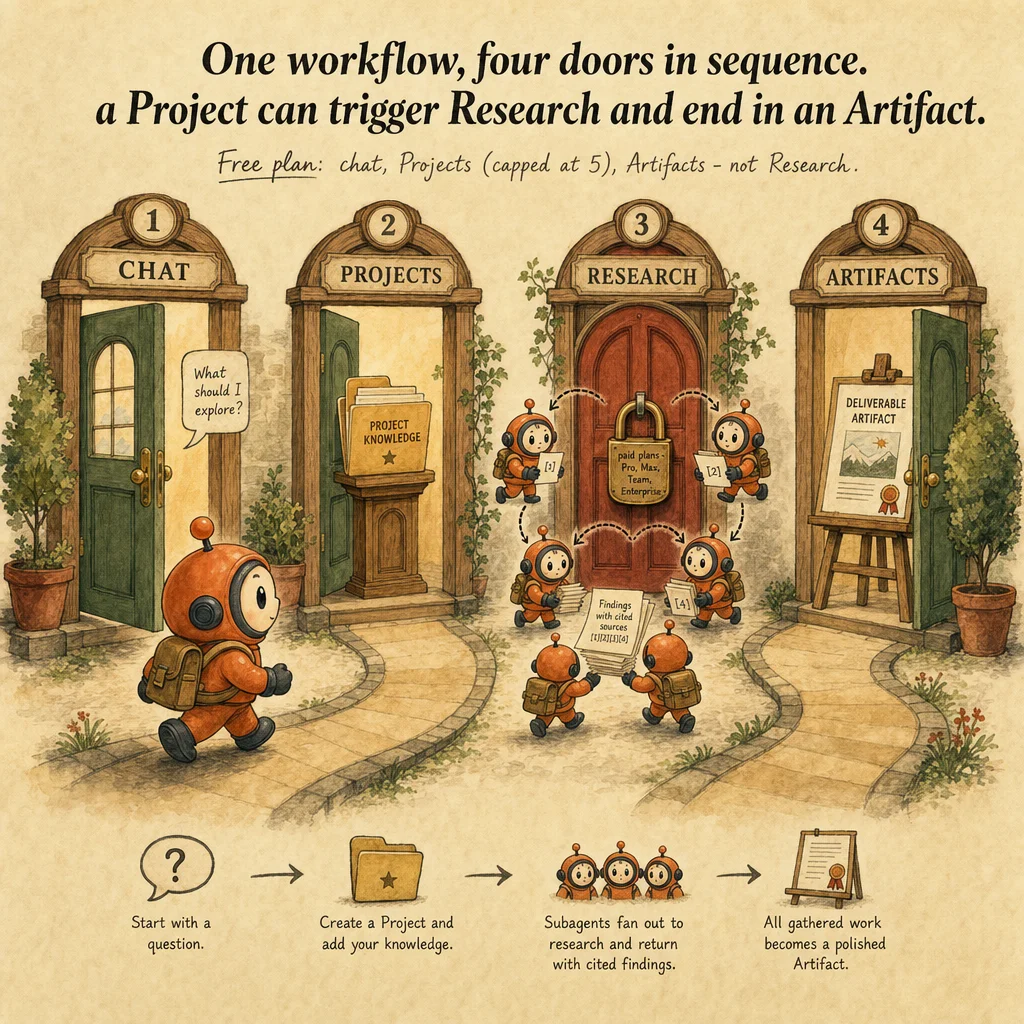
Selecting the Right Claude Product Feature mechanics, painterly diagram featuring Loop mascot.
04 · In production

Where you'll see it

Quarterly campaign review

A marketing manager chains all four surfaces: chat for a quick email draft, a Project holding past campaign decks and a brand-voice instruction, Research to gather cited competitor activity, and a final Artifact for the shareable dashboard.

Recurring onboarding documentation

An ops lead sets up a Project with the company handbook and standard instructions once, then reuses it across every new-hire chat instead of re-explaining context each time - Research and Artifacts stay unused because the task doesn't need fresh external data or a standalone deliverable.

05 · When to use

Decision tree

01

Is this a one-off, self-contained question with no need to reuse this context later?

YesUse plain chat - no setup needed.
NoContinue - this looks like recurring or multi-step work.
02

Does the work recur and need a persistent knowledge base plus consistent instructions across many future chats?

YesSet up a Project (Free: up to 5 Projects; knowledge auto-scales via RAG up to 10x as it grows, automatically, on every plan including Free).
NoContinue - check whether this needs open-ended information gathering.
03

Does the task require gathering and citing fresh information across multiple searches (web and/or connected sources), not just what's already uploaded or known?

YesTrigger Research - paid plans only (Pro/Max/Team/Enterprise), requires web search enabled, runs as a multi-agent parallel search.
NoExisting chat or Project context is likely enough.
04

Should the final output be a standalone, editable deliverable (dashboard, doc, prototype) rather than a chat reply?

YesAsk for it as an Artifact (requires Code execution and file creation to be enabled) - this can sit on top of a Project or a Research pass, not instead of them.
NoA plain chat response is sufficient.
06 · On the exam

Question patterns

Selecting the Right Claude Product Feature exam trap, painterly cautionary scene featuring Loop mascot.
An analyst has a single quick question about a spreadsheet formula, with no plan to revisit it. Which surface fits?
Plain chat - it's a one-off, self-contained question with no reuse need. Named distractor: "start a Project first, for consistency" - Projects exist for recurring work needing shared context, which adds setup overhead a single question doesn't need.
A team runs the same weekly brand-voice content review, reusing the same style guide and past decks every time. What should they set up?
A Project, uploading the style guide and past decks as its knowledge base and setting Project instructions for tone. Named distractor: "Research, since it needs to reference past campaign materials" - Research pulls fresh external/web information agentically; it's not the mechanism for reusing a team's own uploaded, static reference material across sessions.
The same team needs current, cited competitor campaign activity gathered from across the web before writing this week's review. Which surface, and what's required?
Research - it runs multiple, self-directed searches across the web (and connected sources like Gmail/Calendar/Docs if enabled) and returns checkable citations. It requires a paid plan (Pro/Max/Team/Enterprise) and web search turned on. Named distractor: "the Project's knowledge base, since documents were already uploaded there" - a Project's knowledge is fixed, uploaded context; it doesn't agentically fetch new external information the way Research does.
The team wants the finished weekly review delivered as something they can revisit and edit, not a wall of chat text. What should they ask for?
An Artifact - the output qualifies as significant, self-contained, reusable content, so it should render in its own window rather than inline chat text (assuming the Code execution and file creation capability is on). Named distractor: "trigger Research mode to format it nicely" - Research is for information-gathering, not output formatting; Artifacts are the separate output-format decision.
A Free-plan user's knowledge base for a Project has grown past what a single Project can comfortably hold, and they want it to auto-scale the way a colleague's does. What's the actual fix?
Nothing to configure - RAG auto-scaling, expanding a Project's effective knowledge capacity by up to 10x, is available on every plan, Free through Enterprise, and activates automatically once knowledge approaches the context-window limit. Named distractor: "upgrade to a paid plan, since RAG scaling is a paid-only feature" - RAG for Projects is not plan-gated; it works the same way on Free as on Pro/Max/Team/Enterprise.
That same Free-plan user now wants a 6th Project for a new client, but already has 5 active Projects. What's the actual fix?
Upgrade to a paid plan (Pro/Max/Team/Enterprise), or delete/archive an existing Project first - Free accounts are capped at a maximum of five Projects, a limit that is separate from (and unrelated to) RAG knowledge-scaling. Named distractor: "nothing needed, Projects have no cap on any plan" - the five-Project ceiling is real and specific to Free accounts.
07 · FAQ

Frequently asked

Are chat, Projects, Research, and Artifacts mutually exclusive modes?
No. They're complementary surfaces that commonly chain together - a Project can trigger Research internally, and either can produce an Artifact as the final deliverable.
Does every Claude.ai plan get access to Research?
No. Research is available on paid plans only (Pro, Max, Team, Enterprise) and requires web search to be enabled. Free accounts get chat, up to 5 Projects (with the same automatic RAG knowledge-scaling paid plans get), and Artifacts, but not Research.
08 · Practice with AI

Work this with your AI

Work this concept hands-on with Claude Code, Codex, or claude.ai. Copy a prompt, paste it into your assistant, and practise in tandem. Each one keeps you active (explain it back, get drilled, or build) rather than just reading.

  • Drill it like the exam (scenario MCQs)
    Practice in the exam's scenario-MCQ format with trap awareness.
  • Explain it back (Feynman)
    Build durable, transferable understanding of a concept you can half-state.
  • Test me, adapting the difficulty
    Active recall practice on a concept you think you know.
  • Check my prerequisites first
    Before studying a concept that keeps not sticking.
  • Find the high-leverage 20%
    When a domain feels too big and you are short on time.
Self-check

Test yourself

Three diagnostic questions on this primitive. Reveal each answer when you have a guess. Want a full 60-question mock? Open the mock hub →

Q1An analyst has a single quick question about a spreadsheet formula, with no plan to revisit it. Which surface fits?
Plain chat - it's a one-off, self-contained question with no reuse need. Named distractor: "start a Project first, for consistency" - Projects exist for recurring work needing shared context, which adds setup overhead a single question doesn't need.
Q2A team runs the same weekly brand-voice content review, reusing the same style guide and past decks every time. What should they set up?
A Project, uploading the style guide and past decks as its knowledge base and setting Project instructions for tone. Named distractor: "Research, since it needs to reference past campaign materials" - Research pulls fresh external/web information agentically; it's not the mechanism for reusing a team's own uploaded, static reference material across sessions.
Q3The same team needs current, cited competitor campaign activity gathered from across the web before writing this week's review. Which surface, and what's required?
Research - it runs multiple, self-directed searches across the web (and connected sources like Gmail/Calendar/Docs if enabled) and returns checkable citations. It requires a paid plan (Pro/Max/Team/Enterprise) and web search turned on. Named distractor: "the Project's knowledge base, since documents were already uploaded there" - a Project's knowledge is fixed, uploaded context; it doesn't agentically fetch new external information the way Research does.
Last reviewed: 2026-05-04·Refresh cadence: monthly
CCAOF-D3.1 · CCAOF-D3 · Product & Model Selection

Selecting the Right Claude Product Feature, complete.

You've covered the full ten-section breakdown for this primitive, definition, mechanics, code, false positives, comparison, decision tree, exam patterns, and FAQ. One technical primitive down on the path to CCA-F.

More platforms →