

On this page
TLDR
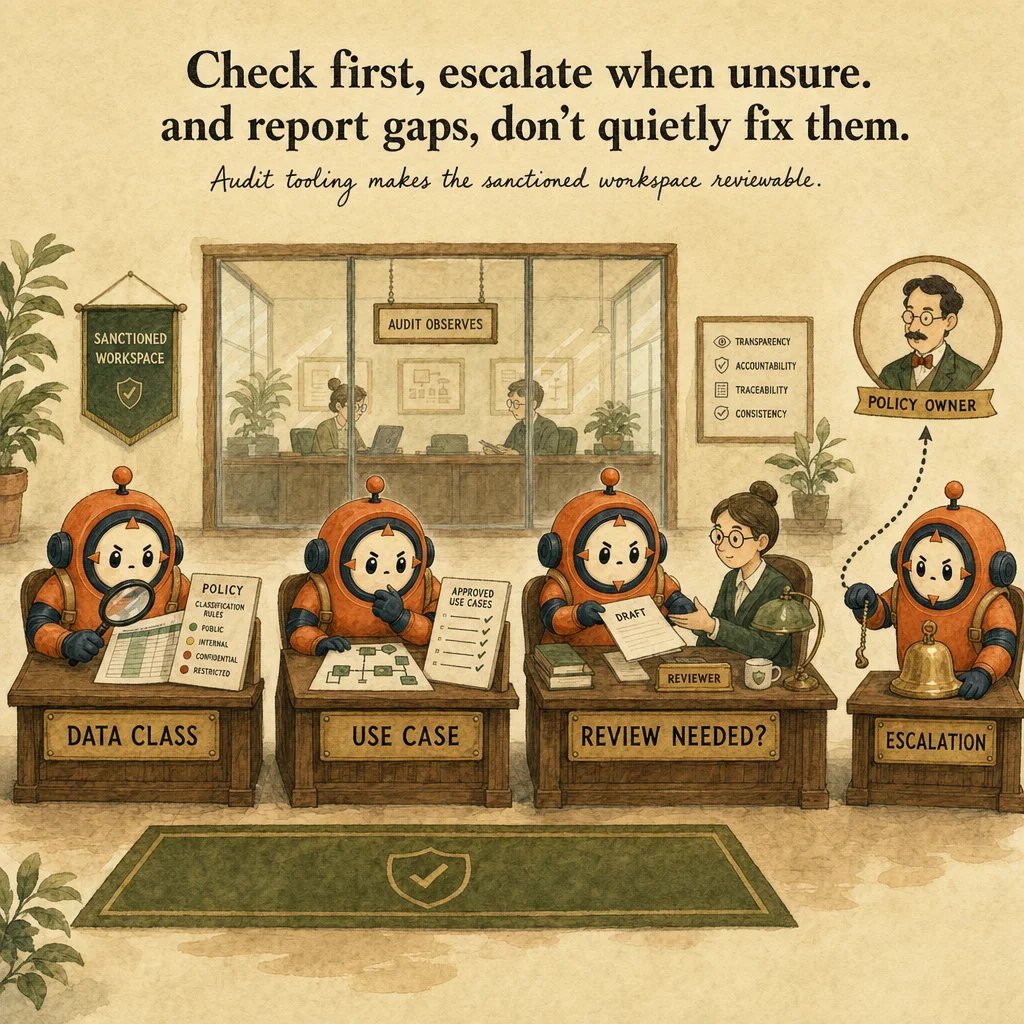
Following your organization's AI governance is an employee-level checklist run before acting: is this data class allowed here, is this use case approved, does this output need review before it ships, and - when any of that is unclear - who do you escalate to before proceeding. That policy layer is separate from Anthropic's own model-level safeguards; Anthropic's Responsible Scaling Policy governs how Anthropic scales its own models, not whether your specific use of Claude with specific data is compliant. Enterprise admin tooling also makes usage inside the sanctioned workspace reviewable after the fact, so working outside it, or sitting on a discovered gap instead of reporting it, is the actual risk, not a technicality.
What you are deciding
Following governance policy means your organization's written rules decide what is allowed, not what the product happens to permit. Apply the policy, identify who approves, keep the evidence, and stop and ask when the policy does not answer the question.
Does our written policy allow this use of this data, who approves it, and what evidence do I keep?
What it is
An Associate-level Claude user does not set AI policy, they operate inside one their employer already has, or should have: rules on what data can be pasted into Claude, which use cases are approved, who reviews AI-assisted work before it ships, and how usage gets audited afterward. Governance, at this level, is two layered things stacked on top of each other. The first is Anthropic's own vendor-level safety framework, how Anthropic itself scales and safeguards its models. The second is the organization's own admin controls and internal policy, layered on top when a company deploys Claude to its employees.
The two layers answer different questions. Anthropic's layer answers whether a model is safe to keep scaling; it does not answer whether a specific employee's use of a specific customer's data, inside a specific company's Claude deployment, satisfies that company's own data-handling rules. That second question belongs to the organization, and the associate's job is to follow the answer, not assume the vendor layer already covers it. Once a company enables audit tooling on its Claude deployment, usage inside the sanctioned workspace also becomes reviewable after the fact, which changes what "following policy" means in practice, from a trust exercise into something that can be checked.
How each certification frames it
CCA-A: How CCA-A tests governance policy
CCAOF-D6-O3Follow organizational AI policies and governance standards
The Associate guide lists following organizational AI policies and governance standards (PDF page 5, Domain 6). It sits beside appropriate use cases, data sensitivity and ethics, but this objective is about the organization's own rules and approvals.
Do not confuse three different questions: whether an output is accurate (Domain 2), whether a Project is set up correctly (Domain 5), and whether the organization approves the use (this domain).
How it works
What actually falls to the employee, day to day, is a short checklist, run before acting, not after. Before pasting data: is this data class (customer PII, financial records, unreleased material) allowed in this tool under company policy, and am I inside the company's sanctioned workspace rather than a personal account? Before adopting Claude for a new workflow: is this use case on the approved list, or does it need sign-off first, even if the task looks obviously low-risk? Before shipping AI-assisted output externally: does this specific output type require a human reviewer's sign-off, and has that review actually happened? None of this requires understanding admin tooling or vendor-level safety frameworks, it requires checking the answer against the org's own policy before proceeding, not after.
When the answer isn't clear, escalate before proceeding, don't decide alone. "This use case seems fine to me" is not a substitute for approval, and guessing at a data-handling rule is not the same as confirming it. The standard escalation path is: check the written policy first, then raise it with the designated policy owner, AI governance lead, or compliance/legal contact your org names for exactly this - before running the task, not after. The same path applies in reverse: if you spot a gap (a use case running without approval, PII that reached an unsanctioned account, an AI-assisted output that shipped without required review), report it promptly through that same channel rather than quietly self-correcting and moving on; governance depends on gaps being surfaced, not smoothed over.
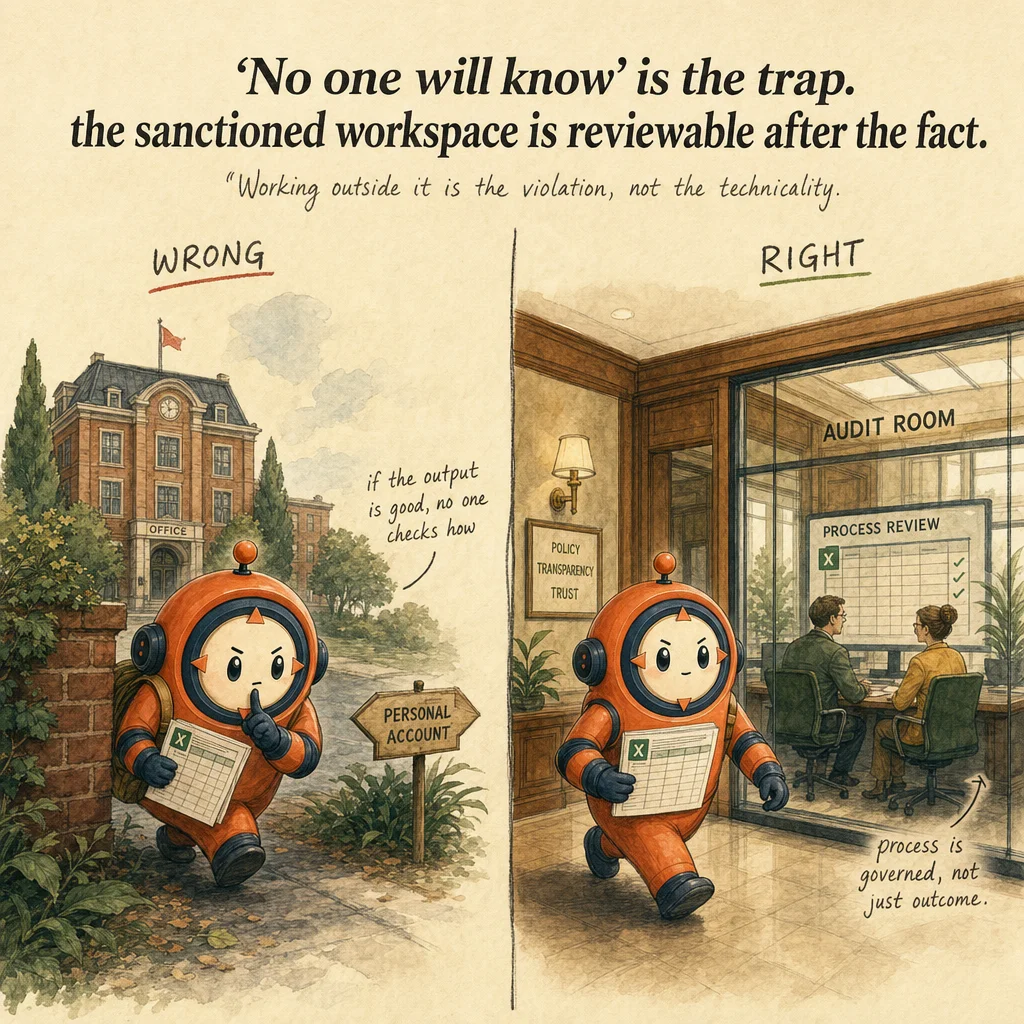
This is layered underneath two things an employee doesn't operate, but should recognize as separate from their own responsibility. Anthropic's own Responsible Scaling Policy (RSP) governs how Anthropic itself trains and scales its models, it is vendor-level and says nothing about whether a specific employee's use of specific data satisfies the company's own rules. Separately, an org's admin/security team enforces its policy technically, not just in writing, through Enterprise-tier tooling (audit access to usage, spend controls, role-scoped admin access), which means work done inside the sanctioned workspace is reviewable after the fact even without any complaint being filed. Neither of these is something an employee configures, but both are reasons "no one will notice" is a bad assumption, and why escalating a concern yourself is safer than hoping it goes unnoticed.
Most companies' internal policy structure echoes a recognizable pattern - NIST's AI Risk Management Framework (Govern, Map, Measure, Manage) - even if no one calls it that. Use-case approval is a Map step (classify the risk before deployment); required review before shipping is a Measure step; an escalation channel for gaps or mistakes is a Manage step. Recognizing the pattern explains why a policy asks for approval or review at all, rather than treating either as arbitrary friction, but an associate's job is following the steps, not designing the framework.
Worked example: an uncertain data-use request under a fictional policy
Authored teaching example, not a bank question.
with a fictional policy. A consultant wants to paste a client's customer list into Claude to draft segments. The firm's written AI policy says client data may be used only with a tool approved by the data owner, and unclear cases go to the governance lead.
The work continues on safe data while the approval is pending, and there is a record of who decided. Check afterwards that real client data was never used before the written answer.
How this decision goes wrong
Treating product safeguards as organizational approval
Looks right: The product allows the upload and has safety features, so the use is permitted.
Why it fails: Anthropic's roles and permissions article describes admin controls over features, sharing and integrations. Those settings control what the product allows. They are not a record that your policy allows this use of this data.
Instead: Check the written policy and get the named approval, then use the product within it.
Silently bypassing an unresolved policy question
Looks right: The deadline is close and the policy is unclear, so proceed and fix it later.
Why it fails: If the use turns out to be prohibited, the data has already been exposed, and you have no approval to point to.
Instead: Pause the risky step, ask the named owner, continue with safe substitute data, and record the decision.
Where you'll see it
Marketing associate summarizing customer feedback
Checks whether customer PII is allowed in Claude under company policy and routes the task through an approved Project or workspace instead of a personal account before pasting a complaints spreadsheet.
Enterprise security team
Reviews audit-accessible usage logs to confirm AI-assisted work followed the required human-review step before it shipped externally - work outside the sanctioned workspace is a visible gap, not a hidden one.
Show 1 more examples
Associate unsure about a new workflow
Checks the written policy, doesn't find a clear answer, and escalates to the org's named AI governance/compliance contact before running the task rather than guessing based on how low-risk it looks.
Decision tree
Does the data you are about to paste into Claude include customer PII or other regulated data?
Is this use case on your organization's approved-use list?
Does the output need human review before it ships externally?
Are you working inside the company's sanctioned Claude workspace rather than a personal account?
Are you genuinely unsure whether a data class, use case, or output is covered by policy, or did you discover a gap (unapproved use, misrouted data, a review step that got skipped)?
The exam trap
The trap is conflating vendor-level model safety with organization-level usage compliance. Anthropic's RSP governs how Anthropic scales and safeguards its own models, it says nothing about whether a specific company's use of a specific data set satisfies that company's own regulatory or data-handling obligations. This objective tests recognizing and following the organization's own policy layer, not reciting Anthropic's safety framework as if it were a compliance guarantee.
Question patterns
CCA-A practice questions
6 approved CCA-A questions for this topic. Tap an answer to check it, then read the rationale for every option.
An employee is about to paste a spreadsheet containing customer names, emails, and account numbers into a personal Claude.ai account to get a quick summary. What should they check first?
Frequently asked
Showing 6 of 6 questions
Sources and next steps
- Claude Certified Associate - Foundations Exam Guide v1.0 (July 2026), PDF page 5, section: Domains 3, 5 and 6, detailed objectives. Checked 2026-10-16.
- Roles and permissions (Claude Help Center, Team and Enterprise), section: Roles; permission tables. Checked 2026-10-16.
CCA-A exam guide: Domain 6, Governance, Risk and Responsible Use