
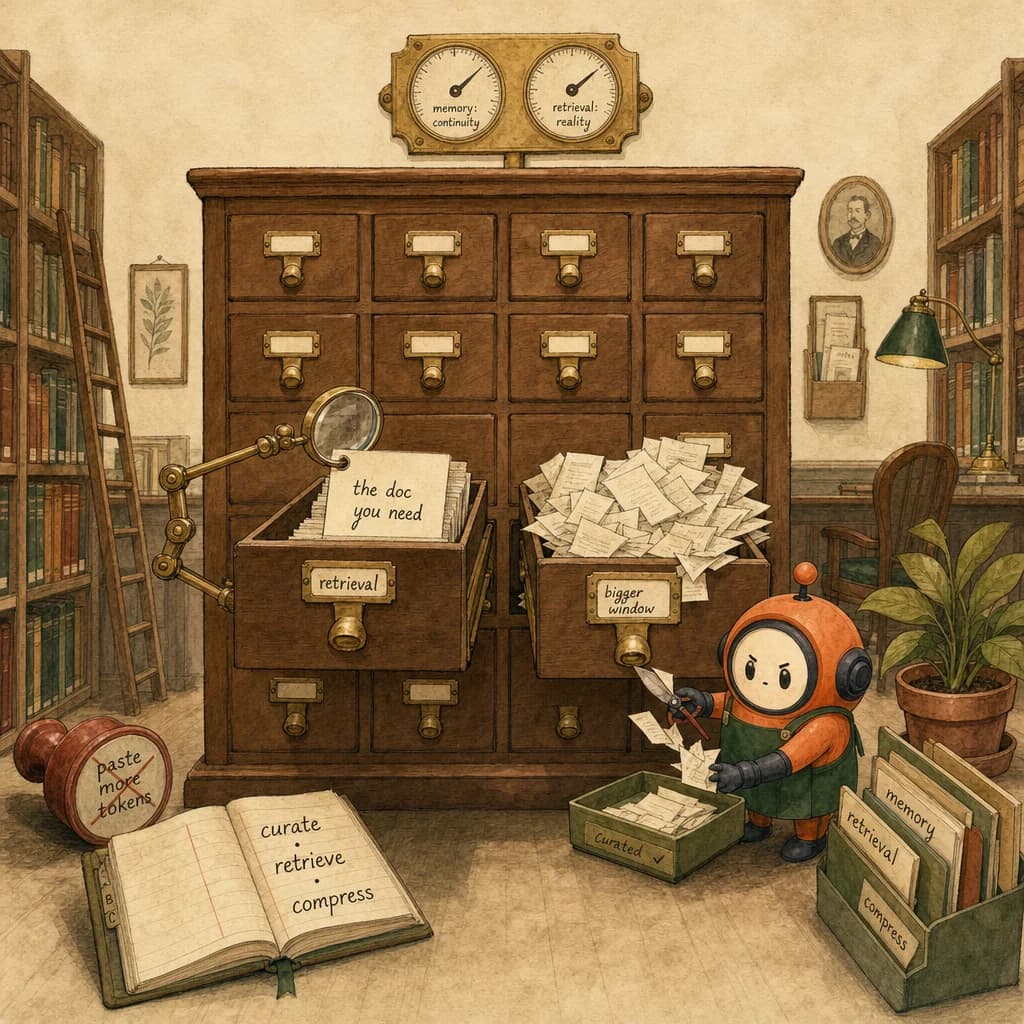
- ✓Because memory is not retrieval, and more tokens is not more signal. An agent can remember your tone and still miss your docs, and a bigger window often just adds junk. Curate the context and connect retrieval instead of inflating the prompt. Context discipline is a CCA-F D5 skill.
- ✓A bigger window is capacity, not comprehension. Knowing what the window is for is the first step to using it with discipline.
- ✓The order and freshness of what you feed the model is part of context discipline. Sequencing beats dumping.
- ✓The practical version of curate-don't-inflate: keep complex business context usable instead of pasting it all in.
Quick answer
Bigger context windows do not fix an agent that misses information. Memory is not retrieval, and more tokens is not more signal. An agent can remember your tone and still forget your docs, and a bigger window often just adds junk. Curate the context and connect retrieval instead of inflating the prompt. For CCA-F D5, that discipline is the skill.
What changed
Context windows kept getting bigger, and that quietly taught everyone the wrong lesson: that more tokens is always better (inference: larger windows raised capacity, but capacity is not the same as the model using that context well). So when an agent misses something, the reflex is to paste in more.
Two confusions hide underneath that reflex, and both cost reliability.
The first is memory versus retrieval. The second is bigger versus smarter context. Fix both and the window stops being the problem.
The two confusions
| Confusion | What people assume | What is actually true |
|---|---|---|
| Memory vs retrieval | If it remembers me, it knows my world | Memory carries the thread; retrieval pulls the document. Different systems. |
| Bigger vs smarter | More tokens means more signal | More tokens often means more junk; curation beats capacity |
| The fix | Increase the window, paste more | Curate what goes in, connect retrieval for the rest |
| The failure it causes | "Why did it miss the obvious thing?" | The thing was never retrieved, or was buried in noise |
How context discipline actually works
Think of the assistant as a coworker with perfect recall of your conversations and zero access to the shared drive. Great memory for you, no memory of the world around your work.
- Memory handles continuity. It keeps the thread of the chat: your tone, your preferences, what you said earlier.
- Retrieval handles reality. It pulls the specific email, doc, record, or fact the task needs. If the task depends on those, you connect a retrieval layer or pass them in. You do not assume rapport implies knowledge.
- Curation beats capacity. A lot of "memory" systems are really hoarding systems. Compress logs and tool output, return the slice the model needs, and sequence what is freshest. Smarter context usually beats a bigger window.
Worked example - "the agent that knows you and is still wrong."
- The agent recalls a preference from an earlier chat, then blanks on the spec or email thread you assumed it "basically knows."
- That is not forgetting. It is a system boundary: continuity was in memory, but the document was never retrieved.
- The fix is not a bigger window. Connect retrieval for the docs, and curate what you pass so the signal is not buried (see context update sequencing).
- Now the agent has both: continuity from memory and the actual document from retrieval, with less noise in between.
A name for it: Context Discipline
Context Discipline - deciding what belongs in the window at all, instead of inflating it. It rests on two distinctions: memory (continuity) is not retrieval (reality), and bigger context is not smarter context. The disciplined move is to curate what reaches the model, connect retrieval for what it does not hold, and compress the rest, so reliability comes from signal, not token count.
Why it matters for CCA-F
This sits in D5 - Context Management and Reliability, which is 15% of the exam, and connects to context window and handling long prompts.
The proprietary read: D5 questions reward curating context and connecting retrieval over inflating the prompt. Reliability is a function of signal, not size.
- Old instinct: the agent missed something, so give it a bigger window and paste more in.
- D5 instinct: decide what it actually needs, retrieve that, and keep the noise out.
The distractor pattern to memorize. On D5 scenarios where an agent misses information or degrades as the prompt grows, the trap answer is "increase the context window" or "add more context." The architecturally correct move is one of:
- Connect retrieval for the documents the task depends on, instead of hoping memory covers them, or
- Curate and compress so the relevant slice is not buried in logs and chunks, or
- Sequence the updates (see context update sequencing) so the freshest, most relevant context is clear.
How to apply it
- Name the boundary. Ask whether the task needs continuity (memory) or a document (retrieval). They are different jobs.
- Connect retrieval for anything outside the conversation: docs, email history, records, research.
- Curate, do not paste. Pass the slice the task needs; return the field, not the whole JSON (MCP token limits).
- Compress before the prompt. Summarize logs and tool output so tokens carry signal, not bulk.
- Reach for a bigger window last. Only after curation and retrieval, not as the first move.
The meta-skill, and the D5 exam skill, is the same: a bigger window is capacity, not comprehension. Reliability comes from what you let in, not how much.
5 direct routes into the scored material.
- conceptsA bigger window is capacity, not comprehension. Knowing what the window is for is the first step to using it with discipline.
- knowledgeThe order and freshness of what you feed the model is part of context discipline. Sequencing beats dumping.
- knowledgeThe practical version of curate-don't-inflate: keep complex business context usable instead of pasting it all in.
- knowledgeRetrieval discipline at the tool boundary: return the slice the model needs, not the whole payload it does not.
- exam-guideD5 (Context Management and Reliability) is 15% of the exam and rewards curating context over inflating it.
Share this post.
One share is one less person stuck on the same question.