

On this page
TLDR
Context window management is how you keep long conversations within limits without dropping critical facts. Patterns: case-facts blocks, progressive summarization, retrieval.
What it is
The context window is the maximum token budget Claude can process in a single request. Claude Sonnet and Opus have a 200K token window, equivalent to ~500 pages of text or ~1 hour of conversation. Hard architectural boundary set by positional embeddings. Cannot be exceeded; requests fail with context_length_exceeded. Managing the window is core production architecture: inefficient windowing wastes budget; strategic windowing unlocks large-scale automation.
The 200K window applies to total input tokens, including system prompt, all messages, all tool definitions. Example: system (500) + prior conversation (5000) + current request (1000) + tool definitions (2000) = 8500 used, 191.5K remaining. If you're building an agent loop and messages grow unchecked, you can hit the limit at turn 12. The window doesn't reset between turns; shared budget for the entire sequence.
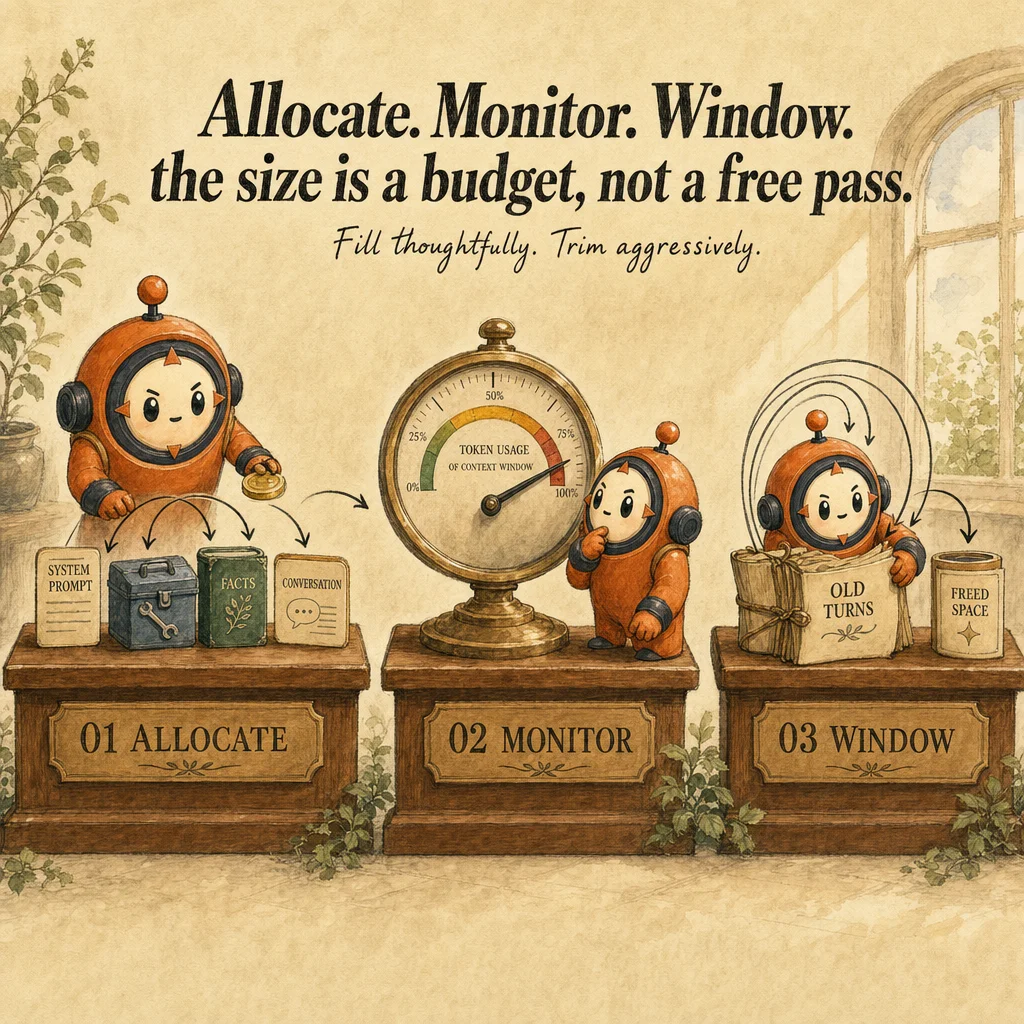
Three production patterns manage the window: prompt caching (90% off repeated prefix), context windowing (summarize old turns into FACTS block, drop verbose history), and streaming output (doesn't reduce tokens but improves UX during long waits). The fourth, underutilized pattern: case-facts immutability (CASE_FACTS rewritten not appended at every turn).
The most-tested anti-pattern is windowing too late. If your loop runs for 12 turns and you window at turn 11, you've wasted tokens for 10 turns. Optimal: window at turn 5 if the conversation is verbose, or preemptively at turn 3 if each turn is expensive. Also tested: context starvation in subagents. Coordinator passes 100KB to a subagent; subagent wastes half its 200K window on irrelevant context. Mitigate: subagents receive only what they need in a compact TASK_CONTEXT block.
How it works
Token counting is deterministic: SDK provides count_tokens() endpoint that returns exact cost before you execute. Always call on large requests. Track at every turn; when remaining <20K, window immediately.
Windowing mechanics: at turn N, extract a summary of turns 1 through N-1 into a PRIOR_CONTEXT block, drop the verbose message history, append PRIOR_CONTEXT + current turn as the new message list. Before windowing, messages = [user_msg, asst_1, tool_1, ..., asst_4, tool_4, user_5]. After windowing at turn 5, messages = [{role: "user", content: "PRIOR_CONTEXT: ...\n\nCURRENT: {turn_5}"}]. The new list is 10% the size of the old list.
Prompt caching exploits that system prompt and tool definitions don't change between turns. Mark with cache_control: {type: "ephemeral"}. On first request, full price; turns 2+ pay only 10% of cache price. Save 88% over 9 turns.
Case-facts immutability means CASE_FACTS is rewritten at every turn, never appended. Turn 1: CASE_FACTS: {customer_id, amount}\nQUESTION: .... Turn 2: CASE_FACTS: {customer_id, amount, order_found: true}\nQUESTION: ... (facts updated, not accumulated). Prevents the block from growing unboundedly. Combined with windowing: production pattern for multi-turn customer service.
Where you'll see it
200-page contract analysis with windowing
Legal team uploads 200-page contract. Without windowing, loop dies at page 15 (context exhausted). With windowing at page 10: "Pages 1-10 analyzed; risks: X, Y, Z." Claude continues fresh on pages 11-20, final turn aggregates findings. ~50% of non-windowed cost despite same work.
Long-running customer support with case-facts immutability
Loop starts CASE_FACTS = {customer_id, order_id}. Turn 2: updated = {..., refund_amount: 150}. Turn 3: {..., policy_check: "under $500, approved", manager_approval: "needed"}. Each turn rewrites (not appends). Combined with windowing at turn 5, agent runs 20+ turns without exhaustion.
Show 2 more examples
Subagent context starvation mitigation
Coordinator delegates with full 150KB case context expecting inheritance. Subagent wastes 100KB on irrelevant history. Fix: coordinator extracts a 2KB TASK_CONTEXT ("Analyze competitor pricing; they offer X, Y, Z") and passes only that. Subagent has 198K for actual research.
Prompt caching for repeated system prompt + tools
Support agent loop runs 50 times/day. System (500 tokens) + 5 tools (2000) = 2500 tokens. Normal: 50 × $0.0375 = $1.875/day. Cached: 1 uncached + 49 cached @ 10% = $0.0375 + 49 × $0.00375 = $0.221/day. 88% savings.
Code examples
from anthropic import Anthropic
client = Anthropic()

def long_agent_with_windowing(case_facts: dict, max_turns: int = 50):
    messages = []
    turn = 0
    system_prompt = """You are a support agent. Refunds >$500 require approval."""
    tools = [
        {"name": "verify_customer", "description": "Check customer exists", "input_schema": {"type": "object", "properties": {}}},
        {"name": "lookup_order", "description": "Find order details", "input_schema": {"type": "object", "properties": {}}},
        {"name": "process_refund", "description": "Issue refund (with policy)", "input_schema": {"type": "object", "properties": {}}},
    ]

    while turn < max_turns:
        turn += 1

        # WINDOWING at turn 5: drop history, keep CASE_FACTS
        if turn == 5:
            case_facts["prior_work"] = "Customer verified, order found."
            messages = []

        # CASE-FACTS IMMUTABILITY: rewrite (not append)
        block = f"""CASE_FACTS:
- Customer ID: {case_facts.get('customer_id', 'N/A')}
- Order ID: {case_facts.get('order_id', 'N/A')}
- Refund Amount: ${case_facts.get('amount', 0)}
- Prior Work: {case_facts.get('prior_work', 'None')}
"""
        user_message = f"{block}\nQuestion: {case_facts.get('question', 'Help')}" if turn == 1 else f"{block}\nContinue."
        messages.append({"role": "user", "content": user_message})

        # PRE-CHECK token count
        token_count = client.messages.count_tokens(model="claude-opus-4-5", system=system_prompt, tools=tools, messages=messages)
        if token_count.input_tokens > 190000:
            print(f"Warning: {token_count.input_tokens} tokens; near limit.")

        resp = client.messages.create(
            model="claude-opus-4-5", max_tokens=1024,
            system=[{"type": "text", "text": system_prompt, "cache_control": {"type": "ephemeral"}}],
            tools=tools, messages=messages,
        )

        if resp.stop_reason == "end_turn":
            return resp.content[0].text if resp.content else "Done"
        messages.append({"role": "assistant", "content": resp.content})

return "Max turns exceeded."Looks right, isn't
Each row pairs a plausible-looking pattern with the failure it actually creates. These are the shapes exam distractors are built from.
The context window resets after each turn.
Cumulative across all turns.
Messages accumulate; budget shrinks. Once you hit 200K, new requests fail.
Streaming reduces context window cost.
Streaming is UX, not cost.
You pay for every token, streamed or not.
Windowing loses information; only for cost reduction.
Windowing trades verbose intermediate details for critical facts.
Information not lost; summarized. Also improves accuracy via attention engineering (facts at top).
Prompt caching is free; no trade-off.
Caching requires 1024-token minimum to be worthwhile.
Short requests: caching overhead exceeds savings. Use for system + tools in loops, not one-off requests.
If you hit the context limit, increase max_tokens.
200K is the input budget, not output.
Increasing max_tokens (output budget) doesn't help. Window the input.
In Claude Code, run /clear to reclaim context - it wipes everything including your CLAUDE.md and memory.
/clear wipes the conversation but preserves CLAUDE.md and memory files.
It does not delete your project instructions. To shrink an ongoing thread without losing it, use /compact (summarize) instead of /clear (wipe).
Side-by-side
| Aspect | 200K window | 100K window | Streaming | Caching |
|---|---|---|---|---|
| Total budget | 200K tokens | 100K tokens | Same as non-streaming | Save 90% on cached |
| Effective usage | ~500 pages or 10 turns | ~250 pages or 5 turns | No savings; UX only | Big if repeated |
| When to use | Default; most tasks | Cost-constrained | Chat UX, long responses | Loops with fixed system/tools |
| Management | Window at turn 5 | Window at turn 2-3 | Stream events; buffer | Mark ephemeral; monitor TTL |
| Cost impact | Baseline | 2x cheaper per task | Neutral; UX benefit | 88% savings per repeated turn |
| Failure mode | Hit 200K limit | Hit 100K limit faster | Network drops | Cache miss on content change |
Decision tree
Single turn or a loop?
Loop likely to run >5 turns?
Repeatedly sending the same system prompt + tools?
cache_control: ephemeral. Save 90% per turn.Response is long (>5 sec wait) and user-facing?
After turn N, approaching 200K tokens?
Question patterns

6 V2 questions wired to this concept. Tap an answer to check it instantly - you'll see whether it's right and why - then expand the full breakdown for the mental model and all four rationales.
Long-document extraction stalls at chunk 18 every single time, regardless of which model you use. What is happening?
Frequently asked
Showing 12 of 12 questions
context_length_exceeded. No partial response; you get an error and are billed nothing (or only for excess).count_tokens() before each turn. Set a threshold (e.g., 180K); window when crossed./compact, trim, or start fresh.