
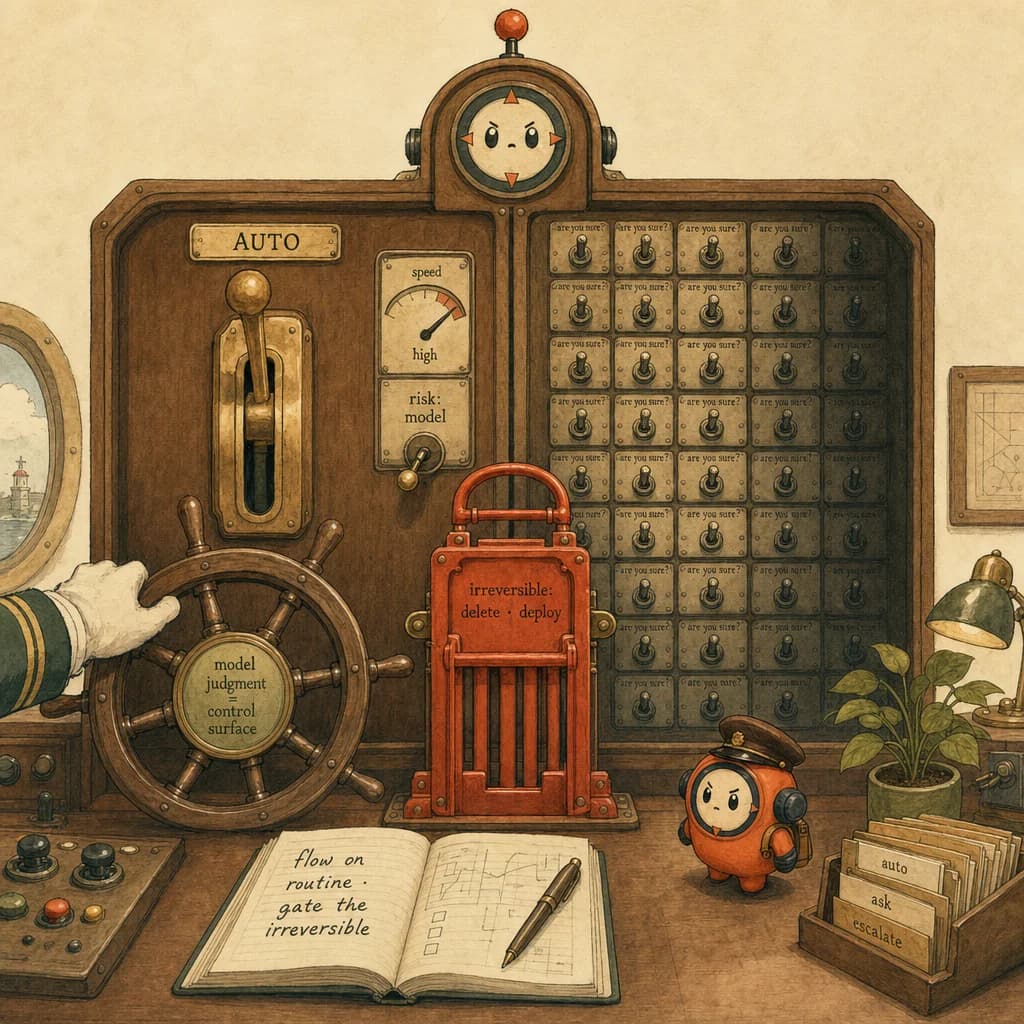
- ✓Not always. Turn off the approval gates and you do not remove the control surface, you swap it from human approval to model judgment - so a weaker model gets dangerous faster and a stronger one becomes a reliability decision. Matching permission mode to model strength is a CCA-F D3 skill.
- ✓Permission posture is configuration. Which actions auto-run and which must ask belongs in your project config, which is D3.
- ✓Removing gates does not mean removing judgment. Escalation is how an agent knows when to stop and ask instead of acting.
- ✓Hooks let you gate only the irreversible actions, so you get flow on the routine path and a hard stop on the dangerous one.
Quick answer
More permission prompts do not automatically make an agent safer. Turn off the approval gates and you do not remove the control surface, you swap it from human approval to model judgment. A weaker model gets dangerous faster; a stronger one becomes a reliability decision. For CCA-F D3, the skill is matching permission mode to model strength and risk.
What changed
Coding agents now run with configurable permission posture. A guarded mode that asks before acting, and a flow mode that executes without stopping for approval (first-hand: Claude Code exposes permission modes that range from ask-before-acting to running without per-step approval). That makes "how much should it ask?" a real configuration decision, not a fixed default.
The instinct is to add more confirmations. If an agent can touch your shell, you do not want it freelancing in your repo at 2 a.m., so more "are you sure?" prompts must mean fewer mistakes.
Sometimes. But every prompt you remove does not delete the risk. It relocates it.
Two theories of failure
| Aspect | Guarded: approve every step | Flow: judgment moves upstream |
|---|---|---|
| Control surface | Human approval | Model judgment |
| Speed | Slow, interrupt-heavy | Fast, fewer pauses |
| Main risk | Rubber-stamp fatigue; reasoning still unproven | A weak model acting unchecked |
| What makes it safer | A human who actually reads each step | A stronger model plus a gate on the irreversible path |
| Best fit | Where a wrong move is expensive | Where the work is routine and reversible |
How the control-surface swap actually works
Removing gates does not remove the control surface. It swaps which thing is keeping you safe.
- Gates on: the human is the runtime firewall, approving commands step by step. Safer on paper, slower in practice, and you still cannot guarantee the model's reasoning was sound.
- Gates off: the model's judgment becomes the firewall. Immediate execution, fewer pauses, and the main risk control is now model capability.
So model choice stops being a quality upgrade and becomes a safety lever. In an environment that will not stop to ask, a weaker model produces bad command chains and confident wrong edits faster, with nothing to catch them.
Worked example - "an agent with shell access."
- Guarded path: every command waits for approval. Safe if you read each one, but most people start clicking approve on autopilot, and the slow pace pushes teams to disable the gate entirely.
- Flow path with a weak model: fast, and one wrong chain later git history is on fire.
- Flow path with a strong model plus one gate: routine work runs free, and an escalation rule plus a hook hard-stops the irreversible actions (deletes, force pushes, production changes).
- The safest unrestricted agent is not the one with the most popups. It is the one with better judgment and a gate where a mistake cannot be undone.
A name for it: the Control-Surface Swap
The Control-Surface Swap - turning off approval gates does not remove the control surface, it swaps it from human approval to model judgment. The risk does not disappear; it moves to the model. That is why autonomy is a model-selection decision: in an environment that will not stop to ask, the model is the last line of defense, so a stronger one is a reliability choice, not a luxury.
Why it matters for CCA-F
This sits in D3 - Claude Code Configuration and Workflows (20% of the exam) and D5 - Context Management and Reliability (15%), and connects to escalation and agent instruction files.
The proprietary read: D3 questions reward matching permission mode to model strength and risk, not maximizing confirmations. The correct posture is per-task, not a global preference.
- Old instinct: add more confirmation prompts to make the agent safe.
- D3 instinct: match the permission mode to the model and gate only what cannot be undone.
The distractor pattern to memorize. On D3 scenarios about an agent with shell or write access, the trap answer is "add more confirmation prompts." The architecturally correct move is one of:
- Match permission mode to model strength so autonomy rides on judgment you trust, or
- Gate only the irreversible actions (with hooks) so you keep flow on the reversible path, or
- Add an escalation rule so the agent stops and asks on genuine ambiguity instead of on every step.
How to apply it
- Pick the posture per task. Guarded where a wrong move is expensive, flow where it is reversible.
- Upgrade the model before you remove gates. In flow mode, capability is your safety lever.
- Keep one hard gate. Always stop on the irreversible: deletes, force pushes, production writes.
- Use escalation, not popups. Let the agent ask on real ambiguity, not on every command.
- Encode it in config. Put the permission posture in your project config so it is consistent, not improvised per session.
The meta-skill, and the D3 exam skill, is the same: fewer prompts do not mean less safety, they mean a different control surface. Make sure the thing you swapped to, model judgment, is strong enough to hold it.
5 direct routes into the scored material.
- conceptsPermission posture is configuration. Which actions auto-run and which must ask belongs in your project config, which is D3.
- conceptsRemoving gates does not mean removing judgment. Escalation is how an agent knows when to stop and ask instead of acting.
- knowledgeHooks let you gate only the irreversible actions, so you get flow on the routine path and a hard stop on the dangerous one.
- knowledgePermission mode is an architecture decision: where the control surface sits, human approval or model judgment.
- exam-guideD3 (Claude Code Configuration and Workflows) is 20% of the exam and rewards matching permission mode to model strength and risk.
Share this post.
One share is one less person stuck on the same question.