
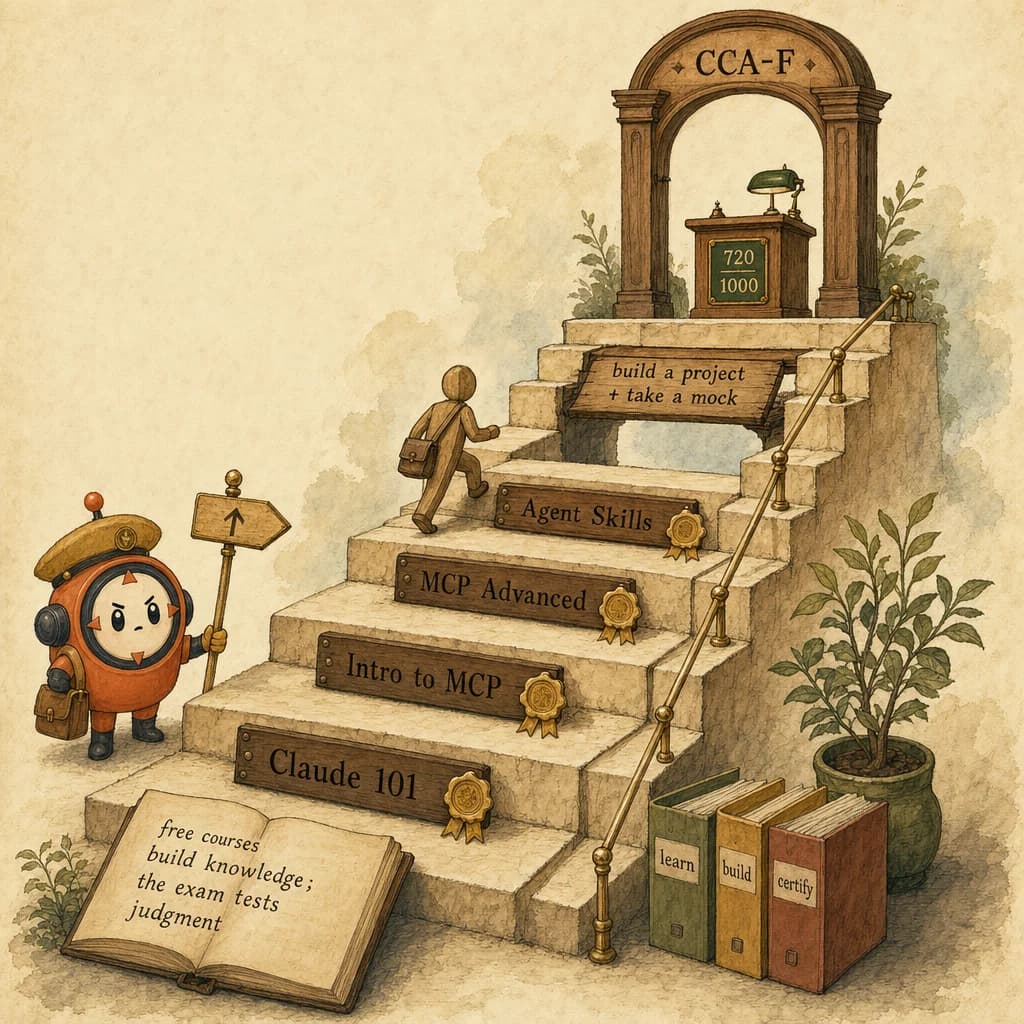
- ✓Anthropic Academy offers free, certificate-bearing courses (Claude 101, Introduction to MCP, MCP Advanced Topics, agent skills) that are the best free on-ramp to the Claude Certified Architect (CCA-F) exam. But the free courses teach the building blocks; the CCA-F tests architectural judgment under production scenarios, so they are a necessary start, not a sufficient finish. Here is how to bridge the gap.
- ✓The Academy courses are the free on-ramp; the exam-guide hub is the map of the actual CCA-F you are ramping toward.
- ✓Once the free courses have built your base, this is how to get exam access through the Claude Partner Network or the individual path.
- ✓Introduction to MCP and MCP Advanced Topics are the two most-recommended Academy courses. This page is the exam-aligned deep dive.
Quick answer
Anthropic Academy's free courses are the best free on-ramp to the CCA-F, but not the finish line. Claude 101, Introduction to MCP, and MCP Advanced Topics teach the building blocks and award real certificates; the Claude Certified Architect exam tests architectural judgment under production scenarios. Take the free courses, build one real project, then close the gap with scenario practice before you register.
What is Anthropic Academy, and what does it give you?
Anthropic Academy is Anthropic's official training platform, launched in March 2026 and hosted on Skilljar from anthropic.com/learn. It is genuinely free: an email enrolls you, there is no subscription or card, and every course awards an official Anthropic certificate you can list on LinkedIn.
The catalog spans Claude 101, the Claude API, Model Context Protocol (introductory and advanced), and agent skills. For anyone heading toward the Claude Certified Architect exam, this is the strongest free starting point that exists. The question is not whether to take them - you should - but whether they are enough on their own. They are not, and understanding why is the whole point.
Free courses versus the CCA-F exam
| Dimension | Anthropic Academy (free courses) | Claude Certified Architect (CCA-F) |
|---|---|---|
| Cost | Free (email enrollment) | Paid, proctored exam |
| What it teaches/tests | What each feature IS (building blocks) | Which feature to reach for and why (judgment) |
| Format | Self-paced lessons | 60 scenario-based questions, 720 of 1000 to pass |
| Credential | Course-completion certificate | Architectural-competence certification |
| Best role | Build the knowledge base | Prove production architectural skill |
The Academy facts (free, certificate-bearing, Skilljar-hosted, the Claude 101 and MCP courses) are reported by Anthropic and corroborated across coverage (reported; the course count is a moving target). The exam format - scenario-based, 720 of 1000 - reflects the published CCA-F blueprint (reported; confirm at registration).
How to actually bridge the gap
The free courses build knowledge. The exam grades judgment. The bridge between them is a real project plus scenario practice.
Worked example - a 4-week free-to-certified sprint
- Week 1 - Claude 101. Get fluent in Claude Code: scope tasks, run it in your terminal, understand the workflow. This seeds Domain 3.
- Week 2 - Introduction to MCP, then MCP Advanced Topics. The two most-recommended Academy courses; they seed Domain 2.
- Week 3 - build one real thing. A small multi-agent workflow or an MCP server integration. This is where features become judgment - the part no course can hand you.
- Week 4 - take a free scenario mock. It exposes your weakest domain in 30 minutes. Close that domain, then register.
- Result: free courses gave the base, the project gave the hands-on reps, the mock found the gap. That is exam-ready.
A name for it: the Knowledge-to-Judgment Gap
The Knowledge-to-Judgment Gap: free courses can teach you what every Claude feature is - the context window, MCP, subagents, dynamic workflows. They cannot teach you which one to reach for when an agent is failing in production at 2 a.m. That judgment comes from building and from scenario practice. The Academy closes the knowledge half for free; the project and the mock close the judgment half. The CCA-F grades the second half.
Whenever you feel "I have watched all the courses but the practice questions still surprise me," that is the gap talking - and it is normal. The fix is reps, not more lectures.
Why it matters for the CCA-F exam
The CCA-F is scenario-based by design, which is exactly why course completion alone underprepares people. The exam spans five domains - Agentic Architecture (27%), Claude Code (20%), Prompt Engineering (20%), Tool Design and MCP (18%), and Context Management and Reliability (15%) - and every question asks for an architectural decision, not a definition. The free courses cover the vocabulary across those domains; the exam tests the calls.
Start at the Claude Certified Architect certification hub to see the full blueprint, scope your study against the technical primitives, go deep on the highest-leverage free-course domain with MCP certification, then find your gap fast on the free CCA-F practice exam. When you are ready, registration and cost is the final step. For the courses themselves, start at Anthropic's official learn hub.
How to apply it this week
- Enroll in Claude 101 and the two MCP courses. They are free and they are the foundation - there is no reason to skip them.
- Collect the certificates, but do not mistake them for exam readiness. They prove attendance, not architectural judgment.
- Build one real project so the features become decisions you have actually made.
- Take a free scenario mock to find the one domain that will sink you, then close it and register.
The free courses are the most generous on-ramp Anthropic has ever offered. Take all of them - then close the knowledge-to-judgment gap with a project and a mock, and the Certified Architect exam becomes the natural next step rather than a leap.
5 direct routes into the scored material.
- exam-guideThe Academy courses are the free on-ramp; the exam-guide hub is the map of the actual CCA-F you are ramping toward.
- exam-guideOnce the free courses have built your base, this is how to get exam access through the Claude Partner Network or the individual path.
- knowledgeIntroduction to MCP and MCP Advanced Topics are the two most-recommended Academy courses. This page is the exam-aligned deep dive.
- practiceThe fastest way to find the gap between what the free courses taught and what the exam tests is a free scenario-based mock.
- conceptsThe free courses cover features; the exam tests primitives. This page scopes the 25 concepts the CCA-F is actually built on.
- learn hub· anthropic.com
Share this post.
One share is one less person stuck on the same question.