
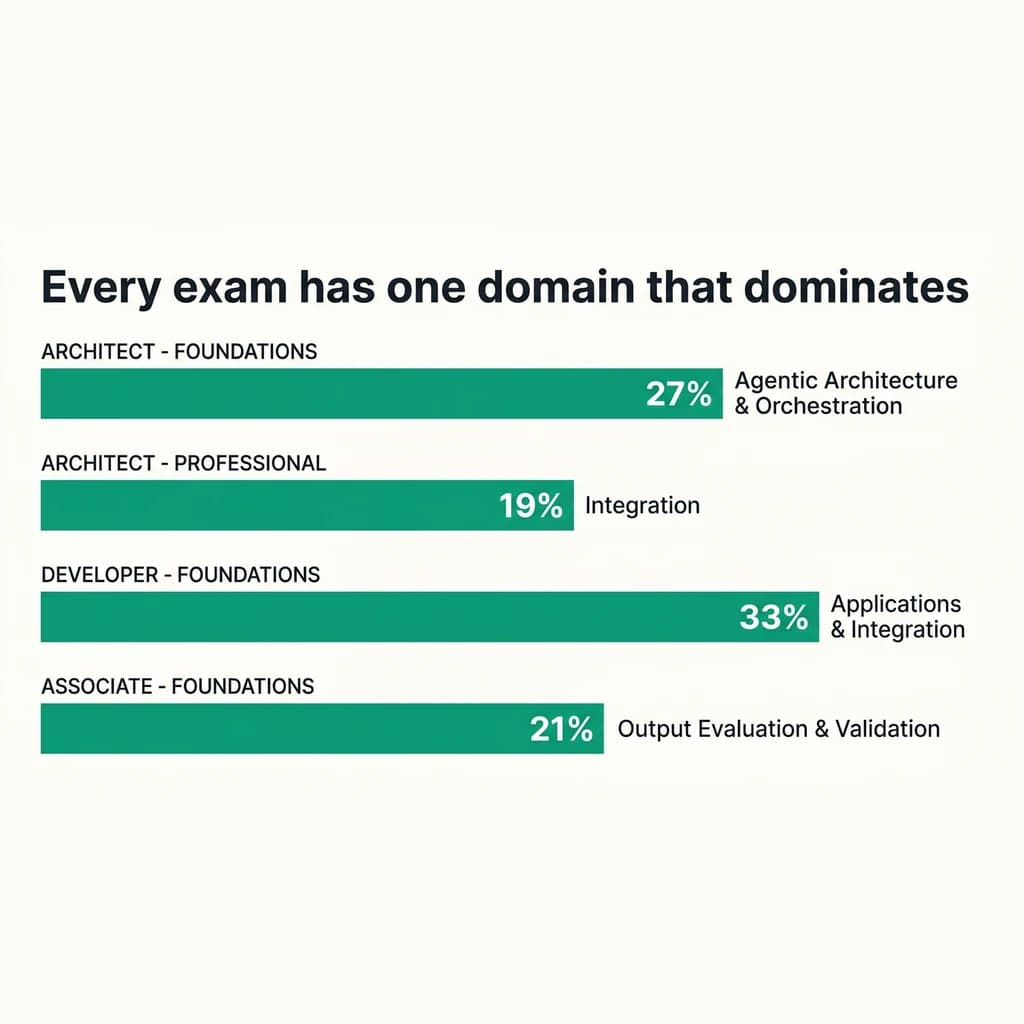
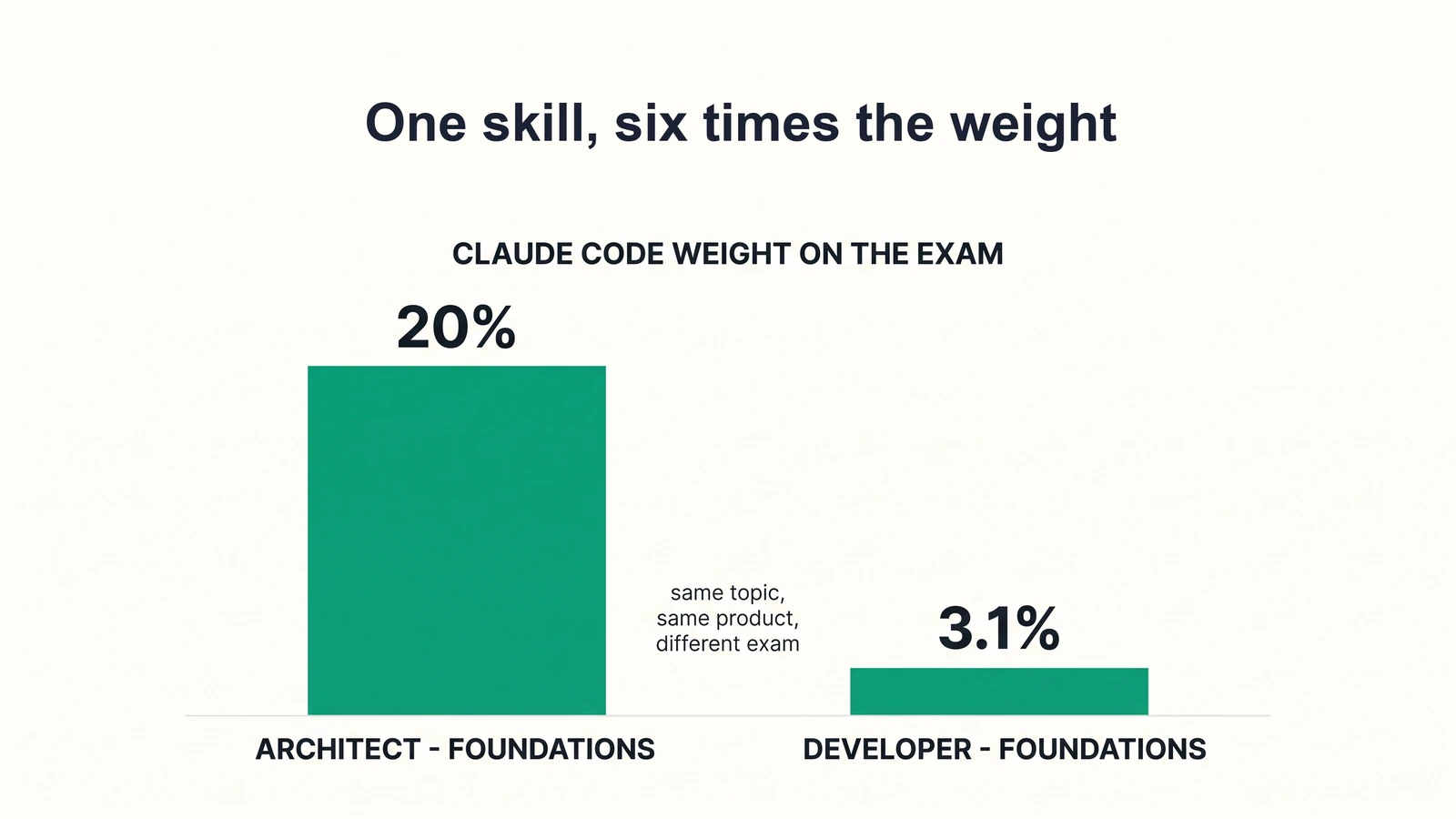
- ✓Anthropic's four Claude certifications share the same pass mark, time limit, and delivery vendor - past that, they test almost nothing in common. Each exam has its own domains and its own single heaviest one, carrying anywhere from under a fifth to a third of the whole test. The sharpest example: Claude Code configuration is a dedicated 20% domain on Architect - Foundations, and just 3.1% on Developer - Foundations - same product, same skill, more than six times the weight on one exam versus the other. Know your exam's heaviest domain before you open a question bank.
- ✓This post breaks down what each exam weighs; this hub covers audience, format, and price for each.
- ✓Knowing a domain's weight only matters once you've picked which of the four exams you're actually sitting.
- ✓Agentic Architecture & Orchestration is the single heaviest domain on the flagship Architect - Foundations exam, at 27% - this is the concept underneath it.
Anthropic runs four Claude certifications - Architect Foundations, Architect Professional, Developer Foundations, and Associate Foundations (confirmed official: claude.com/blog/four-role-based-claude-certifications). All four share the same pass mark (720 out of 1000), the same 120-minute window, the same 12-month validity, and the same Pearson VUE delivery (official exam guides, v1.0, effective July 2026 - these mechanics are set in the candidate-facing guides, not on the public blog post above). Past that, they test almost nothing in common. Each exam has its own set of domains, its own weighting, and its own idea of what "knowing Claude" means for that role.
The domain weightings below - the exact percentages - are not published on the open web. They come from Anthropic's own candidate-facing exam guides (official exam guide, v1.0, effective July 2026 - obtained through certification registration, not a public URL; this site's certification registry is built directly from them).
Architect - Foundations. 60 items, $125.
For solution architects building production Claude apps.
- Agentic Architecture & Orchestration - 27%. The heaviest domain on this exam by a wide margin.
- Claude Code Configuration & Workflows - 20%
- Prompt Engineering & Structured Output - 20%
- Tool Design & MCP Integration - 18%
- Context Management & Reliability - 15%
Over a quarter of this exam is agent design and orchestration. If you are studying for this one and spending equal time on all five domains, you are under-preparing for the biggest one.
Architect - Professional. 63 items, $175.
For mid-to-senior architects and AI/ML engineers with production experience.
- Solution Design & Architecture - 17%
- Claude Models, Prompting & Context Engineering - 13%
- Integration - 19%. The heaviest domain here.
- Evaluation, Testing & Optimization - 16%
- Governance, Safety & Risk - 14%
- Stakeholder Communication & Lifecycle - 14%
- Developer Productivity & Operational Enablement - 7%
Seven domains, and the top three (Integration, Solution Design, Evaluation) carry more than half the exam between them. Stakeholder communication and governance are both real domains here, not footnotes - this is the one exam of the four that tests whether you can explain an architecture decision to a non-technical stakeholder.
Developer - Foundations. 53 items, $125.
For AI/ML engineers and senior software engineers shipping production Claude apps.
- Agents & Workflows - 14.7%
- Applications & Integration - 33.1%. By far the heaviest domain on any of the four exams - close to a third of the entire test.
- Claude Code - 3.1%
- Evaluation, Testing & Debugging - 2.6%
- Model Selection & Optimization - 16.8%
- Prompt & Context Engineering - 11.0%
- Security & Safety - 8.1%
- Tools & MCPs - 10.6%
Notice what happened to Claude Code. On the Architect - Foundations exam above, Claude Code configuration is a dedicated 20% domain. On this exam, aimed at people who actually write the code, Claude Code drops to 3.1% - the second-lightest domain on the paper. The exam that weights Claude Code hardest is the one for architects, not developers. What carries a third of this exam instead is API mechanics, software-engineering practice, and application design across interfaces.
Associate - Foundations. 60 items, $99. Explicitly non-technical.
For client-facing roles: consultants, sellers, delivery, ops, PM.
- Prompting & Task Execution - 14%
- Output Evaluation & Validation - 21%. The heaviest domain.
- Product & Model Selection - 12%
- Workflow Integration & Solution Design - 16%
- Configuration & Knowledge Management - 12%
- Governance, Risk & Responsible Use - 15%
- Troubleshooting & Optimization - 10%
The heaviest domain on the only non-technical exam of the four is judging Claude's output - catching hallucinations, checking accuracy, deciding when a human needs to step in. Not writing prompts. Reading them critically.
What this means for candidates
The four exams are not four difficulty levels of the same test. They are four different jobs, examined separately. Time spent mastering Architect - Foundations' agentic-orchestration content does not transfer cleanly to Developer - Foundations' API-mechanics-heavy exam, and neither transfers to the Associate exam's focus on evaluating output rather than producing it.
Before opening a question bank, the first useful study decision is checking which exam you are actually sitting, then finding that exam's own heaviest domain. On all four exams here, the top-weighted domain alone accounts for somewhere between under a fifth and a third of the entire test.
4 direct routes into the scored material.
- exam-guideThis post breaks down what each exam weighs; this hub covers audience, format, and price for each.
- exam-guideKnowing a domain's weight only matters once you've picked which of the four exams you're actually sitting.
- conceptsAgentic Architecture & Orchestration is the single heaviest domain on the flagship Architect - Foundations exam, at 27% - this is the concept underneath it.
- exam-guideThe post's whole argument is to weight your prep the way Anthropic weighted the exam - these plans are where that translates into a schedule.
Share this post.
One share is one less person stuck on the same question.