

TLDR
"Be clear and direct" is Anthropic's base rule for every Claude prompt, but how you apply it changes with the type of work. The exam objective (CCAOF-D1-O4) names four task types, analysis, research, drafting, brainstorming, and this page is a practical mental model for applying "clear and direct" to each: analysis benefits from structure before conclusions, research from source-scoping and hedged claims, drafting from an audience and tone reference, brainstorming from room to diverge. Anthropic does not publish this four-shape breakdown as an official taxonomy - treat it as applied guidance built on Anthropic's general prompting principles, not a quoted framework. The exam trap is reusing one well-crafted template across all four task types instead of matching the shape to the task.
What it is
Anthropic's core prompting guidance is task-agnostic at its base: be clear and direct, give Claude context the way you would a brilliant but brand-new employee with no knowledge of your norms, and iterate against a defined success criterion. That base principle does not change from task to task. What changes is how a business user applies it once the type of work is known, and the exam objective (CCAOF-D1-O4) itself names four task types to reason about: analysis, research, drafting, and brainstorming. An analysis task benefits from the response being structured and treated with some skepticism before it's trusted; a research task benefits from claims scoped to sources and hedged where evidence is thin; a drafting task benefits from audience and tone specified up front; a brainstorming task benefits from room to diverge rather than early constraints.
The Associate exam objective (CCAOF-D1-O4) tests whether a candidate recognizes these as genuinely different prompting shapes, not variations that a single generalized template can absorb. This four-shape breakdown is a practical mental model for applying Anthropic's general prompting principles to each named task type, not an official taxonomy Anthropic itself publishes. Anthropic's own "6 Techniques for Effective Prompt Engineering" reference is useful supporting evidence for the underlying idea that technique should match the task: its "break complex tasks into steps" technique happens to be illustrated with an analysis example ("Analyze this quarterly sales data... 1. Identify top performers 2. Compare to prior quarter..."), while its "show examples of good" and "define the AI's role" techniques map naturally onto drafting and brainstorming instead, but Anthropic does not present these as a formal four-category system.
How it works
Analysis tasks: structure before conclusions. The instinct to avoid is accepting one confident synthesis as the whole answer. Anthropic's own worked example breaks an analysis prompt into explicit steps, identify, then compare, rather than a single open-ended "tell me what you find." Asking Claude to categorize or structure the evidence first, and only then draw conclusions, surfaces weak or thin evidence that a single-pass synthesis would quietly smooth over.
Research tasks: source-scoped and hedged. Anthropic's own guidance on prompting for business use notes that good prompting reduces, but does not eliminate, hallucination risk. A research prompt should explicitly ask Claude to distinguish claims from the evidence backing them and to flag uncertainty rather than default to a single confident narrative. This is a different failure mode than an analysis task: the risk isn't missed structure, it's an unhedged claim presented with the same confidence as a well-sourced one.
Drafting and brainstorming tasks: audience-first versus constraint-light. These sit at opposite ends of the same spectrum. Drafting benefits from the "show examples of good" and "define Claude's role" techniques, an explicit audience, tone, and a reference example of the target register, per the "be clear and direct" rule: if a colleague with minimal context would misread a vague instruction, so will Claude. Brainstorming needs the opposite treatment: light or no constraints, and an explicit instruction to generate many divergent options, since over-specifying the format or the answer early collapses the breadth the exercise exists to produce.
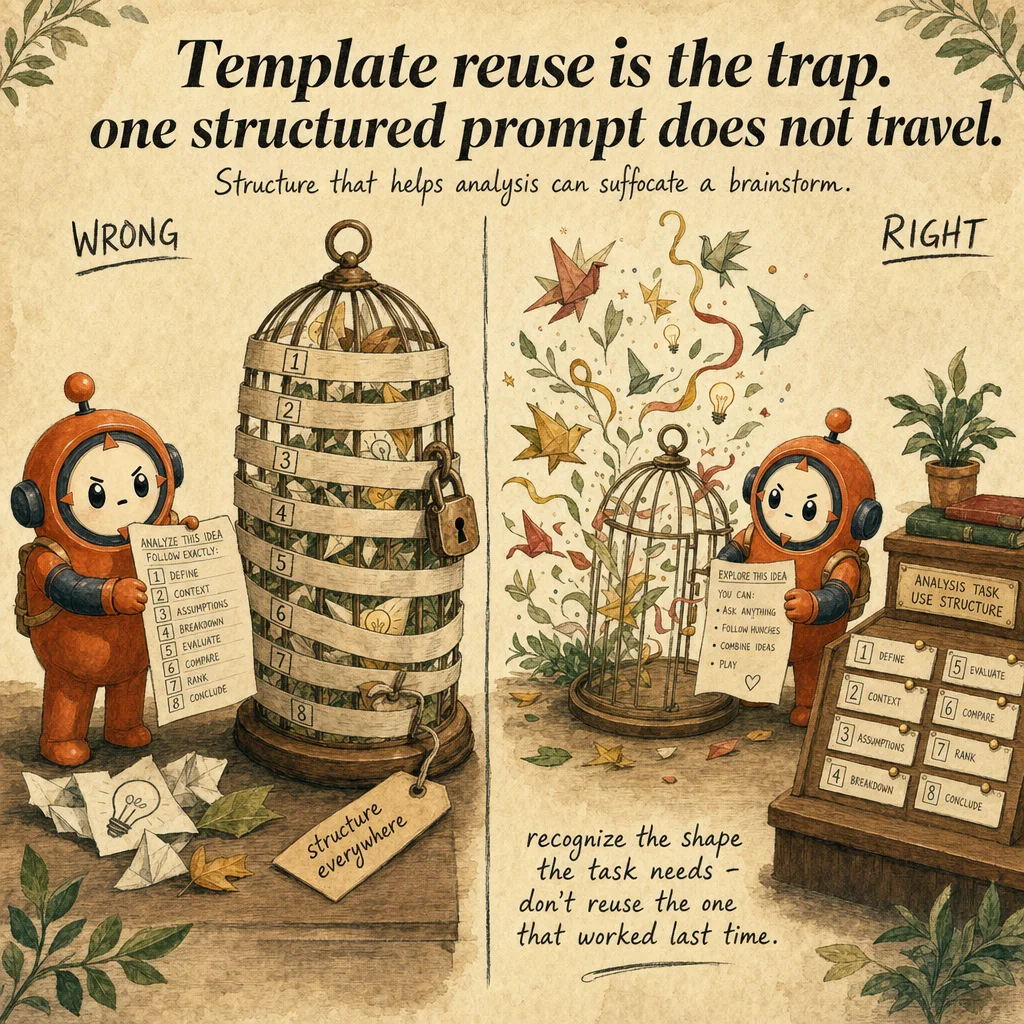
The failure mode is template reuse, not bad prompting. A well-crafted prompt built for one task type, structured steps for analysis, say, does not transfer cleanly to brainstorming, where that same structure suppresses the divergence the task needs. Recognizing which of the four shapes a request needs is itself the skill this objective tests, applying the underlying "clear and direct" principle is assumed baseline competence.
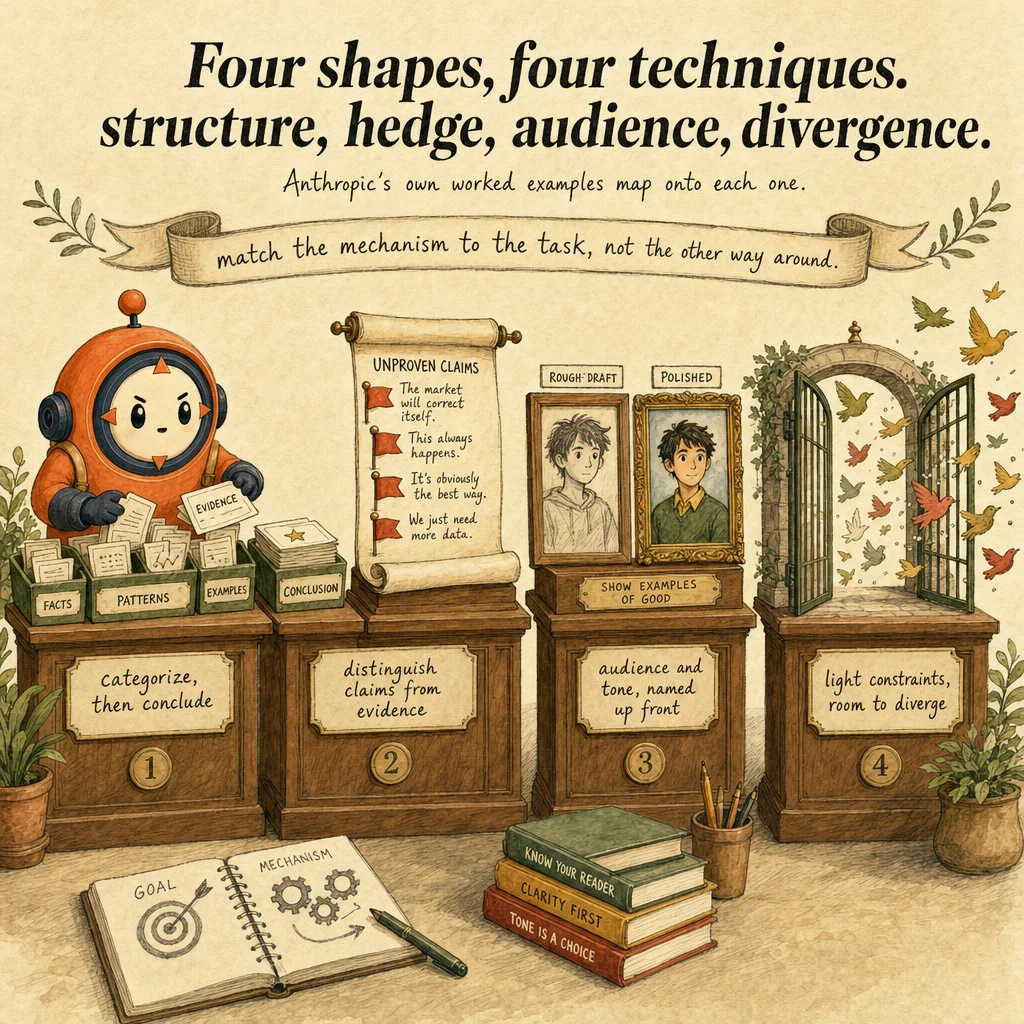
The trap is assuming one well-crafted prompt template generalizes across task types. The objective specifically tests whether a candidate recognizes that analysis, research, drafting, and brainstorming, the four types named in the exam objective itself, need different instruction shapes, structure-first, source-scoped, audience-first, and constraint-light respectively, not that "good prompting" is a single fixed recipe applied everywhere. A second, subtler trap: treating this structure-first/source-scoped/audience-first/constraint-light breakdown as an official Anthropic taxonomy rather than a practical mental model, Anthropic's published prompting guidance is task-agnostic at its base and doesn't itself codify these four categories as a named framework.
Where you'll see it
PM synthesizing customer interviews
Structures the analysis prompt to categorize themes across all 12 transcripts before asking Claude to synthesize, rather than accepting one open-ended pass.
PM brainstorming feature ideas
Explicitly asks for many divergent, lightly constrained options instead of reusing a structured analysis-style template that would collapse the option set early.
Side-by-side
| Task type | Prompting shape | What you must supply | Generic-template failure mode |
|---|---|---|---|
| Analysis | Structure before synthesis | Explicit steps: categorize the evidence, then compare or conclude | One confident synthesis skips categorization, hiding weak evidence |
| Research | Source-scoped and hedged | Instruction to distinguish claims from evidence and flag uncertainty | Unhedged claims read as fact even where the underlying sourcing is thin |
| Drafting | Audience-first | Named audience, tone, and a "show examples of good" reference | Fluent output that's right for the drafter and wrong for the actual reader |
| Brainstorming | Constraint-light, divergent | Explicit permission for many varied options, minimal early constraints | Early format or content constraints collapse the option set before divergence happens |
Question patterns
6 V2 questions wired to this concept. Tap an answer to check it instantly - you'll see whether it's right and why - then expand the full breakdown for the mental model and all four rationales.
A business analyst is drafting two prompts: one asking Claude to brainstorm ten new product names, another asking Claude to analyze customer churn drivers from a dataset summary. Should these use the same prompt structure?
Frequently asked
Showing 3 of 3 questions