

On this page
TLDR
Task decomposition is the up-front architectural choice between two regimes: fixed decomposition (subtasks known in advance, run as a sequential prompt chain) and dynamic decomposition (a lead LLM determines subtasks at runtime because they depend on what earlier steps discover). Reach for dynamic decomposition only when the subtask list genuinely cannot be predicted in advance - defaulting to it on a fixed-path task adds cost and unpredictability with no accuracy gain.
What you are deciding
Split a request by how its parts relate: independent parts run in parallel, sequential parts pass explicit handoffs, and tightly coupled reasoning stays in one request. Dependence alone does not forbid a split; hidden dependence does.
Are these parts independent, sequential with a clear handoff, or so coupled that splitting breaks the argument?
What it is
Task decomposition is the architectural step of breaking a complex request into ordered, delegable subtasks before an agent (or a chain of prompts) starts executing - the analysis happens up front, not as an emergent side effect of one giant prompt. Anthropic frames this as a choice along a spectrum: some tasks decompose cleanly into a fixed set known in advance (a workflow), while others require a dynamic decomposition that only an LLM orchestrator can determine at runtime, because the right subtasks depend on what earlier steps discover. The architect's job is picking which regime a given problem falls into, then applying the matching pattern, not defaulting to the more complex one.
In fixed decomposition, subtasks are pre-defined - but predictability and execution order are two separate questions. Predictable subtasks most often run as prompt chaining (a sequential workflow that trades a bit of latency for higher accuracy on each step, since each stage gets a focused prompt instead of one that has to do everything); the same predictability can just as validly run as parallelization/sectioning, where the pre-defined subtasks execute independently and simultaneously rather than one after another. "Fixed" describes whether the subtask list is knowable in advance, not whether it runs sequentially - that coupling is a common oversimplification. In dynamic decomposition (the orchestrator-workers pattern), a central LLM analyzes the unique task and determines the best subtasks to delegate to specialized worker LLMs at runtime - the subtask list is not known ahead of time, which is what separates it from parallelization or sectioning, where subtasks are pre-defined.
How each certification frames it
CCA-A: How CCA-A tests task decomposition
CCAOF-D1-O2Apply task decomposition techniques to structure complex requests
The Associate guide lists applying task decomposition techniques to structure complex requests (PDF page 4, Domain 1). The skill is judging where to split, not splitting everything.
Anthropic describes prompt chaining as decomposing a task into a sequence of steps with checks between them, and parallelization as running independent subtasks at once. Chaining works because each step receives the previous output explicitly, while hidden shared assumptions are what break a split.
How it works
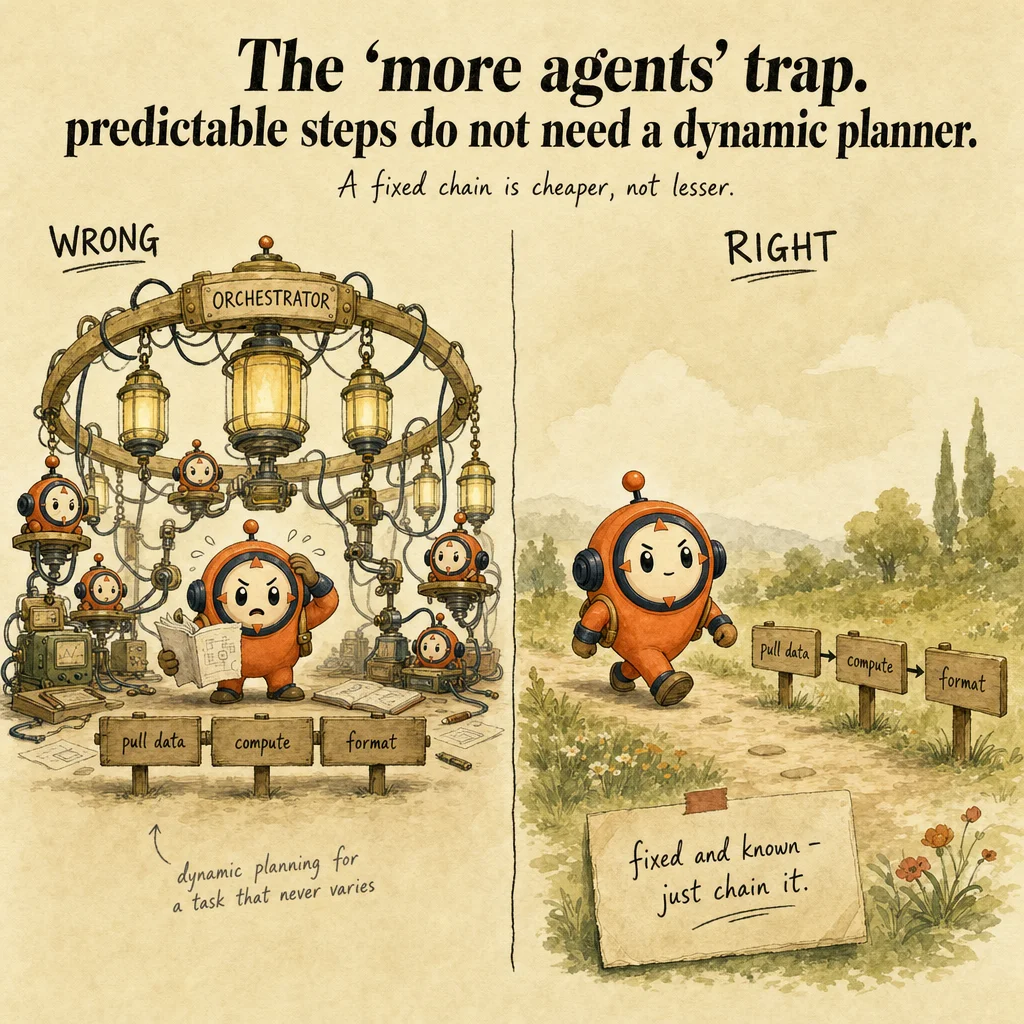
Start by classifying the regime. If a task can be easily and cleanly decomposed into fixed subtasks, hardcode it as a sequential prompt chain - it is cheaper, more predictable, and easier to debug than a dynamic system. Only escalate to orchestrator-workers when the subtasks genuinely cannot be enumerated in advance.
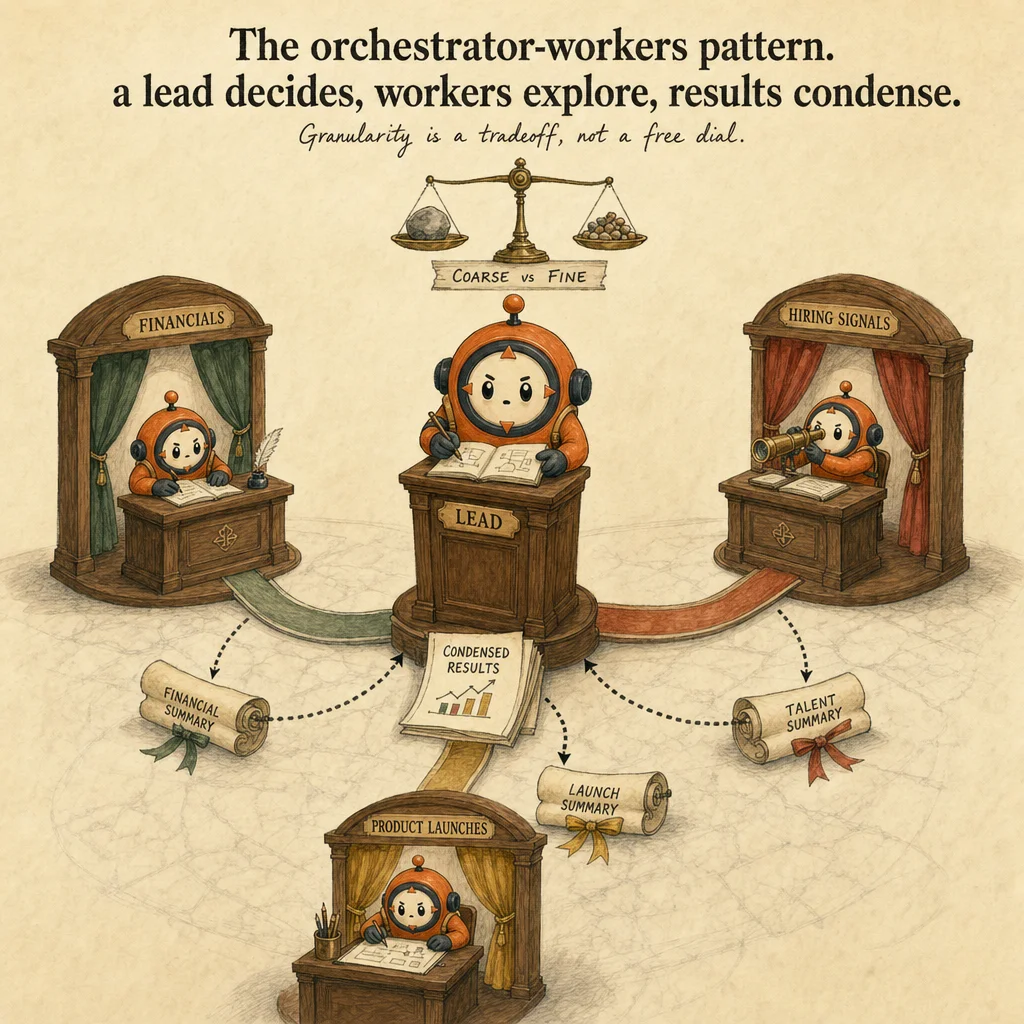
Dynamic decomposition puts the planning inside the loop. A lead LLM reads the query, decides which angles matter, and spins up parallel subagents, each with its own tools and an independent exploration trajectory, which minimizes overlap and path dependency between workers. Anthropic's production multi-agent Research system runs exactly this: the lead agent plans from the user query, decomposes it into parallel subagent tasks, and updates the decomposition based on intermediate findings rather than committing to a static plan.
Granularity is a real tradeoff, not a free dial. Coarser subtasks cut coordination overhead but risk one agent doing too much to verify cleanly; finer subtasks improve parallelism and auditability but raise the context-handoff cost between agents. Anthropic's guidance to start with the simplest workflow and escalate only when needed implicitly encodes this tradeoff - default to the coarsest split that stays independently verifiable.
Decomposition scales to long-running, human-off-the-loop work too. Anthropic's C-compiler experiment split one large goal (a Linux-capable C compiler) across 16 parallel Claude agents over roughly 2,000 sessions - at that scale, the harness has to structure the decomposition so agents can make progress in parallel without stepping on each other's work, not just split the task once and walk away.
A softer framing worth holding loosely. Decomposition is sometimes described as splitting by meaning or intent (semantic decomposition) rather than by string or token boundaries (lexical splitting). That framing captures the underlying orchestrator-workers idea well, but the exact phrase is not independently verified against a single citable Anthropic source, so treat it as a mental model rather than a quoted principle.
Decomposition also works as a single-prompt technique, not just a multi-call architecture (CCAOF-D1-O2). Everything above assumes decomposition happens across separate calls or agents - fixed prompt chaining or dynamic orchestrator-workers. At the prompting level, an architect or associate can ask Claude, inside one turn, to explicitly break a complex request into an ordered list of subtasks before acting on them - a numbered plan, or steps enumerated in XML tags - the same instinct as chain-of-thought prompting, applied to structuring the request itself rather than to reasoning about a single answer. This needs no orchestration infrastructure at all: it is a prompt-engineering move (structure the ask so Claude decomposes it explicitly) that sits underneath, and is compatible with, the fixed-vs-dynamic architectural choice - a single well-decomposed prompt can still be one step in a fixed chain, or one call inside a dynamic worker.
Worked example: three requests, three ways to split
Authored teaching example, not a bank question.
A manager has three requests: summarize five separate vendor proposals, turn the summaries into a recommendation memo, and decide whether to move a warehouse.
| Task | Pattern | Reason |
|---|---|---|
| Five vendor proposal summaries | Parallel | Each stands alone and can be checked alone |
| Recommendation memo from the summaries | Sequential | Needs the summaries, passed in as an explicit handoff |
| Warehouse move decision | Keep together | Cost, timing and location form one connected argument |
Parallel work is checked piece by piece, the chain passes its handoffs explicitly, and the coupled argument stays in one request. Check afterwards that combined outputs share the same format and assumptions.
How this decision goes wrong
Fragmentation
Looks right: Smaller prompts are always clearer.
Why it fails: Splitting a connected argument loses the links, and the pieces read well but do not fit together.
Instead: Split where parts are independent or hand off cleanly, and keep tightly coupled reasoning in one request.
Missing dependencies
Looks right: Cost, risk and timing can each be analysed separately.
Why it fails: Each part may assume different facts, such as a different location, so the results conflict.
Instead: List what each part depends on before splitting, pass an explicit handoff for needed outputs, and give every part the shared facts.
Merging incompatible outputs
Looks right: Joining the parts gives the full answer.
Why it fails: Parts produced separately may use different formats or assumptions that do not combine cleanly.
Instead: Fix the format and shared assumptions up front, and review the merged result as a whole.
Where you'll see it
Quarterly report generator
Fixed decomposition: pull data, compute metrics, format the doc, hardcoded as a prompt chain since the steps never vary.
Anthropic's multi-agent Research system
A lead agent decomposes a user query into parallel subagent tasks per research angle, updating the plan as intermediate findings come in, then condenses each subagent's output before returning it.
Decision tree
Can every subtask be enumerated in advance, independent of what earlier steps find?
Do the subtasks need independent, parallel exploration paths rather than a single sequential thread?
Is subtask granularity (coarse vs fine) a live design concern for this task?
Will the work run long enough, or across enough parallel agents, that they could collide on the same resources?
Once subtasks are confirmed fixed (predictable in advance), do they have data dependencies on each other's output?
Is this a single-turn prompting task rather than a multi-call architecture decision?
How each cert tests this
CCA-F
Domain 1, Task Statement 1.6 (Design task decomposition strategies for complex workflows): tests fixed (prompt chaining) vs dynamic (orchestrator-workers) regime selection at the architecture-pattern level, plus the granularity tradeoff between coordination cost and verifiability.
CCA-P
CCARP-D1-O5 (Apply decomposition techniques for complex problem solving): tests decomposition as part of end-to-end solution design, including how it composes with pattern selection (workflow vs agent) and multi-agent orchestration design in Domain 1, Solution Design & Architecture.
CCA-A
CCAOF-D1-O2 (Apply task decomposition techniques to structure complex requests): tests decomposition at the prompting level - breaking a complex request into an ordered set of prompts or sub-asks manually, without necessarily building agent infrastructure.
The exam trap
The trap is assuming decomposition always means "more agents." A cleanly decomposable task should be a fixed sequential workflow, which is cheaper, more predictable, and easier to debug than spinning up a dynamic orchestrator-workers system. Reach for dynamic, LLM-driven decomposition only when the subtasks genuinely cannot be predicted in advance.
Question patterns
CCA-A practice questions
2 approved CCA-A questions for this topic. Tap an answer to check it, then read the rationale for every option.
A strategy analyst splits a single cause-and-effect argument into a separate "list causes" call and a "list effects" call, then stitches them together. The combined logic no longer holds up. What does this illustrate about decomposition?
CCA-F practice questions
No approved public CCA-F sample question is published for this topic yet. The worked example above is an authored teaching example.
CCA-P practice questions
No approved public CCA-P sample question is published for this topic yet. The worked example above is an authored teaching example.
Frequently asked
Showing 6 of 6 questions
Sources and next steps
- Claude Certified Associate - Foundations Exam Guide v1.0 (July 2026), PDF page 4, section: Domains 1 and 2, detailed objectives. Checked 2026-10-16.
- Building effective agents (Anthropic engineering), section: Prompt chaining; Parallelization; Orchestrator-workers; Agents. Checked 2026-10-16.
- Prompting best practices (Claude API docs), section: Be clear and direct; Use examples effectively; Chain complex prompts; Overthinking and excessive thoroughness. Checked 2026-10-16.