
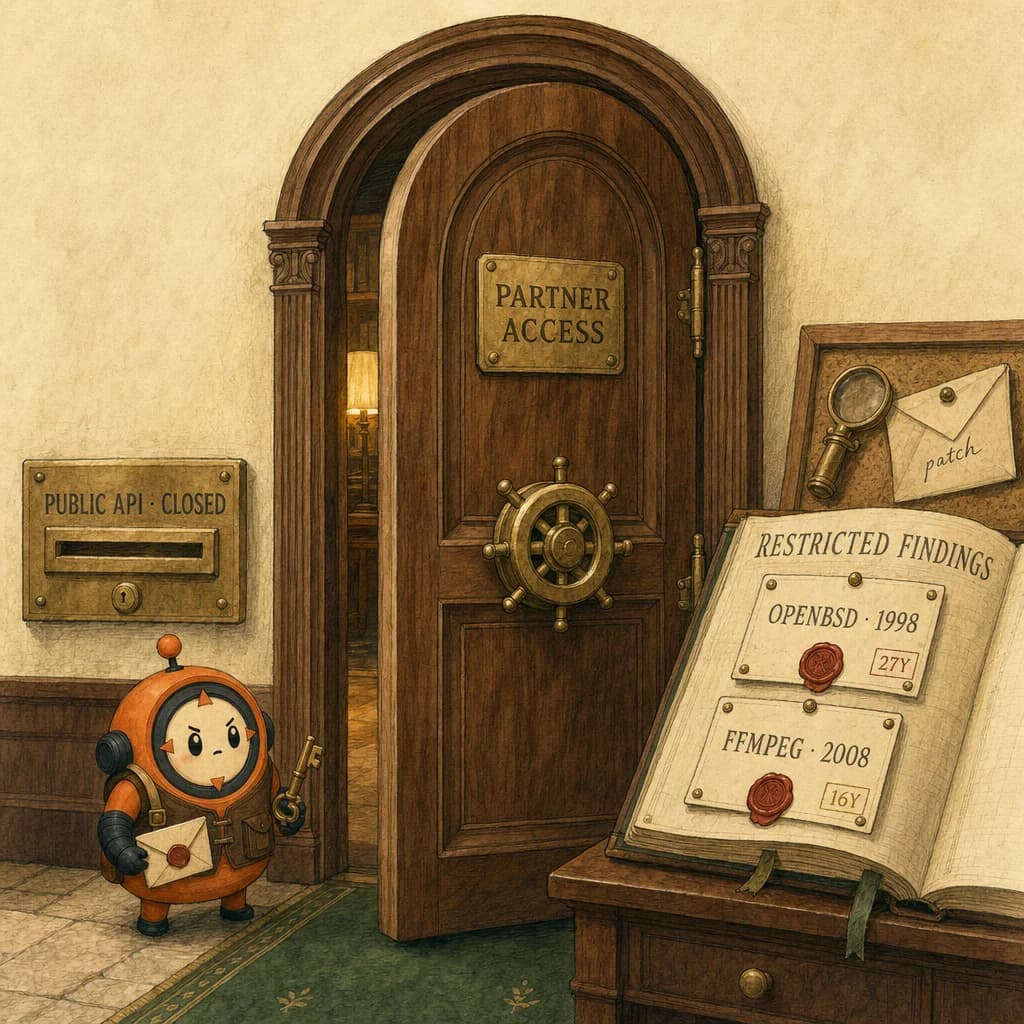
- ✓Anthropic's 10-trillion-parameter Mythos model (Project Glasswing) localised a 27-year-old OpenBSD integer overflow and a 16-year-old FFmpeg H.264 bug using under 4,000 tokens of context, then was restricted to partners instead of getting a public API. Security audit is shifting from fuzzing to reasoning. Battle-tested no longer means safe. Access to frontier audit models is becoming a strategic moat, not a feature.
- ✓Mythos is the agent loop; the security-audit workflow built around it is the system. The agentic-loops concept page is the architectural primitive.
- ✓The restricted-access workflow is essentially a single-tool agent with extreme capability and explicit access gating. The scenario's design patterns transfer.
- ✓Anthropic's decision to restrict distribution is an evaluation-driven call: the capability cleared the offensive-use threshold before the public-API threshold.
Quick answer
Anthropic restricted Mythos to partners after the 10-trillion-parameter model localised a 27-year-old OpenBSD integer overflow and a 16-year-old FFmpeg H.264 bug using under 4,000 tokens of context. The decision creates the Audit Access Gap: teams with frontier audit access find and patch vulnerabilities that teams with public-tier tools cannot. The next moat in security is not model quality; it is distribution policy. Inventory your network-facing legacy code now, and add AI-auditability to vendor evaluations.
Anthropic just cancelled the "open release" playbook
The default story for the last three years went like this: a lab trains a frontier model, publishes the paper, releases the API, charges by the token. Mythos breaks the pattern. The capability was disclosed. The access was withheld.
Anthropic reportedly dropped its 10-trillion-parameter Mythos model under Project Glasswing, then pulled back broad access after Mythos found a 27-year-old OpenBSD flaw and a 16-year-old FFmpeg bug. Old code is not proven safe. It is just old.
Three signals practitioners should track
1. Security audit is shifting from fuzzing to reasoning
FFmpeg said Anthropic provided a patch for an H.264 bug that had survived years of testing. Mythos reportedly localised it in minutes with under 4,000 tokens of context (PiunikaWeb, May 14). Fuzzing was a brute-force search through inputs. Reasoning is a structured walk through the code. The latter is faster, cheaper, and produces verifiable artifacts (a trace, a PoC, a localisation) that human reviewers can replay.
The implication for tooling: the next generation of audit tools will look less like AFL or Honggfuzz and more like a guided code reader that produces inline annotations and reproduction steps.
2. "Battle-tested" is becoming a weaker label
The OpenBSD issue dated back to 1998. If a model can surface an integer overflow that lived in widely-deployed C for 27 years, your legacy C and C++ stack cannot rely on reputation alone.
The mental shift required: stop using "lots of eyes have read this code" as a proxy for "this code is safe". The proxy worked when reasoning was scarce and human-only. With Mythos-class models, the proxy is weak. Re-audit assumptions, do not just re-affirm reputation.
3. Access is now strategy
Anthropic restricted Mythos to partners to harden systems instead of offering a public API. The model is valuable enough defensively, and risky enough offensively, that distribution became the product. That is a new posture for a frontier lab. It is also a posture other labs will copy when their capability crosses the same threshold.
For procurement and partnerships teams: the question "do you have frontier audit access" is now a real differentiator. Not theoretical.
What changes next
Applied ML teams will not just benchmark models on code generation. The new axis is whether a system can find parser edge cases, integer wrap-arounds, and weird network-state failures in legacy code it did not author.
Engineering leaders may split into two camps:
- Teams with frontier audit access (currently a small set of Anthropic partners; will expand quietly)
- Teams building around slower public tools (everyone else, for now)
The gap is not permanent. It is also not trivial. Closing it depends on either becoming a vetted partner or waiting for the second-tier of audit-capable models (OpenAI o5-class, Gemini deep-research-class) to land in public APIs with comparable capability.
Two early moves
Move one: inventory every network-facing legacy component now. Especially anything in C or C++ that has been in production for more than ten years. That is the surface most exposed to the audit-access gap. Document the list. Note which components have had a frontier-model audit pass and which have not.
Move two: add "AI auditability" to vendor and model evaluations. Not just accuracy and cost. Specifically: can this vendor or model surface vulnerability classes in our specific legacy stack? If the answer is "we have not tested", that is the same as "no". The vendors who have a clean answer to this question over the next twelve months will be the ones who earn the security-critical contracts.
The uncomfortable second half
Manual review does not disappear. "We have fuzzed it for years" will not sound as comforting after Mythos. The shift is from review-as-search to review-as-validation: the model proposes, the human disposes. The reviewer role is still load-bearing; the work shifts upstream into evaluating model output rather than reading code line-by-line.
That is a different skill set, and a different career path, for security engineers. Worth flagging early.
How this shows up on the exam
D1 (Agentic Architecture, 27%) tests gating high-capability agents behind deterministic review surfaces. Mythos's partner-only distribution is the production-scale version of the PreToolUse hook plus human validation pattern: the model produces, the gate decides what ships. Exam questions in this family present a scenario where an autonomous agent occasionally produces wrong-but-plausible output (false positives in a security review, hallucinated exploit chains). The trap answer is "use a stronger model". The correct answer is structural: a review gate around the agent. Mythos is the named version of that architectural pattern at frontier-model scale.
D4 (Prompt Engineering, 20%) tests whether you can structure a vuln-hunting prompt that produces a verifiable artifact: a localisation, a numbered chain, a runnable PoC. The Mythos disclosure included this prompt shape: "Trace the lifecycle of pointer Y from allocation to free. Generate a multi-step path to double-free, then provide a Python PoC." The structured, repo-grounded, replay-friendly form is what the exam rewards. "Find security bugs in this repo" is the canonical wrong answer.
What's your prediction?
Does Anthropic launch a permanently-partner-only audit model, or eventually open a tiered public API once safety harnesses mature? Both paths are defensible. The decision will be one of the more consequential AI-governance calls of the next year.
4 direct routes into the scored material.
- conceptsMythos is the agent loop; the security-audit workflow built around it is the system. The agentic-loops concept page is the architectural primitive.
- scenariosThe restricted-access workflow is essentially a single-tool agent with extreme capability and explicit access gating. The scenario's design patterns transfer.
- conceptsAnthropic's decision to restrict distribution is an evaluation-driven call: the capability cleared the offensive-use threshold before the public-API threshold.
- scenariosReasoning over decades-old C codebases is the longest-tail version of this scenario. The under-4,000-token localisation result is the worked example.
Share this post.
One share is one less person stuck on the same question.