

On this page
TLDR
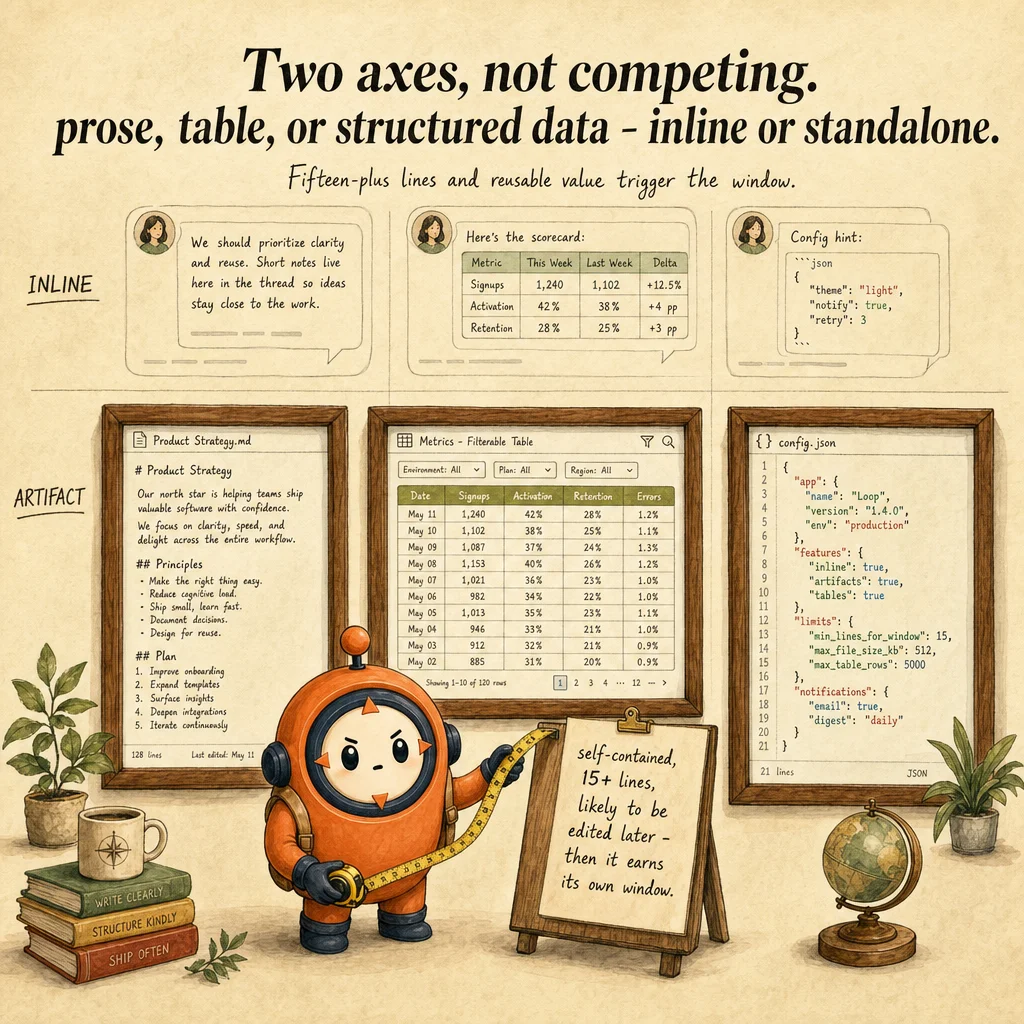
Choosing how a Claude response looks is really two independent decisions, not one three-way pick. Axis 1: delivery surface - does the response fold into the chat thread (inline) or open in a dedicated, standalone window (an Artifact)? Axis 2: representation - is the content prose, a table, or machine-parseable structured data like JSON? These axes are orthogonal: a table can render inline as a Markdown table or inside an Artifact as a spreadsheet-like document; a JSON block can sit inline in a code fence or be the content of an Artifact. Claude creates an Artifact when content is "significant and self-contained, typically over 15 lines" and something you're "likely to want to edit, iterate on, or reuse outside the conversation" - and it also requires the Code execution and file creation capability to be turned on, regardless of which representation the content uses.
What you are deciding
Choose the delivery surface separately from the representation. Inline suits a short, disposable answer, an Artifact suits substantial content you will edit, reuse or share, and structured data suits content another tool will read.
Where should this output live, and in what form, given how it will be used?
What it is
When Claude finishes a task, there are two separate decisions to get right, and the exam trap is treating them as one three-way choice. Delivery surface asks *where* the response lives: folded into the chat thread as inline text, or opened in a dedicated, standalone Artifact window separate from the conversation. Representation asks *what shape* the content takes: free-form prose, a table a human can scan, or structured data like JSON that a downstream system is meant to parse. These two questions are independent of each other - representation does not determine delivery surface, and delivery surface does not determine representation.
Concretely: a table can be delivered inline (a Markdown table in the chat reply) or as an Artifact (a larger, editable document); JSON is a representation choice, most often delivered inline in a code fence for a human to copy, or as the content of an Artifact when it's large enough to qualify. JSON is never itself a third "place" alongside inline and Artifact - it's a shape the content takes, the same way prose or a table is, and that shape can land on either delivery surface.
How each certification frames it
CCA-A: How CCA-A tests output formats
CCAOF-D2-O6Organize and curate information and select appropriate output formats (artifacts, inline, structured data)
The Associate guide lists selecting appropriate output formats: artifacts, inline and structured data (PDF page 4, Domain 2). Two decisions hide in each item: the surface where the output appears and the form it takes.
Anthropic's Help Center article describes Artifacts as substantial, self-contained content, typically over 15 lines, that you are likely to edit or reuse, and says they start private to you. Shorter, one-off or context-dependent answers stay in the conversation.
How it works
Delivery surface, axis 1: inline is the default for disposable answers. A one-off question, a single line of copy, or an explanation that fully answers the question with no expected follow-on editing belongs in the chat thread itself, regardless of whether it's prose, a small table, or a short JSON snippet. Wrapping it in an Artifact adds friction without adding reuse value.
Delivery surface, axis 1: Artifacts trigger on a specific, named set of criteria, not raw length or representation. Claude creates an Artifact when content "is significant and self-contained, typically over 15 lines," is something the user is "likely to want to edit, iterate on, or reuse outside the conversation," and "stands on its own without requiring extra conversation context." Common Artifact types include documents (Markdown/plain text, which can hold prose or tables), code snippets (which can hold JSON or other structured data), single-page HTML sites, SVG images, diagrams, and interactive React components - the Artifact is the window, not the content shape inside it. Artifacts also require Code execution and file creation to be enabled in Settings > Capabilities (individual) or Organization settings > Capabilities (Team/Enterprise); if that toggle is off, nothing becomes an Artifact no matter how it qualifies otherwise.
Representation, axis 2: prose vs table vs structured data is about who or what consumes the output next, not where it renders. Prose fits a human reading for understanding. A table fits a human scanning rows and columns of comparable data. Structured data, JSON, a defined schema, fits a machine: a script, an API caller, or another tool that needs to parse the output programmatically rather than read it. This choice is made independently of delivery surface - a JSON block that a script will consume can still be short enough to stay inline, and a long descriptive table meant purely for human reading can still qualify as an Artifact if it's substantial and reusable.
The two axes combine, they don't compete. A short JSON snippet for a script stays inline. A large, editable data table a team will revisit weekly becomes an Artifact, still represented as a table, not converted to prose. A one-off explanatory paragraph stays inline as prose. The representation answers "what shape," the delivery surface answers "where it lives" - conflating them into a single three-way pick (inline vs Artifact vs structured data) misses that a table or a JSON block can legitimately go either place.
Sharing scope differs by plan once something is an Artifact. Free and Pro users can publish and remix Artifacts with the broader community; Team plan users can share Artifacts inside Projects for secure, internal team collaboration instead. That distinction (public remix vs scoped team sharing) applies to the delivery-surface axis specifically, once content has already qualified as an Artifact.
Worked example: three requests, three choices
Authored teaching example, not a bank question.
A marketer makes three requests in one afternoon: the meaning of an acronym, an editable campaign brief, and a keyword list to import into an ad tool.
| Request | Surface | Representation | Why |
|---|---|---|---|
| What does ROAS mean | Inline | Short prose | Disposable answer |
| Campaign brief to revise | Artifact | Document | Substantial and reused |
| Keyword list for an ad tool | Inline or Artifact | Structured table | Another tool reads it |
Each output fits its use, with no formatting wasted on a disposable answer. Check afterwards that the brief can be edited and shared, and that the import file loads without cleanup.
How this decision goes wrong
Treating JSON as automatically an Artifact
Looks right: It is structured data, so it must go in an Artifact.
Why it fails: Representation is separate from surface. A small snippet can sit inline, while a long document is an Artifact whatever its content.
Instead: Decide the surface by size and reuse, and the representation by the destination.
Over-formatting a disposable answer
Looks right: Headings and a table make even a one-line answer look professional.
Why it fails: Formatting adds reading effort and noise for something that will be read once.
Instead: Use plain prose for short answers and reserve structure for content that benefits from it.
Overlooking intended reuse
Looks right: The draft is in the chat, so it can be found later.
Why it fails: A long output you will revise gets buried in the conversation and is hard to edit or share.
Instead: When you expect to iterate or share, ask for an Artifact at the start.
Where you'll see it
Campaign copy vs campaign dashboard
A single line of ad copy stays inline as disposable prose; a filterable, revisit-weekly campaign table qualifies as an Artifact, still represented as a table, because it's substantial, self-contained, and meant to be iterated on.
Handing numbers to another tool
When a colleague needs figures as JSON to import into a script, the representation is structured data, and the delivery surface depends on size: a short snippet stays inline, a large reusable dataset becomes an Artifact - the two decisions are made separately.
Side-by-side
| Representation (axis 2) | Can go inline (axis 1)? | Can go in an Artifact (axis 1)? | Who/what it's for |
|---|---|---|---|
| Prose | Yes - the default for a short, disposable explanation | Yes - a long-form document meant to be edited or referenced later | A human reader |
| Table | Yes - a small Markdown table in the chat reply | Yes - a larger, revisit-weekly data table as its own document | A human scanning comparable rows/columns |
| Structured data (JSON, schema) | Yes - a short snippet in a code fence for a script to copy | Yes - a substantial JSON/config artifact meant to be reused or edited | A machine or downstream system that parses it |
Decision tree
Axis 2 first - does a downstream system need to parse this output programmatically (spreadsheet import, another tool, an API)?
Axis 1 next - is the content substantial and self-contained (roughly 15+ lines) and something the user will likely edit, iterate on, or reuse outside this conversation?
Is "Code execution and file creation" enabled in Settings > Capabilities (or Org settings for Team/Enterprise)?
Does the output need to be shared beyond the requester - publicly remixed, or securely with a specific team?
The exam trap
The trap is collapsing two independent decisions into one three-way pick: inline vs Artifact vs structured data. They are not peers on one axis. Delivery surface (inline vs Artifact) decides *where* the response lives; representation (prose vs table vs structured data) decides *what shape* it takes; a table or a JSON block can legitimately go either place. A second, related trap: treating "longer output = Artifact" as the rule - the actual Artifact criteria are reusability, self-containment, and standalone value, independent of representation, and the Code execution and file creation capability must be explicitly turned on or nothing becomes an Artifact regardless of content length, shape, or quality.

Question patterns
CCA-A practice questions
6 approved CCA-A questions for this topic. Tap an answer to check it, then read the rationale for every option.
A marketing manager asks Claude for one line of ad copy for a single social post. What output format is most appropriate?
Frequently asked
Showing 6 of 6 questions
Sources and next steps
- Claude Certified Associate - Foundations Exam Guide v1.0 (July 2026), PDF page 4, section: Domains 1 and 2, detailed objectives. Checked 2026-10-16.
- What are artifacts and how do I use them? (Claude Help Center), section: When Claude creates an artifact; Sharing. Checked 2026-10-16.
CCA-A exam guide: Domain 2, Output Evaluation and Validation