

On this page
TLDR
Hallucination is Anthropic's own term for Claude generating text that's factually incorrect or inconsistent with the material it was given, and it's a known limitation, not a rare bug: "users should not rely on Claude as a singular source of truth" and should scrutinize high-stakes output carefully. Fluent, authoritative-sounding text is not evidence of accuracy, hallucinated content often looks correct.
What you are deciding
Errors in AI output are found by checking specific claims against an original source, not by judging how confident the text sounds. Verify names, figures, dates and citations first, record what you found, then revise or escalate.
Which specific claims need independent verification, and what do I do when a check fails?
What it is
"Hallucination" is Anthropic's own term for Claude generating text that is factually incorrect or inconsistent with the material it was given, for example, a quote that sounds authoritative but isn't actually grounded in the source document. Anthropic frames this as a known limitation of frontier generative AI, not a rare bug: models can be confidently wrong, especially on current events or niche subject areas outside recent training. Anthropic's own design goal for Claude is HHH, Helpful, Honest, Harmless, where "honest" specifically means giving accurate information, not confabulating, and acknowledging limitations when appropriate.
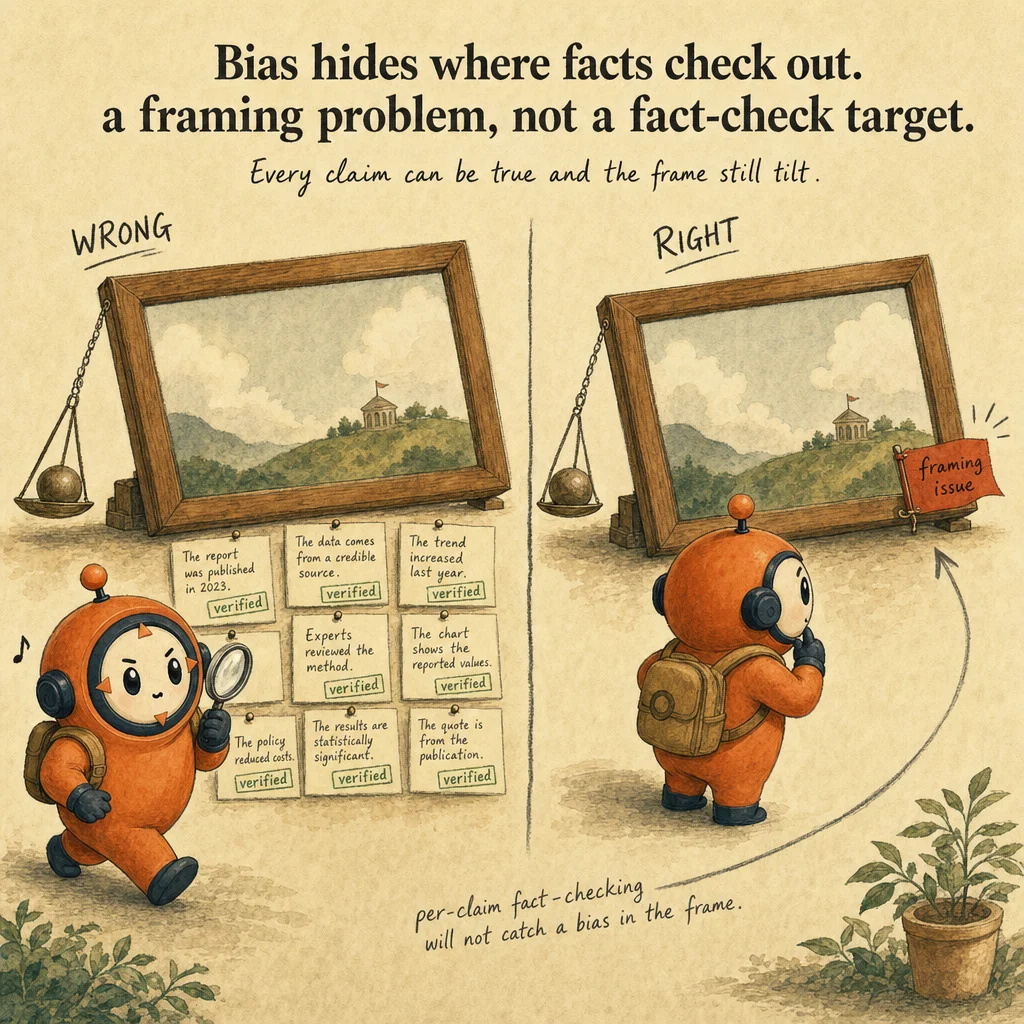
Inconsistency and bias are related but distinct failure categories a business user should check for alongside hallucination. Inconsistency shows up as the same prompt producing materially different answers across repeated runs, or a response contradicting itself internally, this is directly covered by Anthropic's documented mitigation techniques below. Bias, by contrast, shows up as an output that leans toward one framing, assumption, or perspective, particularly on ambiguous or judgment-based questions, without acknowledging that another framing exists, kept here at a general, definitional level since Anthropic's own hallucination-reduction sources don't prescribe a specific bias-detection technique. The fuller governance and fairness treatment of bias lives on a dedicated page (see Study Next). All three categories share the same practical implication: never treat a Claude response as a single source of truth, and scrutinize high-stakes outputs, financial figures, legal claims, compliance statements, before acting on them.
How each certification frames it
CCA-A: How CCA-A tests error identification and validation
CCAOF-D2-O2Identify hallucinations, inconsistencies, and biases in responsesCCAOF-D2-O3Apply fact-checking and validation techniquesCCAOF-D2-O4Determine when human review or additional verification is required
The Associate guide lists identifying hallucinations, inconsistencies and biases, applying fact-checking and validation techniques, and determining when human review or further verification is required (PDF page 4, Domain 2).
The decision to test is both what to check and when checking is not enough on its own. High-stakes or unsupported claims go to a person who can judge them.
How it works
Anthropic's own mitigation techniques give a reviewer six concrete moves. (1) explicitly permit Claude to say "I don't know" rather than guess; (2) for long documents, have Claude extract direct quotes before analyzing, so claims are grounded in actual text; (3) ask Claude to cite a supporting quote for every claim and retract claims it can't support; (4) chain-of-thought verification, have Claude explain its reasoning before the final answer, to surface faulty logic; (5) best-of-N, run the same prompt multiple times and compare outputs, since inconsistency across runs signals a likely hallucination; (6) restrict Claude to only the provided documents rather than its general knowledge. These significantly reduce hallucinations but do not eliminate them, validation is always still required for high-stakes decisions.
When Claude uses web search, review the cited sources yourself. Anthropic recommends checking the original source pages directly rather than trusting the summary alone, the source page may contain context Claude's summary dropped, and overall response quality depends on the underlying sources referenced.
Inconsistency across repeated runs is itself a detection technique, not just a symptom. Because a single output can look plausible in isolation, running the identical prompt again and comparing, best-of-N, surfaces disagreement that one run alone would hide. Materially different answers to the same question is a signal to dig deeper, not a coin flip to resolve by picking the most recent run.
Bias is a framing problem, and it needs a different check than a factual one. Unlike a hallucinated fact, a biased response can have every individual claim check out while still consistently favoring one stakeholder's perspective or one set of assumptions on an ambiguous question, so per-claim fact-checking alone will not surface it. Anthropic's own hallucination-reduction guidance does not prescribe a specific bias-detection technique the way it does for hallucination (quote-grounding, best-of-N, and the rest), so treat bias at this general, definitional level here: recognize that it exists as a distinct failure category from hallucination and inconsistency, and route it to the deeper, dedicated treatment of bias, fairness, and governance on the ethical-ai-considerations page rather than applying an unsourced ad hoc method as if it were a documented Anthropic technique.
Surface plausibility is not evidence of accuracy. Anthropic's own guidance stresses that hallucinated content often "looks correct" and can include convincing, authoritative-sounding fake quotes. The exam-relevant behavior isn't spotting the obviously wrong answer, it's applying a consistent verification habit, quote-grounding, source review, permission to say "I don't know", to every output, especially the ones that read fluently and confidently.

Worked example: verifying a cited report in a market summary
Authored teaching example, not a bank question.
Claude drafted a market summary that states: 'According to the 2024 Regional Logistics Index, last-mile costs rose notably.' You cannot tell from the text whether that report exists.
The unsupported citation is gone, the record shows what was checked, and the revised draft cites only verified material. Anthropic notes these techniques reduce hallucinations but do not eliminate them, so critical information is still validated.
How this decision goes wrong
Treating model confidence as evidence
Looks right: The statement is specific and sounds certain, so it is probably right.
Why it fails: Fluent, specific text can still be invented. Tone carries no information about whether a source exists.
Instead: Verify specifics at an original source regardless of how they are phrased.
Asking the same model to certify an unsupported answer
Looks right: Ask Claude 'are you sure?' and accept the reassurance.
Why it fails: With no source in front of it, the model can repeat the same invented detail. Anthropic's guidance uses quote-backed verification against documents you provide, and says a claim without a supporting quote should be retracted.
Instead: Verify against a real document, or give Claude the document and require supporting quotes.
Where you'll see it
Vendor contract termination clauses
Rather than accepting a single-pass summary, the reviewer asks Claude to first pull direct quotes for each clause, then checks that every summarized point traces back to an actual quoted sentence.
Web-search-backed research answer
Reviews the original cited source pages directly rather than trusting Claude's summary alone, since the summary may drop context present in the source.
Side-by-side
| Error type | What it looks like | How to catch it |
|---|---|---|
| Hallucination | A fact, quote, or citation that sounds authoritative but isn't grounded in the source or reality | Ask for a supporting quote per claim; retract any claim that can't produce one |
| Inconsistency | The same prompt produces materially different answers across runs, or the answer contradicts itself internally | Best-of-N: run the same prompt multiple times and compare; divergence signals an unreliable claim |
| Bias | A response consistently leans toward one framing or assumption without acknowledging an alternative, especially on ambiguous questions | Recognize it as a distinct, framing-level failure category, not a per-claim fact-check target; see ethical-ai-considerations for the fuller detection and governance treatment |
The exam trap
The trap is assuming hallucination is a rare failure that only shows up as an obviously wrong fact. Anthropic's guidance stresses the opposite: hallucinated content often looks correct and can include convincing, authoritative-sounding fake quotes, so surface plausibility is not evidence of accuracy. The exam-relevant behavior is applying a consistent verification habit to every output, not scanning for the obviously wrong answer. A second trap specific to bias: treating it as just another fact to spot-check. Bias is a framing-level problem that can coexist with a response where every individual claim is accurate, so it needs a different, more general kind of scrutiny than hallucination does, not a documented step-by-step technique.
Question patterns
CCA-A practice questions
6 approved CCA-A questions for this topic. Tap an answer to check it, then read the rationale for every option.
Claude summarizes a 40-page vendor contract and lists payment milestones. Which check best captures both accuracy and completeness before the team acts on it?
Frequently asked
Showing 5 of 5 questions
ethical-ai-considerations for the deeper fairness and governance treatment.Sources and next steps
- Claude Certified Associate - Foundations Exam Guide v1.0 (July 2026), PDF page 4, section: Domain 2: Output Evaluation and Validation, detailed objectives. Checked 2026-10-16.
- Reduce hallucinations (Claude API docs), section: Basic hallucination minimization strategies; closing note. Checked 2026-10-16.
CCA-A exam guide: Domain 2, Output Evaluation and Validation