

On this page
TLDR
Ethical AI for an architect is not a vendor guarantee, it is three published artifacts to consult: Claude's Constitution (intended values, the training-time "final authority"), per-model System Cards (disclosed bias and safety evaluation results), and the Transparency Hub (aggregated Model Reports plus voluntary commitments). Anthropic states plainly the model will not always live up to the Constitution's ideals and commits to disclosing the gap, so the architect's job is reading those disclosures and layering application-level fairness and transparency controls, not assuming compliance is inherited.
What you are deciding
Ethical use is a set of checks you run on your own use case: whether outputs treat people unequally, whether judgments rest on evidence, whether people are told AI was involved, and who is accountable. Vendor safeguards do not replace these checks.
What bias, transparency and accountability checks does this use case need, and who owns them?
What it is
For an architect, ethical AI is not a philosophy exercise but a set of concrete, published artifacts to consult and design around: Anthropic's Constitution (the values document shaping model training), per-model System Cards (bias and safety evaluation results), and the Transparency Hub (aggregated model reports and voluntary commitments). Anthropic is explicit that the model will not always live up to the Constitution's ideals, and commits to disclosing gaps via system cards rather than claiming perfection.
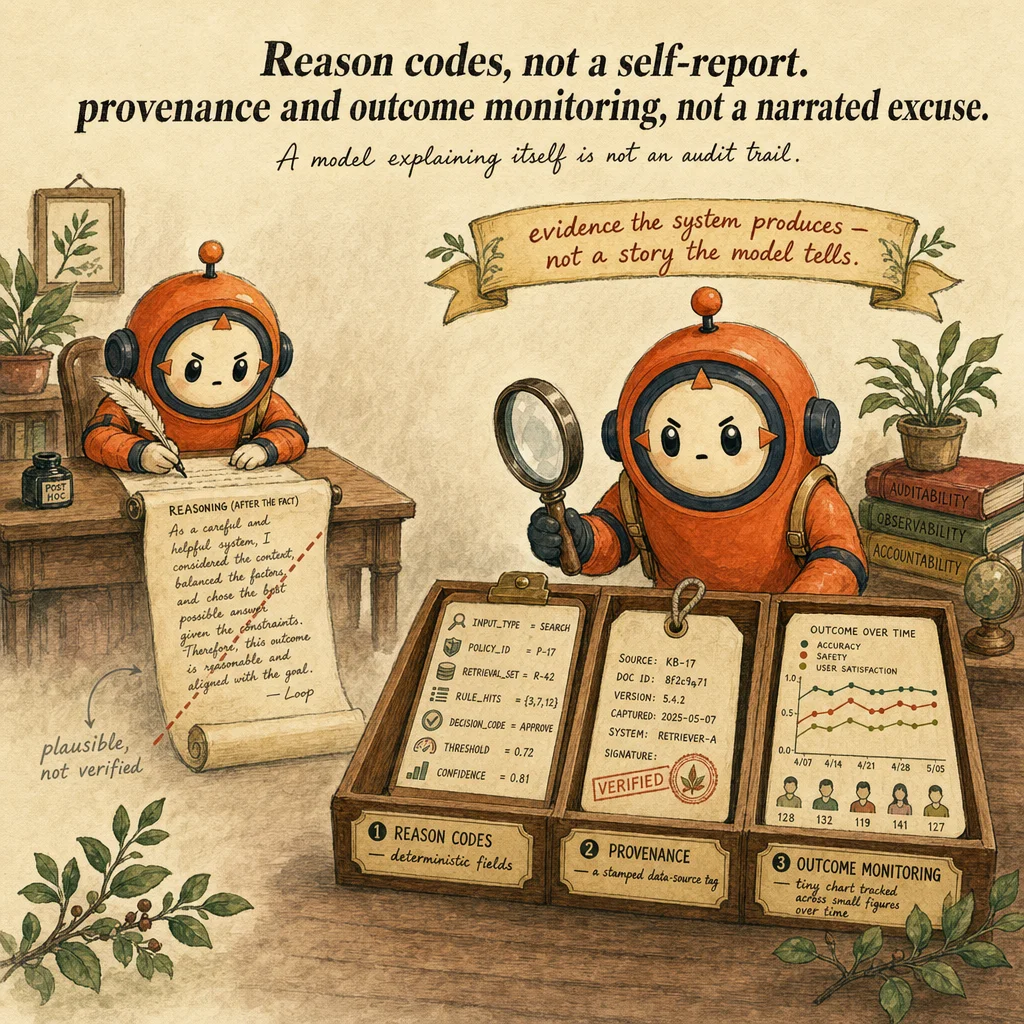
That disclosure commitment means an architect's job includes reading those disclosed gaps for the specific model in use, not assuming ethical behavior is guaranteed by the vendor. Bias, fairness, and transparency are three related but separate concerns: bias and fairness are evaluated properties of model behavior an architect checks per model version, while transparency is partly a vendor disclosure practice and partly a design requirement on the system the architect builds - and that design requirement means auditable evidence (reason codes, input provenance, outcome monitoring), not a model-generated explanation treated as if it were ground truth.
How each certification frames it
CCA-A: How CCA-A tests ethical use
CCAOF-D6-O4Understand the ethical implications of AI usage
The Associate guide lists understanding the ethical implications of AI usage (PDF page 5, Domain 6). Items describe a use case and ask which check is missing: bias, unsupported claims, disclosure or accountability.
Claude's Constitution states a high bar for honesty and lists equal and fair treatment among the values Claude weighs. It also says operators who accept Anthropic's usage policies take on responsibility for appropriate use on their platforms, so the deploying organization still owns its checks.
How it works
The Constitution states intent, at training time. Claude's Constitution is Anthropic's detailed description of intended values and behavior, playing "a crucial role in our training process" and serving as "the final authority" on Claude's intended character. It is written with Claude itself as the primary audience, prioritizing precision over human readability, so it reads as a reference document rather than a runtime enforcement mechanism an architect can point to as a technical control.
Anthropic commits to disclosing divergence, not hiding it. Anthropic explicitly states it will be open about the gap between the Constitution's ideals and actual model behavior, disclosed via system cards, because "transparency about those intentions is important regardless." That framing is the load-bearing fact for an architect: the Constitution is not a claim of perfection, it is a stated target the disclosures are measured against.
The Transparency Hub is the aggregation layer. It publishes a Model Report per released model, covering capabilities, safety evaluations, and deployment safeguards, plus sections on System Trust & Reporting and Voluntary Commitments, condensing technical assessments into accessible summaries. This is the right stop for comparing safety posture across releases rather than digging through every individual System Card from scratch.
Bias evaluation has a documented, comparative history. Anthropic's Claude 2 model card includes explicit findings that "models trained purely to be helpful are much more biased than Claude," treating bias mitigation as a measurable, comparable evaluation axis, not an assumed property. Fairness and bias findings trace back to Anthropic's published safety research lineage, RLHF, preference modeling, red-teaming, and work on measuring representation of subjective global values, cited as the technical basis for those evaluations.
Per-model System Cards are the versioned, citable artifact. The System Card for Claude Opus 4 and Sonnet 4 (May 2025) documents pre-deployment safety testing under the Responsible Scaling Policy, evaluations of reward-hacking behavior, and, for the first time in that release, a detailed alignment assessment. That gives an architect a concrete artifact to check for the exact model version in production, rather than a general vendor claim that applies to "Claude" as a whole.
Application-level transparency is built from auditable evidence, not from asking the model to narrate itself. A model-generated "explain your reasoning" output is not a reliable audit trail - it's a further generation from the same model, prone to plausible-sounding post-hoc rationalization that may not reflect what actually drove the output, so it cannot serve as ground truth for a bias review. What an architect actually needs to design in: reason codes tied to the deterministic or rule-based factors that fed the decision (which fields, thresholds, or retrieved records were involved), provenance of the inputs the decision was based on (what data was retrieved, from where, as of when), and outcome monitoring - tracking decisions and their downstream results across demographic groups over time to catch disparate impact empirically, independent of any explanation the model provides. Transparency, in this sense, is evidence the system produces about itself as a side effect of how it's built, not a text field the model fills in on request.
Worked example: an applicant-summary workflow
Authored teaching example, not a bank question.
A fictional company uses Claude to summarize job applications for hiring managers. The team reviews the workflow before launch.
| Check | What to look at | Owner |
|---|---|---|
| Unequal omissions | Same facts, different applicants, compare summaries | Workflow designer |
| Unsupported judgments | Statements with no source text | Reviewing manager |
| Disclosure | Who is told AI was involved | Process owner |
| Accountability | Who decides and checks sources | Named hiring manager |
The workflow has defined checks and an accountable person. Check afterwards that the comparison was repeated on new applications and that flagged statements led to a change in the prompt or process.
How this decision goes wrong
Assuming vendor safeguards are sufficient
Looks right: The model was built with safety in mind, so the use case is covered.
Why it fails: The deploying organization chooses the use case, inputs and decisions. Anthropic's Constitution says operators take on responsibility for appropriate use on their platforms.
Instead: Run your own checks for bias, support and disclosure.
Assuming fluent output is fair
Looks right: The summaries read well and sound balanced.
Why it fails: Tone says nothing about what was omitted or whether different applicants were treated alike.
Instead: Compare outputs for matched inputs and check claims against the source.
No accountable reviewer
Looks right: Claude's summary is the record, so no one needs to own it.
Why it fails: When a decision is challenged, nobody can explain or correct it.
Instead: Name a person who decides, reads sources and answers for the outcome.
Where you'll see it
Hiring-screening assistant
Pull the current model's System Card, check what bias and fairness evaluations were run and what limitations were disclosed, and layer application-level fairness checks, for example demographic-parity monitoring on outputs, on top.
Regulated model-version sign-off
Before promoting a new Claude model version into a compliance-sensitive pipeline, pull that release's System Card to confirm what bias and safety evaluations ran and what limitations were disclosed, rather than assuming parity with the prior version.
Side-by-side
| Artifact | What it covers | When an architect consults it | Update cadence |
|---|---|---|---|
| Claude's Constitution | Intended values and character; the training-time "final authority" | Understanding the stated baseline before evaluating where behavior diverges | Static, revised on major updates |
| System Card (per model) | Pre-deployment safety testing under the RSP, bias and reward-hacking evaluations, alignment assessment | Before deploying a specific model version into a bias-sensitive workflow | Versioned, one per model release |
| Transparency Hub | Aggregated Model Reports, System Trust & Reporting, Voluntary Commitments | Comparing safety posture across released models or citing a vendor-level commitment | Updated on an ongoing basis |
How each cert tests this
CCA-P
CCARP-D5-O5 (Governance, Safety & Risk, 14%): tests knowing which published artifact, Constitution, System Card, or Transparency Hub, answers a given ethics question, and designing application-level fairness and transparency controls that assume divergence from stated ideals rather than perfection.
CCA-A
CCAOF-D6-O4 (Governance, Risk & Responsible Use, 15%): tests understanding the ethical implications of AI usage at the business-user level, recognizing that a vendor's stated values do not guarantee bias-free output for a specific use case, without necessarily designing the mitigation architecture.
The exam trap
The trap is treating "ethical AI" as a vendor-side guarantee that requires no architect action. Anthropic's own published stance is the opposite: the Constitution states intent, system cards disclose where behavior diverges from that intent, and the architect is expected to consult those per-model disclosures and add application-level fairness and transparency controls rather than assume compliance is inherited automatically from using Claude.

Question patterns
CCA-A practice questions
3 approved CCA-A questions for this topic. Tap an answer to check it, then read the rationale for every option.
A hiring team uses Claude to draft a first-pass ranking of resumes against a job description, then has a human recruiter review every ranking before any candidate is rejected. Is this sufficient to address the ethical and bias considerations of this use case?
CCA-P practice questions
3 approved CCA-P questions for this topic. Tap an answer to check it, then read the rationale for every option.
A publisher uses an LLM to produce short factual explainers. Which practice most directly supports transparency to readers?
Frequently asked
Showing 5 of 5 questions
Sources and next steps
- Claude Certified Associate - Foundations Exam Guide v1.0 (July 2026), PDF page 5, section: Domains 3 to 7, detailed objectives. Checked 2026-10-16.
- Claude's Constitution (Anthropic), section: Honesty; Avoiding harm: fair treatment; Operators and usage policies. Checked 2026-10-16.
CCA-A exam guide: Domain 6, Governance, Risk, and Responsible Use