

TLDR
A multi-pass review architecture runs more than one independent Claude pass over the same artifact and reconciles the results, instead of trusting a single evaluation - it covers two related patterns: the evaluator-optimizer loop (generate, then a separate evaluator critiques, repeat) and fleet-style parallel review (many independent reviewer instances, each verifying its own findings, reconciled before a human sees them). Reconciliation happens by independently reproducing and verifying each finding, not by majority vote.
What it is
A multi-pass (or multi-instance) review architecture runs more than one independent Claude pass over the same artifact, code, a plan, a generated output, and reconciles the results, rather than trusting a single evaluation. This spans two related but distinct patterns: the evaluator-optimizer workflow (a generator LLM and a separate evaluator LLM loop until a quality bar is met) and fleet-style parallel review (many independent reviewer instances explore the same change in parallel, each verifying its own findings, aggregated and ranked before a human sees them).
Anthropic runs this pattern in production on its own pull requests via Code Review (and its deeper ultrareview mode), not as a research demo, but as a default review layer on Anthropic's own codebase. The two patterns solve different problems: evaluator-optimizer improves a single generated artifact against explicit criteria through iteration; fleet review increases confidence in a judgment (did this diff introduce a bug) by decorrelating the reviewers.
How it works
Evaluator-optimizer is a two-role loop. One LLM call generates a response while another provides evaluation and feedback, iterating until the bar is met. It is the right fit when there are clear evaluation criteria and iterative refinement demonstrably improves the result - both when a human could articulate useful feedback and when the LLM can generate that same feedback itself.
Structurally, multi-pass review runs the same task many times, which is the shape of parallelization's "voting" variant (Anthropic's workflow taxonomy contrasts it with sectioning, which splits one task into independent parallel subtasks). That shape is not the same thing as the reconciliation mechanism: Anthropic's canonical description of voting aggregates redundant attempts for higher-confidence output, which reads as consensus/majority-style aggregation - but that generic description is not how production multi-pass review architectures actually resolve disagreement, see below.
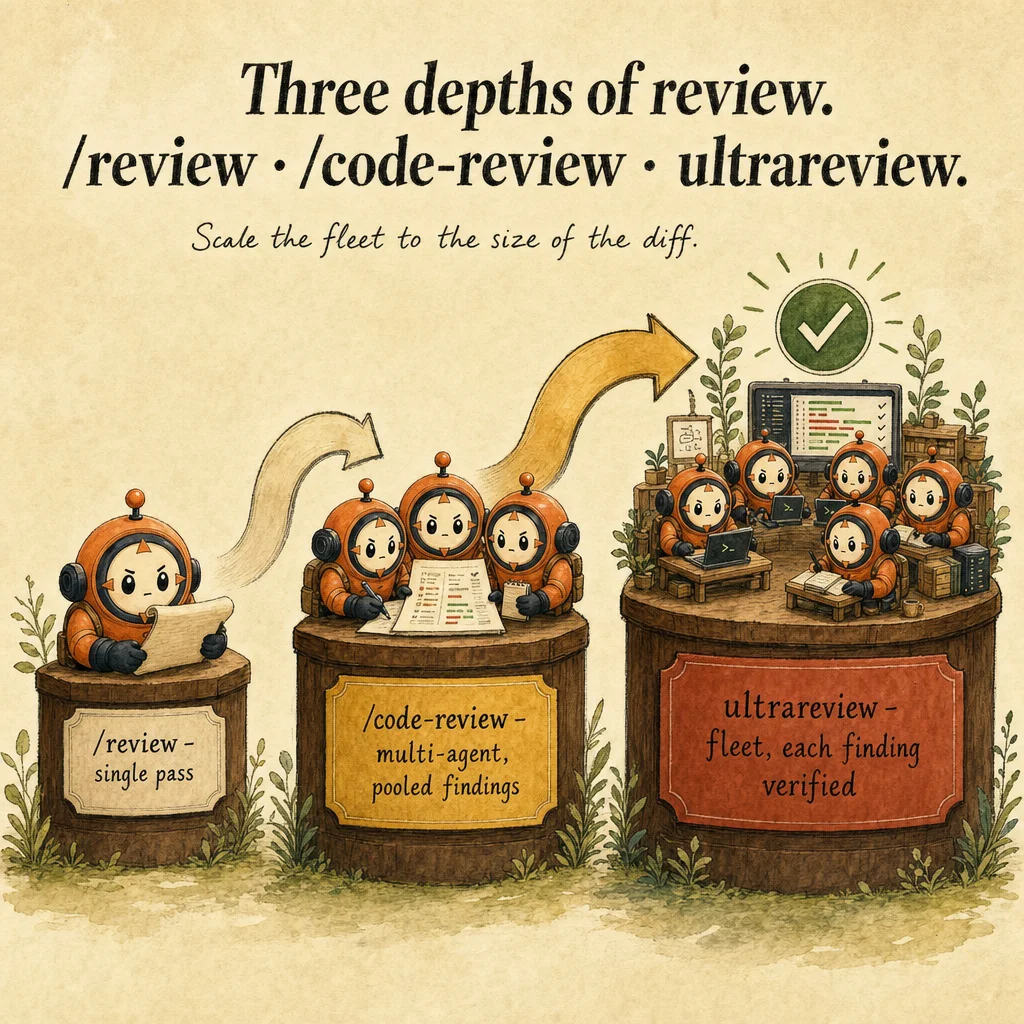
Claude Code's review stack has three depths. /review is a fast, single-pass, read-only PR review. /code-review (or /code-review <pr#>) runs a multi-agent review of a diff and can apply fixes with --fix. /code-review ultra (alias /ultrareview) launches a fleet of reviewer agents in a remote sandbox, where every reported finding is independently reproduced and verified before it ever surfaces, prioritizing real bugs over style nitpicks.
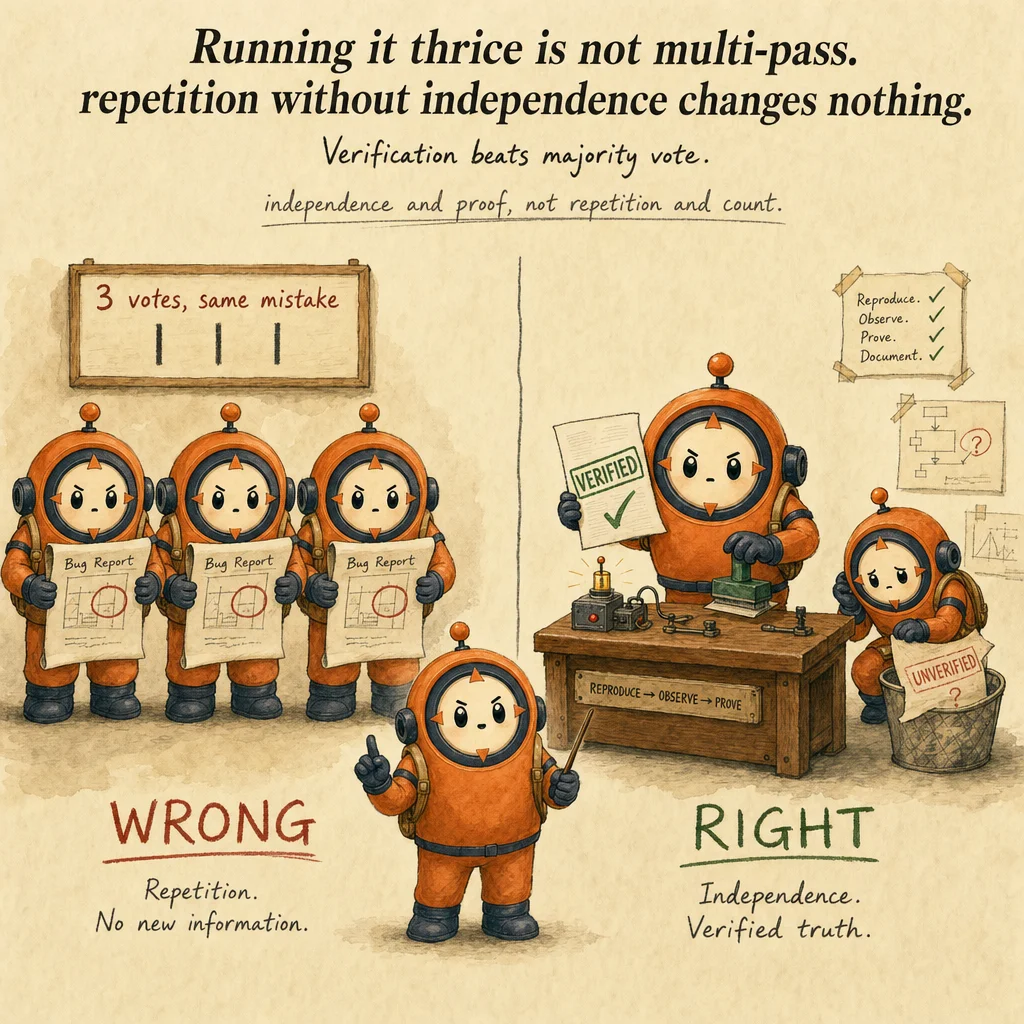
Reconciliation is verification, not majority-vote aggregation. Rather than resolving disagreement across passes by counting votes or taking a consensus, Anthropic's production design has each finding independently reproduced and verified before it is reported - a finding stands or falls on proof, regardless of how many passes did or didn't flag it. Internally this raised the share of PRs receiving substantive review comments from 16% to 54%; on PRs over 1,000 lines, 84% get findings (avg. 7.5) versus 31% on small PRs (avg. 0.5); fewer than 1% of findings are marked incorrect by engineers. It does not auto-approve, merge stays a human call.
The pattern generalizes past code review. The same "many independent parallel agents, condense and reconcile before reporting up" shape appears in Anthropic's multi-agent Research system (subagents explore independently, compress findings for a lead) and in the C-compiler project, where automated tests served as the ground-truth reconciliation mechanism across parallel agents' work.
The trap is conflating "run it twice" with "multi-pass review." A true multi-pass architecture needs (a) independence between passes so errors are not correlated, and (b) an explicit reconciliation step (verification-before-reporting, or an evaluator feedback loop), not just re-running the same prompt and hoping for a better answer. A second trap: assuming more agents is always better and cheaper - Code Review scales agent count and depth with PR size and complexity precisely because fleet review on a trivial change wastes cost without improving signal.
Where you'll see it
Anthropic's own PR review (dogfooding)
Code Review dispatches a team of agents per PR, verifies each finding before surfacing it, and raised substantive-comment coverage from 16% to 54% internally.
Iterative report or content generation
An evaluator-optimizer loop checks a drafted report against a fixed rubric and feeds back critique until the quality bar is met, before a human ever sees it.
Side-by-side
| Pattern | Mechanism | Reconciliation | Best for |
|---|---|---|---|
| /review | Single-pass, read-only PR review | None - one opinion | Small or trivial diffs, a fast check |
| /code-review | Multi-agent review of a diff, can --fix | Multiple agents on one diff, findings pooled | Everyday PRs that need substantive review |
| /code-review ultra (ultrareview) | Fleet of reviewer agents in a remote sandbox | Each finding independently reproduced and verified before surfacing | Large or security-sensitive changes (auth, encryption keys) |
| Evaluator-optimizer | Generator LLM + separate evaluator LLM loop | Evaluator feedback loop until a quality bar is met | Iterative content generation against a rubric, not diff review |
Question patterns
A one-line typo-fix PR triggers `/code-review ultra` by default. What is wrong with this default?
"ultra review is always the safest default" - it wastes cost without improving signal on a change this small; /review (fast single-pass) is the right fit.A generated compliance report needs to hit a fixed rubric before delivery, and no diff or PR is involved. Which pattern fits, not fleet code review?
"spin up N parallel reviewer instances and vote" - that is the wrong pattern outside a diff-review context and has no explicit rubric-checking loop.Two independent reviewer instances flag conflicting severities for the same finding on a PR. How does Anthropic's production Code Review architecture resolve the disagreement?
"take whichever pass has the higher-severity vote" - that describes a voting or consensus scheme Anthropic's design explicitly does not use here.A large, security-sensitive auth refactor (roughly 1,200 lines) gets the fast single-pass `/review` to save time before merge. What is the risk?
"single-pass review is fine as long as a human also reads the diff" - on large or complex diffs a single pass has much lower substantive-comment coverage than fleet review (the 16% vs 54% lift Anthropic reports).A team assumes running the identical review prompt three times and picking the majority answer counts as a "multi-pass review architecture." What is missing?
"running the same prompt more than once is sufficient for multi-pass review" - true multi-pass requires independent passes plus reconciliation (verification or evaluator feedback), not repetition alone.Frequently asked
Showing 2 of 2 questions