CCARP-D3.4 · Domain 3 · Integration · 19% of CCA-P

Progressive Discovery vs Monolithic Context Strategy.

5 min read·7 sections·Tier A

As an agent's tool/skill/knowledge surface grows, an architect chooses between loading everything upfront (monolithic - predictable, but token-expensive) or exposing capabilities on demand (progressive discovery - token-efficient, but dependent on the model finding the right thing at the right time). Anthropic names the monolithic failure mode directly: loading every tool definition into context upfront wastes tokens, increases latency, and degrades model performance at scale. MCP client best practices

Official Anthropic + MCP guidanceCCA-P Domain 3 · IntegrationCCA-P
Progressive Discovery vs Monolithic Context Strategy, hero illustration featuring Loop mascot in a warm gallery scene.
Domain CCARP-D3Integration · 19%
On this page
01 · Summary

TLDR

As an agent's tool/skill/knowledge surface grows, an architect chooses between loading everything upfront (monolithic - predictable, but token-expensive) or exposing capabilities on demand (progressive discovery - token-efficient, but dependent on the model finding the right thing at the right time). Anthropic names the monolithic failure mode directly: loading every tool definition into context upfront wastes tokens, increases latency, and degrades model performance at scale. MCP client best practices

2
Strategies
CCARP-D3
Exam domain
Small, stable sets
Monolithic fits
Non-zero
Discovery risk
Yes
Hybrid viable
02 · Definition

What it is

As an agent's tool, Skill, or knowledge surface grows past a handful of items, an architect faces a strategic choice with no universally-correct default: load every definition into context upfront (monolithic) or expose capabilities on demand as the task requires them (progressive discovery). Anthropic's own MCP client guidance names this exact tradeoff for tool management at scale - monolithic loading is predictable and has zero discovery-latency risk, but wastes tokens, increases latency, and degrades model performance once a host connects to many servers with hundreds or thousands of tools.

The same pattern recurs across Anthropic's stack, not just MCP. Agent Skills load only metadata (name + description) at startup; the full SKILL.md body and any bundled scripts load only when a task actually matches. Claude Code applies it to MCP tools directly - deferring tool definitions and using a search tool to discover relevant ones on demand, the exact production mechanism behind this repo's own ToolSearch deferred-tool pattern. Anthropic's context-engineering guidance frames it as a general principle: the context window is a public good shared across the system prompt, conversation history, every other Skill's metadata, and the current request - which is the argument for minimal footprint even under progressive discovery.

03 · Mechanics

How it works

Monolithic loading front-loads everything. Every tool/Skill/document definition enters the context window before the conversation starts. The upside is zero discovery risk - the model can never fail to find a capability it can't see, because it can see all of them. The downside compounds with scale: more definitions means more tokens spent on every single turn, higher latency, and degraded reasoning quality as the surface grows, independent of whether that turn ever uses most of what was loaded.

Progressive discovery exposes capabilities on demand. Only a lightweight index (names, descriptions, a search tool) loads upfront; the full content loads only when a task matches. This is how Agent Skills work by design, how Claude Code handles MCP tools at scale, and how Anthropic's context-engineering guidance frames autonomous retrieval generally - letting agents navigate and incrementally discover relevant context rather than front-loading it all.

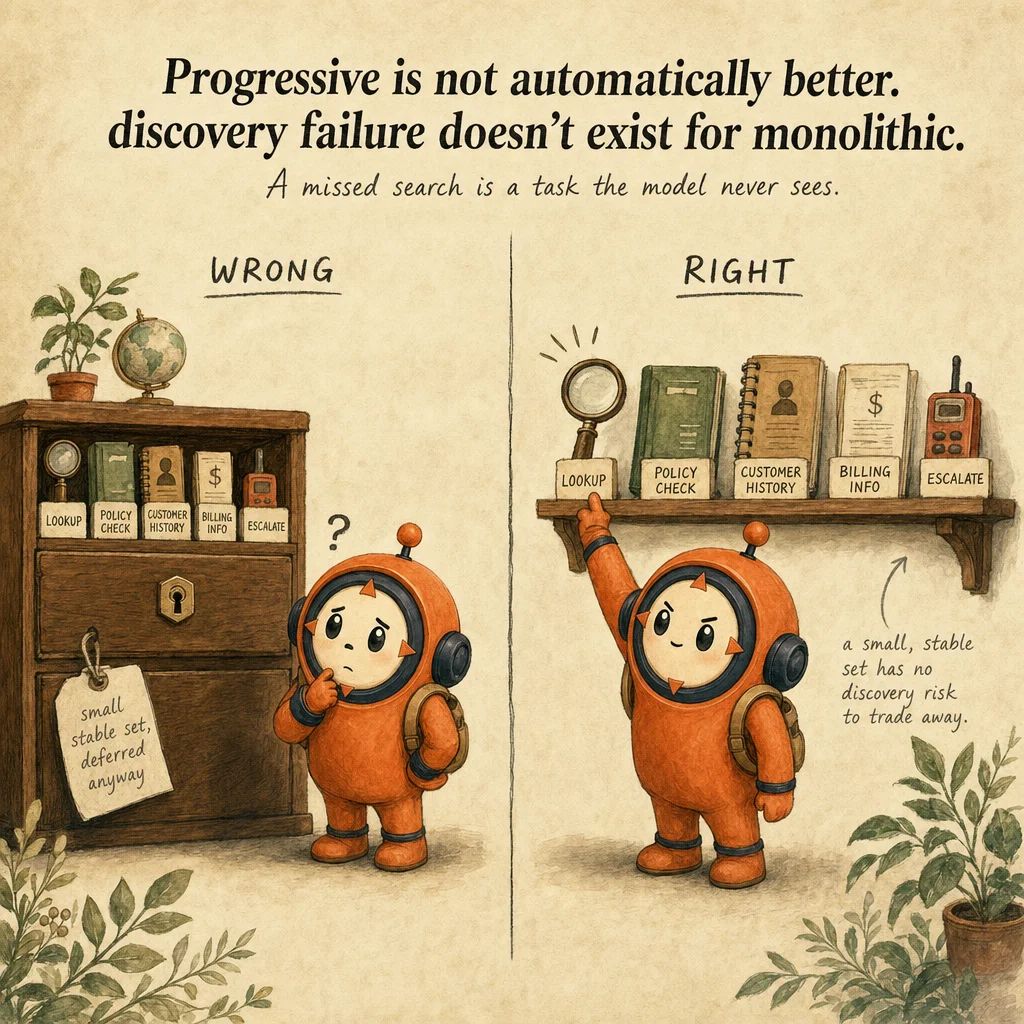
The tradeoff is reliability for efficiency, not a free upgrade. Progressive discovery is dependent on the model reliably finding and selecting the right deferred item. If it fails to search for or picks the wrong tool, the task fails in a way monolithic loading never would - monolithic can't have a *discovery* failure because there's nothing left to discover. This is why the exam framing treats progressive discovery as a scaling answer, not a universal default.

Scale and volatility are the deciding variables. A narrowly-scoped agent with a small, fixed tool set (say, lookup_order, get_customer, issue_refund, escalate, log_note) has little discovery risk to trade away - loading them all upfront costs a handful of tokens and adds minimal latency. An enterprise agent connected to 40 MCP servers spanning finance, HR, and engineering catalogs is the opposite case: loading every definition would flood the context window before the conversation begins, so it should expose a small meta-tool that searches for relevant tools and defer the rest.

The two strategies compose within one system. Nothing forces an architect to pick one strategy uniformly across an entire agent. A small, stable, frequently-reused core (a few always-needed tools) can be monolithic while a large, volatile long tail (hundreds of optional integrations) is progressively discovered - the real-world answer is often a tiered hybrid, not an either/or vote.
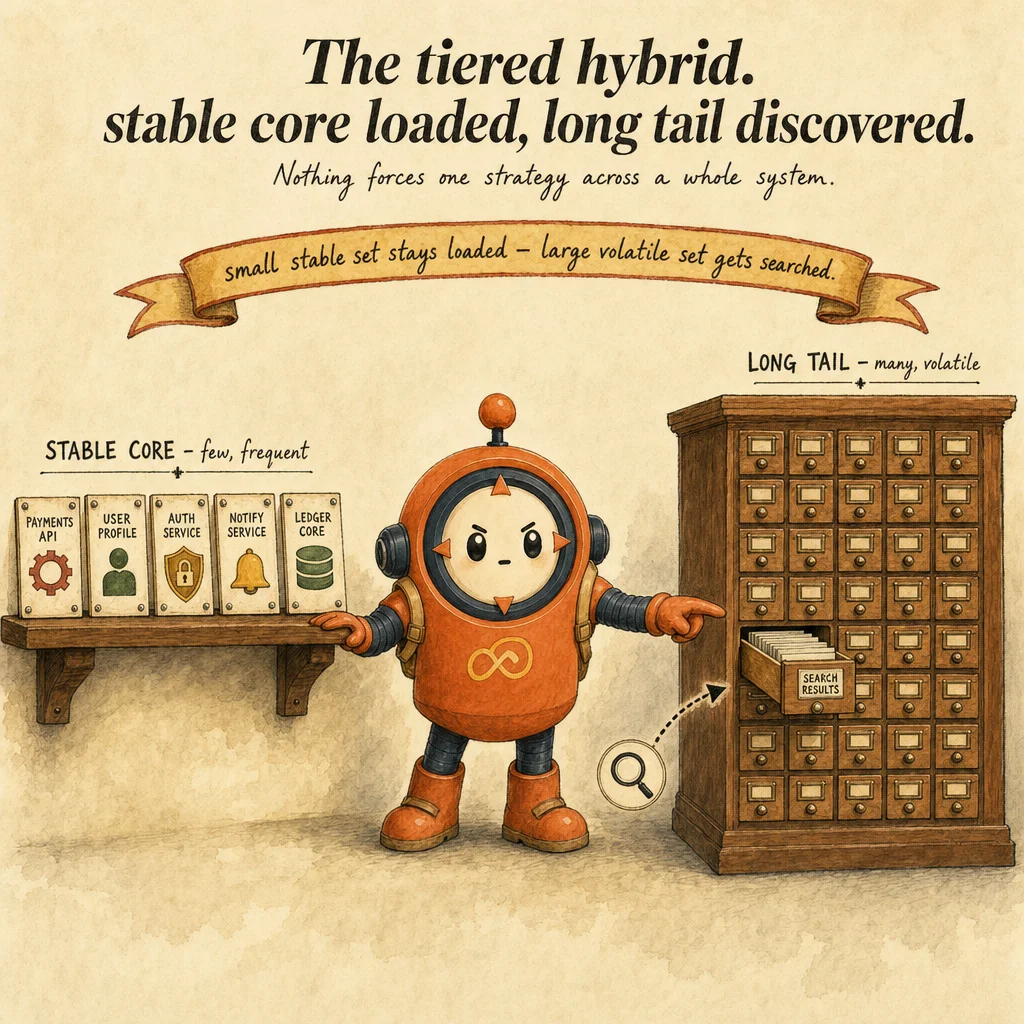
Progressive Discovery vs Monolithic Context Strategy mechanics, painterly diagram featuring Loop mascot.
04 · In production

Where you'll see it

40-server enterprise integration agent

Finance, HR, and engineering MCP catalogs expose a search-tools meta-tool; individual tool definitions load only when a task matches, avoiding a context flood at conversation start.

5-tool customer support agent

lookup_order, get_customer, issue_refund, escalate, and log_note load upfront every turn - there's no discovery risk at this scale, so progressive discovery would only add latency.

05 · When to use

Decision tree

01

Is the tool/Skill/knowledge surface large (dozens-thousands) and/or growing or volatile?

YesLean progressive discovery - token/latency savings outweigh discovery risk at this scale.
NoA small, stable, frequently-reused set: monolithic upfront loading avoids most discovery-latency and discovery-failure risk - there's little scaling benefit to defer.
02

Is discovery-failure tolerance low (a missed capability must never silently fail the task)?

YesWeight that subset toward monolithic even if the rest of the surface is progressive - the two axes combine within one system.
NoProgressive discovery's dependency on the model finding the right deferred item at the right time is an acceptable risk here.
03

Is context-window budget the binding constraint (long conversations, many concurrent Skills/MCP servers)?

YesProgressive disclosure directly relieves it - only matched Skill/tool content ever loads.
NoToken savings are a secondary benefit here; weigh latency and discovery reliability first.
04

Can the surface be tiered into a small stable core plus a large long tail?

YesHybrid: monolithic-load the stable core, progressive-discover the long tail - the common real-world answer, not a uniform either/or pick.
NoPick one strategy uniformly, decided by the axes above.
06 · On the exam

Question patterns

Progressive Discovery vs Monolithic Context Strategy exam trap, painterly cautionary scene featuring Loop mascot.
An enterprise agent connects to 40 MCP servers spanning finance, HR, and engineering catalogs (hundreds of tools total). What loading strategy fits?
Progressive discovery - expose a small "search tools" meta-tool and defer the rest, exactly as Claude Code does for MCP tools. The distractor "load every tool definition upfront for predictability" is the named monolithic failure mode at this scale: it wastes tokens, increases latency, and degrades model performance.
A narrowly-scoped customer-support agent has exactly 5 fixed tools (lookup_order, get_customer, issue_refund, escalate, log_note) that are used on nearly every turn. What loading strategy fits?
Monolithic - load all 5 upfront. The distractor "always use progressive discovery to save tokens" ignores that a small, stable, frequently-reused set has little discovery risk to trade away; deferring here adds discovery latency for negligible benefit.
What does Claude actually load into context at startup for a connected Agent Skill?
Only the Skill's metadata (name + description) - the full SKILL.md body and bundled scripts load only when a task matches. The distractor "Claude loads the full SKILL.md body for every connected skill at startup" describes monolithic loading, which is exactly what progressive disclosure for Skills is designed to avoid.
In Claude Code, MCP tools are deferred rather than loaded into context upfront. What happens when a task actually needs one of those deferred tools?
Claude uses a search tool to discover and load the relevant tool definition on demand. The distractor "the tool is unavailable until a human manually enables it" misdescribes progressive discovery as a hard gate - it's an automatic, model-driven retrieval step, not a manual unlock.
Per Anthropic's MCP client guidance, what is the named cost of loading every tool definition into context upfront once a host connects to many servers with hundreds or thousands of tools?
It wastes tokens, increases latency, and degrades model performance - stated directly in the guidance. The distractor "the primary risk is data leakage between tool definitions, not performance degradation" invents a security framing the source does not make; the documented cost is token/latency/performance, not leakage.
07 · FAQ

Frequently asked

Is progressive discovery always the more "advanced" or correct choice?
No. It's a scaling answer for large or volatile surfaces, not a universal default - a small, stable tool set is generally better served by monolithic loading, which avoids discovery-failure risk almost entirely.
Can an agent mix both strategies?
Yes - a common real-world pattern is a small stable core loaded monolithically plus a large long tail exposed progressively, rather than picking one strategy for the entire surface.
08 · Practice with AI

Work this with your AI

Work this concept hands-on with Claude Code, Codex, or claude.ai. Copy a prompt, paste it into your assistant, and practise in tandem. Each one keeps you active (explain it back, get drilled, or build) rather than just reading.

  • Drill it like the exam (scenario MCQs)
    Practice in the exam's scenario-MCQ format with trap awareness.
  • Explain it back (Feynman)
    Build durable, transferable understanding of a concept you can half-state.
  • Test me, adapting the difficulty
    Active recall practice on a concept you think you know.
  • Check my prerequisites first
    Before studying a concept that keeps not sticking.
  • Find the high-leverage 20%
    When a domain feels too big and you are short on time.
Self-check

Test yourself

Three diagnostic questions on this primitive. Reveal each answer when you have a guess. Want a full 60-question mock? Open the mock hub →

Q1An enterprise agent connects to 40 MCP servers spanning finance, HR, and engineering catalogs (hundreds of tools total). What loading strategy fits?
Progressive discovery - expose a small "search tools" meta-tool and defer the rest, exactly as Claude Code does for MCP tools. The distractor "load every tool definition upfront for predictability" is the named monolithic failure mode at this scale: it wastes tokens, increases latency, and degrades model performance.
Q2A narrowly-scoped customer-support agent has exactly 5 fixed tools (lookup_order, get_customer, issue_refund, escalate, log_note) that are used on nearly every turn. What loading strategy fits?
Monolithic - load all 5 upfront. The distractor "always use progressive discovery to save tokens" ignores that a small, stable, frequently-reused set has little discovery risk to trade away; deferring here adds discovery latency for negligible benefit.
Q3What does Claude actually load into context at startup for a connected Agent Skill?
Only the Skill's metadata (name + description) - the full SKILL.md body and bundled scripts load only when a task matches. The distractor "Claude loads the full SKILL.md body for every connected skill at startup" describes monolithic loading, which is exactly what progressive disclosure for Skills is designed to avoid.
Last reviewed: 2026-05-04·Refresh cadence: monthly
CCARP-D3.4 · CCARP-D3 · Integration

Progressive Discovery vs Monolithic Context Strategy, complete.

You've covered the full ten-section breakdown for this primitive, definition, mechanics, code, false positives, comparison, decision tree, exam patterns, and FAQ. One technical primitive down on the path to CCA-F.

More platforms →