
On this page
TLDR
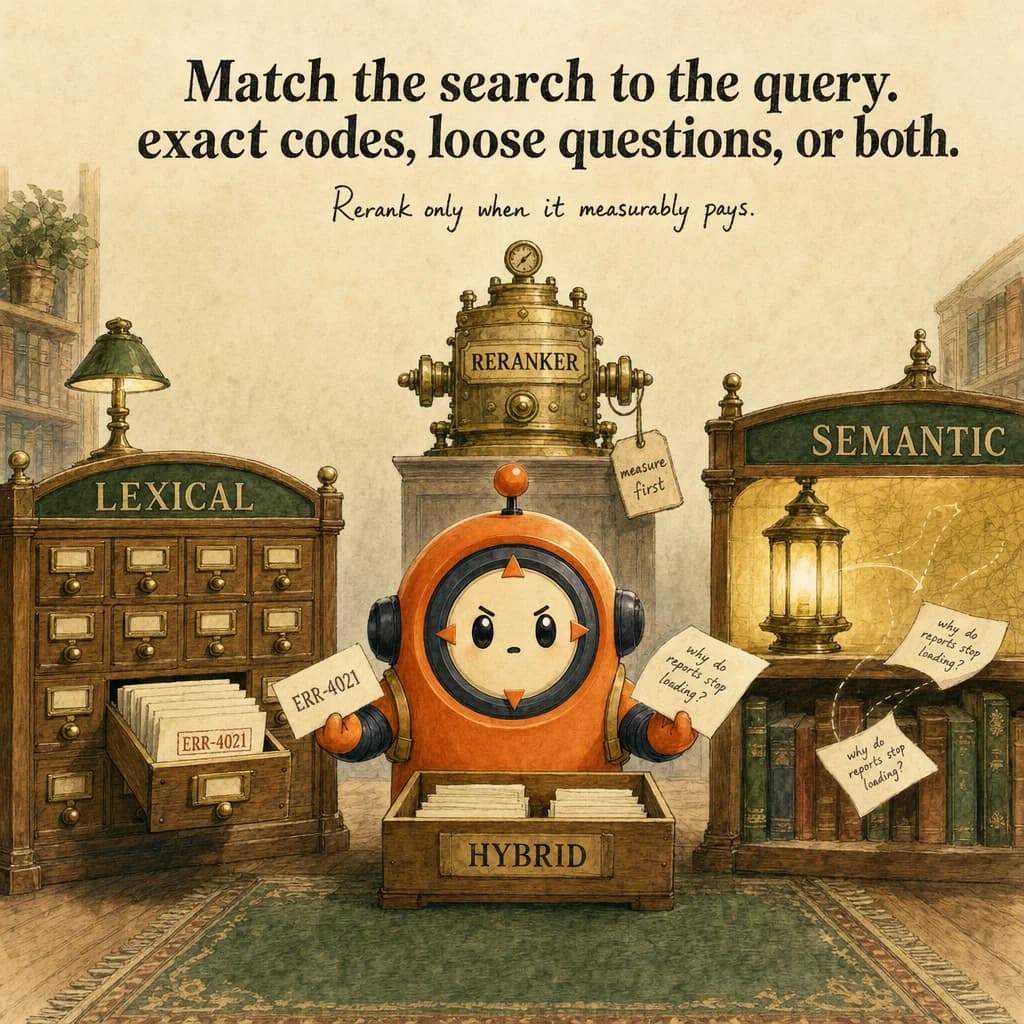
Retrieval strategy matching is the decision of which retrieval method fits the data shape and the query pattern: lexical search for exact identifiers and rare terms, semantic search for paraphrased questions, hybrid when both kinds of query arrive, and reranking only when a measured gain justifies the added latency and cost.
What you are deciding
Pick the retrieval method by the query pattern and the data shape: lexical for exact identifiers, semantic for paraphrase, hybrid when both arrive. Add reranking only after measurement shows its gain is worth its latency and cost.
Which retrieval method does this query mix need, and does reranking earn its cost on your own queries?
What it is
A retrieval-augmented system finds passages for the model to read. The architect's decision is not whether to retrieve but which method to retrieve with, because each method fails on a different kind of query. Lexical search (BM25 and similar) matches the exact tokens in the query. Semantic search compares embeddings, so it matches meaning even when the words differ. Hybrid retrieval runs both and merges the ranked lists.
The choice is driven by two facts the architect can inspect: the shape of the data (identifier-heavy records, long prose, tables) and the pattern of the queries (a ticket number, a product code, or a loosely worded question). Matching the method to those two facts is the objective this page teaches.
How each certification frames it
CCA-P: How CCA-P tests retrieval strategy
CCARP-D3-O6Apply retrieval strategies matched to data shape and query pattern
The Professional guide lists applying retrieval strategies matched to data shape and query pattern (PDF page 5, Domain 3). It sits beside, and is separate from, designing a RAG pipeline with chunking and indexing strategies.
Keep the end-to-end document-processing walkthrough on the long-document-processing scenario. This page owns only the choice of retrieval method by query type.
How it works
An exact identifier query favors lexical search. A query such as an error code or an order number has no paraphrase. An embedding may place a different code close by, while a lexical match returns the passage that contains the exact string. Anthropic's contextual retrieval write-up makes this point with an error-code example.
A paraphrased question favors semantic search. When the user describes a problem in their own words, the passage that answers it may share no keywords with the query. Embeddings bridge that vocabulary gap, and lexical search alone misses the passage.
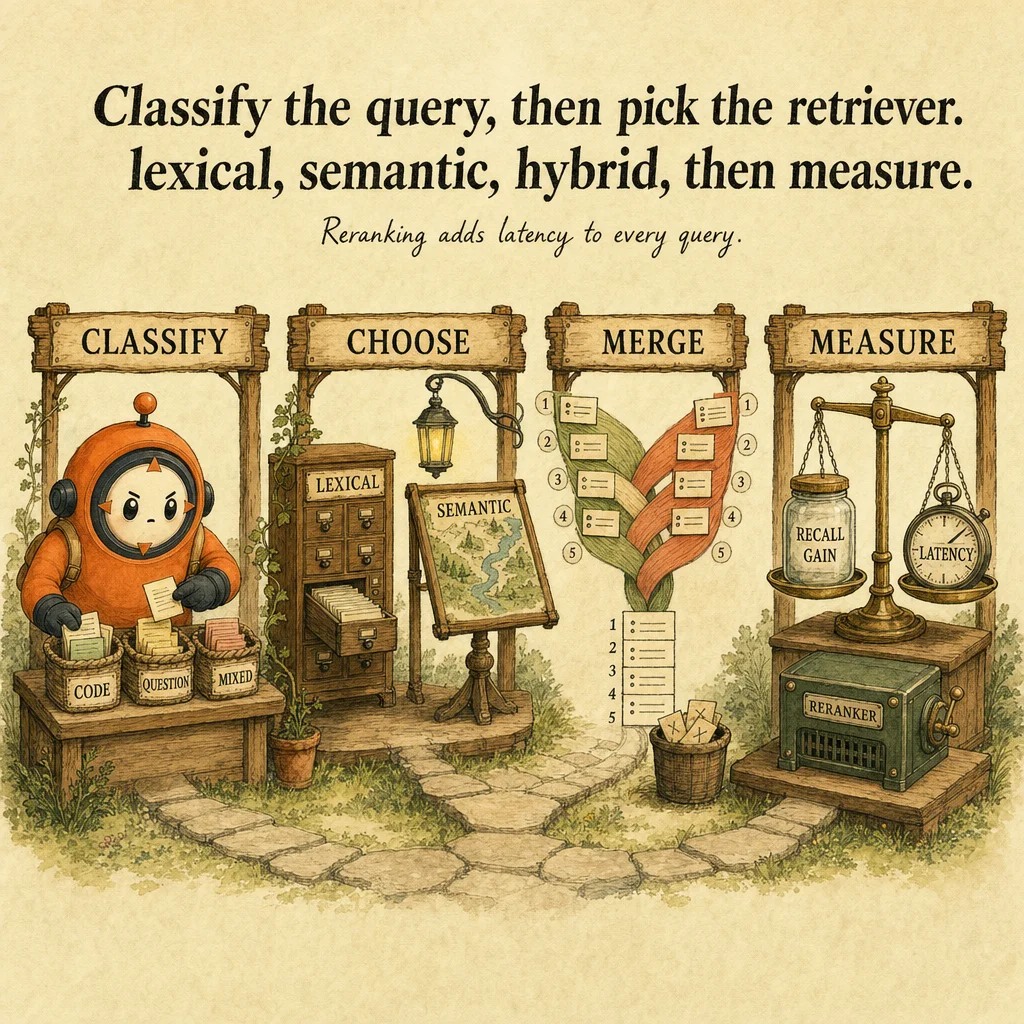
Mixed traffic favors hybrid retrieval. If both query types arrive, run both retrievers and merge the ranked results, for example with rank fusion, then deduplicate. The cost is a second index to build and keep fresh.
Reranking is an optional second stage, not a default. A reranker re-scores the merged top candidates with a stronger model before the final few passages reach Claude. It can raise precision, and it adds a model call to every query, so adopt it only after measuring that the gain on your own queries outweighs the latency and cost.
Worked example: sorting a query log into a retrieval design
Authored teaching example, not a bank question.
An internal help assistant searches support notes. Users type ticket codes such as an error identifier, and they also describe problems in their own words. The first build uses embeddings only.
| Query in the log | Label | Method that retrieves it | Why |
|---|---|---|---|
| An error code typed verbatim | Identifier | Lexical | The answer note contains the exact string |
| 'Why do my reports stop loading overnight?' | Paraphrased | Semantic | The answer shares few words with the question |
| A code plus a description of the symptom | Mixed | Hybrid | One signal needs the string, one needs meaning |
The design is hybrid retrieval, with reranking adopted or rejected by measurement on this team's own queries. Check afterwards that the labelled sample includes both query types and that the result is re-run when the data or the query mix changes.
How this decision goes wrong
Semantic-only retrieval for identifier-heavy data
Looks right: Embeddings understand meaning, so they should beat keyword search everywhere.
Why it fails: An exact code or part number has no paraphrase. The embedding may rank a merely similar passage above the one containing the exact string.
Instead: Add lexical retrieval for identifier queries, or use hybrid retrieval with rank fusion when both query types arrive.
Irrelevant semantic matches on rare terms
Looks right: The top result is topically close to the query, so it looks right.
Why it fails: Topical closeness is not the same as containing the needed fact. Claude then reads a plausible but wrong passage and answers from it.
Instead: Check retrieved passages against labelled queries, and let a lexical signal vote on exact terms.
Reranking everything without a measured benefit
Looks right: A reranker usually improves ordering, so add it to every query.
Why it fails: It adds a model step to every request. If recall at your cut-off barely moves, you pay more latency and cost for nothing.
Instead: Measure the gain on your own labelled queries first, and keep the reranker only if it clears a threshold you set in advance.
Where you'll see it
Support knowledge base
Agents paste ticket numbers and also describe symptoms in plain words. Hybrid retrieval serves both without forcing users to choose a search mode.
Compliance document search
Clause numbers need exact matching while policy questions need semantic matching, so the retriever combines both signals.
Side-by-side
| Method | Strong when | Weak when | Cost to add |
|---|---|---|---|
| Lexical (BM25) | Exact identifiers, rare terms, codes | The query is paraphrased | Low, a keyword index |
| Semantic (embeddings) | Paraphrased or conceptual questions | The query hinges on an exact string | Embedding model plus a vector index |
| Hybrid | Both query types arrive | Only one type ever arrives | Both indexes plus a merge step |
| Reranking | Top candidates are noisy | Latency budget is tight, gain unmeasured | An extra model call per query |
Decision tree
Do queries contain exact identifiers such as error codes or order numbers?
Do users also ask loosely worded questions that share few keywords with the answer?
Do both kinds of query arrive in the same system?
Is the merged top list still noisy and is there latency and cost budget to spend?
The exam trap
Treating semantic search as strictly better because it understands meaning. An exact identifier can be missed or outranked by a merely similar passage, and reranking everything adds latency without a measured benefit. The correct answer names the query pattern first and picks the method that fits it.
Question patterns
CCA-P practice questions
5 approved CCA-P questions for this topic. Tap an answer to check it, then read the rationale for every option.
A team wants to reduce token usage on a document-QA system by truncating the retrieved document to the first 2,000 tokens for every query, regardless of the query's topic. Users now regularly report answers that miss information located later in the document. What is the architectural error?
Frequently asked
Showing 5 of 5 questions
Sources and next steps
- Claude Certified Architect - Professional Exam Guide v1.0 (July 2026), PDF page 5, section: Domain 3: Integration and Domain 4: Evaluation, Testing & Optimization, detailed objectives. Checked 2026-10-16.
- Contextual Retrieval (Anthropic engineering), section: Embeddings and BM25; Reranking. Checked 2026-10-16.