
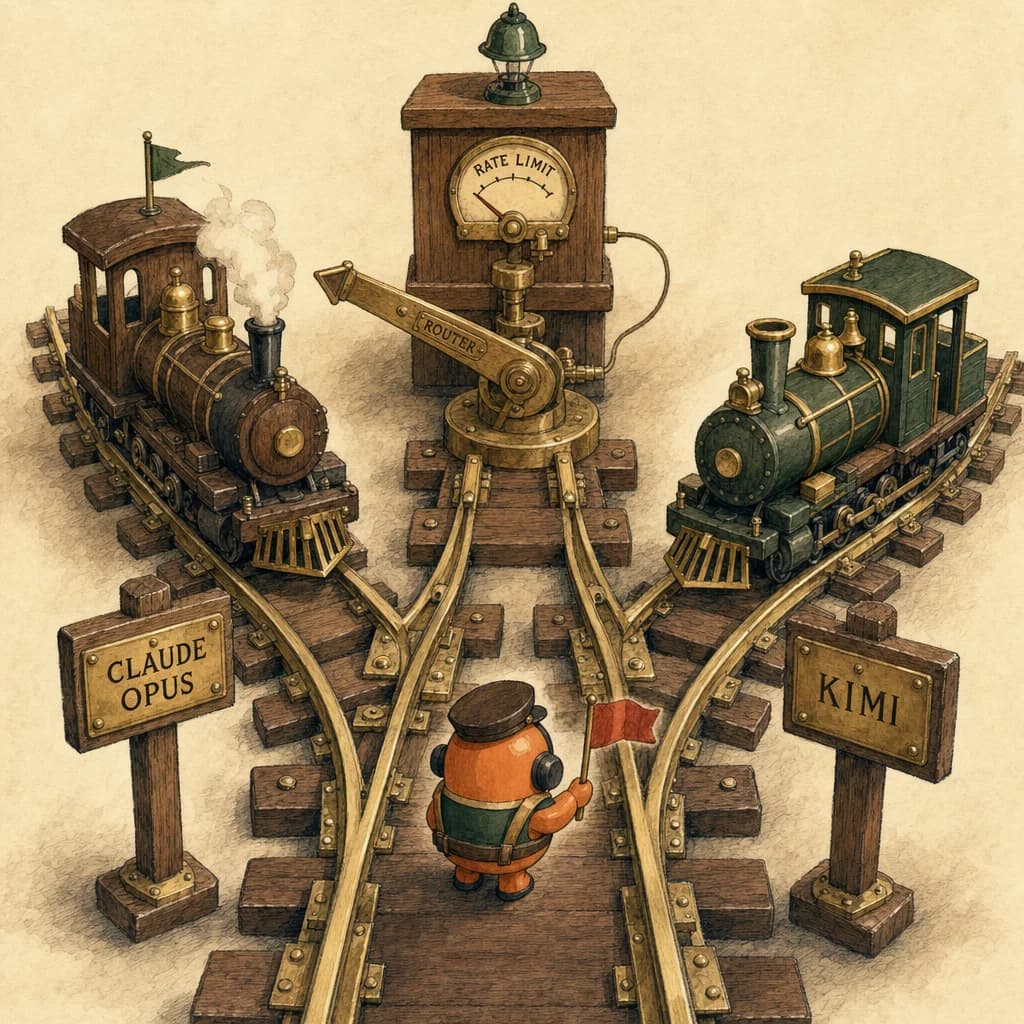
- ✓Anthropic's Tier 1 and Pro limits rose this month, but heavy refactors still throttle on token-per-minute ceilings. The fix circulating among teams is a two-model loop: Claude 4.7 Opus plans and verifies, Kimi K2.6 implements in bulk. OpenRouter's May 21 pricing put Kimi K2.6 at $0.73 per 1M input tokens, roughly 40% cheaper than Opus for boilerplate, and Kimi's Tier 1 ($10 recharge) already unlocks 2,000,000 TPM. The architectural point: a fallback chain is a deployment-tier decision, not an ops workaround.
- ✓Routing planning to Opus and implementation to Kimi is the escalation pattern in reverse: cheap tier handles bulk, premium tier handles judgement. Same primitive.
- ✓Batch is the orthodox Anthropic answer to throughput pressure. A two-model loop is the alternative when latency matters and batch windows do not fit.
- ✓Repository indexing in Opus only survives rate-limit pressure if the cached read context is reused across planning calls. Caching turns the loop from expensive to viable.
Quick answer
The Opus + Kimi pattern is a two-model loop: Claude 4.7 Opus writes a structured blueprint, Kimi K2.6 implements the files in bulk via its Agent Swarm, then Opus performs a diff-check against the original spec. It exists because Anthropic's bottleneck on long refactors is token-per-minute throughput, not intelligence. OpenRouter's May 21 pricing made Kimi roughly 40% cheaper for boilerplate, and Kimi Tier 1 unlocks 2,000,000 TPM on a $10 recharge. Provider redundancy is the bonus; cost and throughput are the reason.
Why "just upgrade your tier" is the wrong answer
The popular reflex when an agent hits a rate limit is to push the tier up. Buy more Pro seats. Move to Enterprise. Wait for the next limit increase, then keep going.
That reflex misreads the problem. Anthropic's tier increases this month (Tier 1, Pro, and the May 18 doubling of Claude Design limits noted by pasqualepillitteri.it) do raise the ceiling. But on a multi-thousand-file refactor, you are not limited by how clever the model is. You are limited by how many tokens per minute it can read and write before the 5-minute cooldown kicks in. Upgrading the tier moves the ceiling. It does not change the shape of the wall.
The teams shipping production agentic workflows in May figured this out and stopped trying to make one model do everything. They split the loop across providers and now treat rate limits as a property of the system, not an error to retry around.
Four routing patterns that actually work
Pattern 1. The blueprint handoff (Opus plans, Kimi implements)
Reality: per NXCode.io (May 18) the strongest loop in circulation is three phases. Opus 4.7 reads the codebase and emits a blueprint.json with file paths and required logic. A worker feeds that blueprint to Kimi K2.6's Agent Swarm, which writes files in parallel across 30+ concurrent requests. Opus returns for a diff-check against the original spec. The blueprint is the load-bearing object; both models contract against it. Without a schema for the handoff, the two models drift and you burn iterations re-aligning them.
Pattern 2. Context conservation as a deployment rule
Reality: Zenn.dev (May 17) framed the principle bluntly: "Using Opus for boilerplate is like hiring a Principal Engineer to write unit tests for getters and setters." Opus 4.7's role fidelity is its scarce resource. Burn it on repetitive syntax and you lose the headroom for the calls where reasoning matters. The deployment rule is to route high-entropy work (new logic, ambiguous specs) to Opus and low-entropy work (file moves, refactors, boilerplate) to Kimi. Predictors quoted in late-May reporting suggest model-agnostic routers will automate this entropy-based split by year-end.
Pattern 3. Throughput arbitrage at the tier boundary
Reality: Kimi Tier 1 unlocks 2,000,000 TPM on a $10 recharge (Kimi.ai, May 22). The same $10 against an Anthropic entry tier buys a small fraction of that throughput. OpenRouter's May 21 pricing on Kimi K2.6 at $0.73 per 1M input tokens makes the implementation tier roughly 40% cheaper for boilerplate than Opus, with Medium (May 22) reporting up to 55% monthly API spend reduction at 95% code quality. The arbitrage is real but only on tasks where Kimi's quality is sufficient; the diff-check phase exists precisely so you can detect when it is not.
Pattern 4. Provider redundancy as deployment-tier reliability
Reality: by splitting providers you get fallback for free. If Anthropic experiences a regional outage or a sudden limit tightening (the May 18 Claude Design adjustment caught teams who had assumed stable backend limits), the Kimi-based implementation layer keeps writing files. The planning layer stalls, but planning is intermittent and the queue absorbs short interruptions. This is the same reliability primitive that multi-cloud deployments buy at the infrastructure tier, applied at the model tier.
The nuanced point
The Opus + Kimi loop is not a hack to dodge Anthropic's limits. It is what happens when teams stop conflating cost with capability. Opus is expensive because reasoning is expensive; that does not make it the right tool for renaming 400 files. The frontier model's job description narrows as the ecosystem matures, and the narrowing is the whole point.
Rate limits, framed properly, are a deployment-tier constraint. They sit alongside latency budgets, regional availability, and unit economics. A fallback chain across providers is not an ops workaround you bolt on after the first outage; it is an architectural decision you make on day one, before the agent ships. Teams that absorbed this in May are running migrations 3x faster (per benchmark coverage of hybrid scripts versus Opus-only agents stuck in 5-minute cooldowns). Teams still waiting for "just one model that does everything" are paying for the wait in throttled refactors.
How this shows up on the exam
D1 (Agentic Architectures, 27%) is the domain that most often tests whether you treat model selection as a first-class architectural decision. Expect a scenario where an agent stalls mid-refactor with rate-limit errors. The distractor answers are "upgrade to a higher Anthropic tier" or "add retry with exponential backoff". Both are defensible and both miss the architectural answer, which is to split the workload across model classes - high-reasoning work on the premium tier, bulk implementation on a cheaper, higher-TPM tier. The exam rewards candidates who see model routing as a system property, not a vendor-buying decision.
D5 (Context + Reliability, 15%) tests retry, fallback, and handoff patterns directly. A two-provider loop with a structured blueprint (file paths, function signatures, contracts) is the canonical pattern when questions describe inconsistent results across providers or drift between planning and implementation. D4 (Prompt Engineering, 20%) shows up adjacently: the blueprint is the persistent, structured artifact that survives model switches; a free-form prompt does not. If a question mentions multi-model coordination, the correct answer almost always involves a schema, not a longer prompt.
What part of your stack would change if you stopped assuming one model has to do everything?
The honest answer for most teams: the planning surface gets sharper, the implementation surface gets cheaper, and the verification surface becomes the only place you actually need premium reasoning. The model-purity instinct fades fast once the first month's invoice arrives. The teams that internalised this in May are not the ones who upgraded their tier; they are the ones who stopped treating their architecture diagram as a single-model diagram.
4 direct routes into the scored material.
- conceptsRouting planning to Opus and implementation to Kimi is the escalation pattern in reverse: cheap tier handles bulk, premium tier handles judgement. Same primitive.
- conceptsBatch is the orthodox Anthropic answer to throughput pressure. A two-model loop is the alternative when latency matters and batch windows do not fit.
- conceptsRepository indexing in Opus only survives rate-limit pressure if the cached read context is reused across planning calls. Caching turns the loop from expensive to viable.
- scenariosThis is the scenario where the Opus-plans / Kimi-implements loop actually shows up in production. The blueprint.json handoff is the deployable shape.
Share this post.
One share is one less person stuck on the same question.