CCAOF-D4.1 · Domain 4 · Workflow Integration & Solution Design · 16% of CCA-A

Using Claude for Research, Planning & Solution Development.

7 min read·7 sections·Tier A

Beyond one-off Q&A, Claude is used as a research and planning partner across a three-stage arc: research a problem, draft an approach, then refine it over several turns before anything ships. The dedicated Research feature extends stage one - it runs multiple sub-agents in parallel to search the web and connected sources, decomposing a broad question and synthesizing a cited answer. Anthropic: multi-agent-research-system The value is the multi-turn, multi-stage workflow itself - a single unverified answer to a complex question is the exact failure mode this domain tests against.

Official Anthropic engineering + Support docsCCA-A Domain 4 · Workflow & Solution DesignCCA-A only
Using Claude for Research, Planning & Solution Development, hero illustration featuring Loop mascot in a warm gallery scene.
Domain CCAOF-D4Workflow Integration & Solution Design · 16%
On this page
01 · Summary

TLDR

Beyond one-off Q&A, Claude is used as a research and planning partner across a three-stage arc: research a problem, draft an approach, then refine it over several turns before anything ships. The dedicated Research feature extends stage one - it runs multiple sub-agents in parallel to search the web and connected sources, decomposing a broad question and synthesizing a cited answer. Anthropic: multi-agent-research-system The value is the multi-turn, multi-stage workflow itself - a single unverified answer to a complex question is the exact failure mode this domain tests against.

3 (research → plan → draft/refine)
Workflow stages framed
CCAOF-D4 (16%)
Exam domain
2 (O2 research/planning, O3 solution design/iteration)
Objectives covered
Pro / Max / Team / Enterprise
Research plan gating
90% (one customer, marketing ops)
Advolve case-study ops-time cut
02 · Definition

What it is

Beyond one-off Q&A, Claude is used across a business's daily work as a research and planning partner: exploring a problem, drafting an approach, and refining it over several turns before anything ships. Anthropic's own "Claude for work" hub frames this as helping teams maximize productivity across roles, not just engineering. A dedicated Research feature extends this specifically for open-ended information-gathering: it lets Claude search across the web, Google Workspace, and any enabled integrations to accomplish complex tasks, running multiple sub-agents in parallel to explore a topic more thoroughly than a single-turn answer could.

This objective covers two related but distinct skills: leveraging Claude for research, planning, and process optimization (finding information and shaping it into an actionable plan), and using Claude to support solution design, development, and iteration (turning that plan into concrete deliverables, refined across multiple exchanges rather than accepted on the first draft). Both share the same underlying discipline - treat Claude as an ongoing collaborator across a solution's development, not a single-shot generator.

03 · Mechanics

How it works

The workflow runs in three stages: research, plan, develop. A PM planning a feature rollout might first ask Claude (or trigger Research) to survey how competitors approached a similar rollout and summarize tradeoffs; then iterate with Claude turn-by-turn to turn that research into a phased plan, pressure-testing assumptions each round; then use Claude to draft the rollout communication, a risk log, and a first-draft process doc, refining each across multiple exchanges. This matches the "iteration" language in the solution-design objective directly - Claude stays in the loop across the whole arc, not just at the first step.

The Research feature is the mechanism for the research stage when the question is genuinely broad. It decomposes a broad question into sub-questions, runs them in parallel via multiple Claude agents, and synthesizes a combined, cited answer - detailed in Anthropic's engineering writeup on its multi-agent research system. Research can draw on the public web plus connected sources like Google Workspace and other integrations, not just Claude's training data, and requires web search to be enabled. It's a paid-plan feature (Pro, Max, Team, Enterprise), distinct from a standard chat turn.

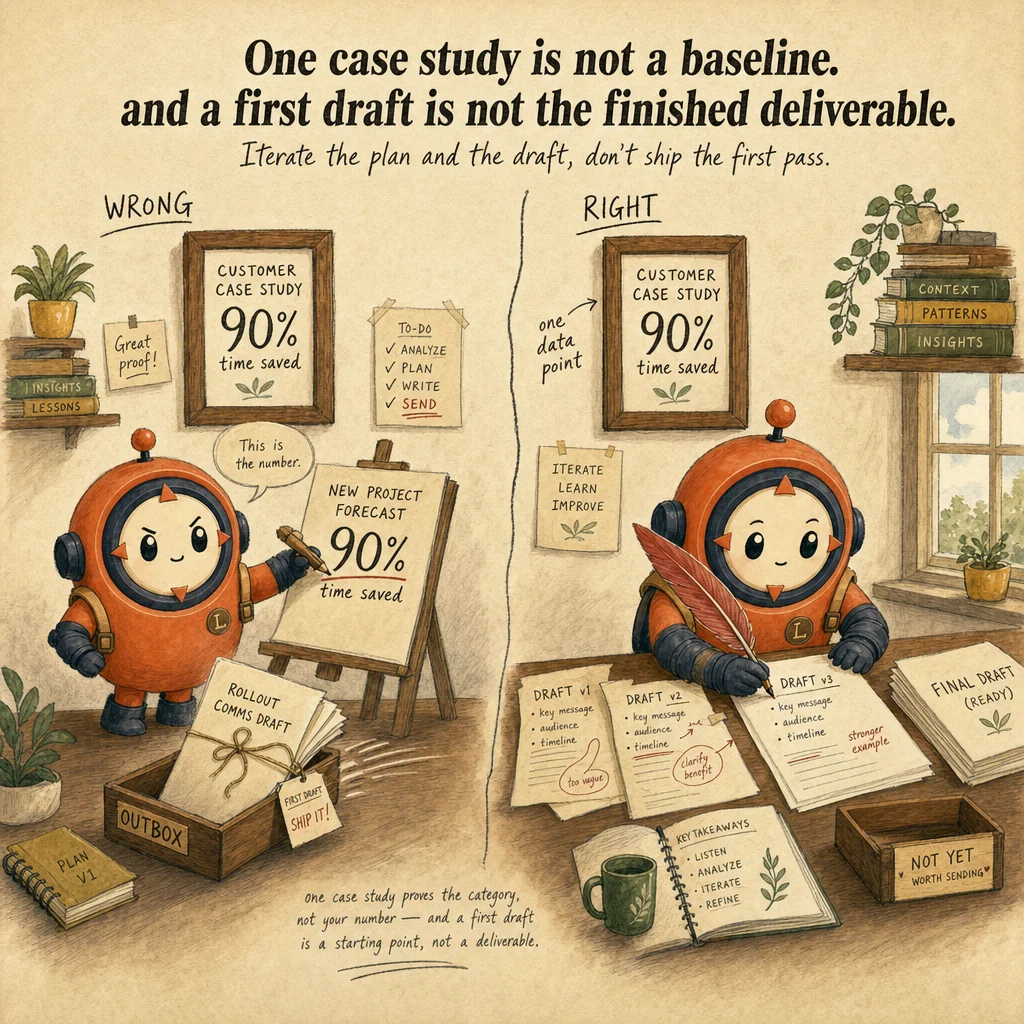
Anthropic also markets Claude for research, planning, and process optimization more broadly than the Research feature alone, through customer case studies. Advolve, for example, reports a 90% reduction in operational work time and a 15% increase in customer ROI using the Claude Platform for marketing operations. That's one customer's result for one use case, useful as an existence proof of the category, not a number to project onto every workflow.

Solution design and iteration (O3) is the second half of this objective, and it's a discipline, not a feature. After research produces findings and a plan takes shape, the deliverables themselves, communication drafts, risk logs, process documents, prototypes, get built and refined across multiple exchanges with Claude rather than shipped as a first draft. The exam framing treats accepting the first output as the failure mode, not a shortcut.

The core trap is collapsing this into "ask Claude one question." The objective specifically calls out planning, process optimization, and iteration - the value comes from the multi-turn, multi-stage workflow (research → plan → draft → refine), and for genuinely broad research questions, from the Research feature's decomposed, parallel multi-agent exploration across many sources rather than a single chat turn. Note this isn't a training-data-versus-web-access distinction: an ordinary Claude.ai chat can also use web search when enabled, so it isn't limited to training data either. What Research adds is the multi-step, multi-source agentic investigation itself, decomposing the question, running parallel sub-agents, and synthesizing a cited answer, not access to the live web as such.
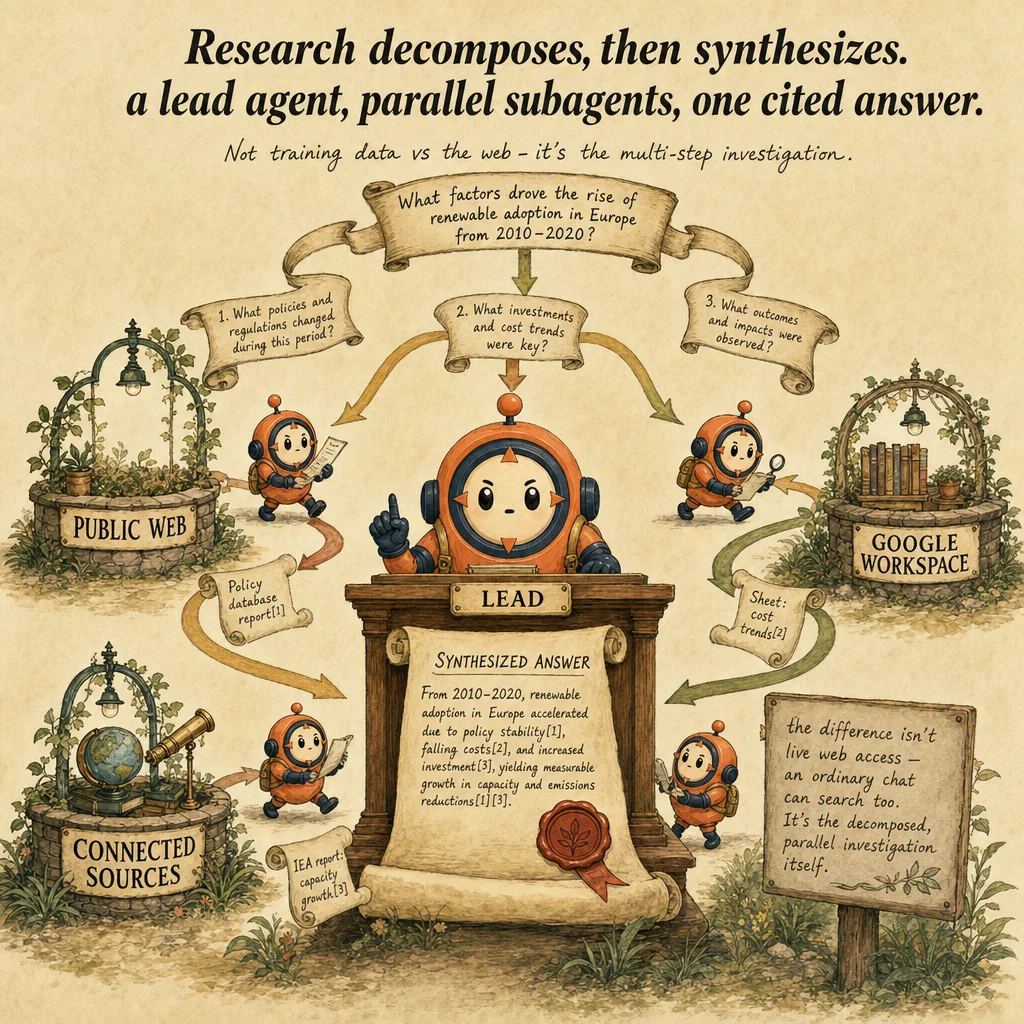
Using Claude for Research, Planning & Solution Development mechanics, painterly diagram featuring Loop mascot.
04 · In production

Where you'll see it

Feature rollout planning

A PM chains all three stages: Research to survey competitor rollouts, turn-by-turn iteration to build a phased plan, then multiple refinement passes on the comms draft and risk log rather than shipping first drafts.

Marketing operations process optimization

A marketing-ops team uses Claude across research and iterative drafting to redesign a recurring process, the same category of use Anthropic's Advolve case study reports results for, without assuming their own numbers will match that one case study.

05 · When to use

Decision tree

01

Is the question broad and open-ended enough to benefit from many parallel web/connector searches, rather than one bounded chat turn?

YesTrigger the Research feature (paid plans, web search enabled) for a decomposed, multi-agent, cited synthesis.
NoA normal chat turn on existing knowledge or a Project's context may be enough - Research is for genuinely broad, multi-source questions.
02

Once you have research findings, do they need to become an actionable, phased plan?

YesIterate with Claude turn-by-turn, pressure-testing assumptions each round - this is the planning/process-optimization half of the objective (O2).
NoThe findings themselves may be the deliverable - stop here.
03

Does the plan need to turn into concrete deliverables (comms draft, risk log, process doc, prototype)?

YesDraft and refine each deliverable across multiple exchanges with Claude rather than accepting the first draft - this is the solution-design/iteration half (O3).
NoThe plan alone may satisfy the request.
04

Are you about to accept a single first-turn answer to a complex, multi-part question as final?

YesStop - this is the objective's core failure mode. Verify further, iterate, or trigger Research instead of treating one-shot output as authoritative.
NoYou're already applying the multi-turn workflow this objective tests.
06 · On the exam

Question patterns

Using Claude for Research, Planning & Solution Development exam trap, painterly cautionary scene featuring Loop mascot.
A PM wants to survey how several competitors approached a similar product rollout, pulling from current public sources. What's the right move, and why not just ask in a normal chat turn (with web search enabled)?
Trigger the Research feature - it decomposes the broad question into sub-questions, runs them in parallel across multiple Claude agents, and returns a cited, synthesized answer covering many sources at once. This isn't because a normal chat turn is stuck on training data, an ordinary chat turn can also search the web when enabled, it's because Research's decomposed, parallel, multi-agent investigation covers a broad question far more thoroughly than one bounded chat turn can, even a web-search-enabled one. Named distractor: "one detailed chat prompt is equivalent, since Claude already knows about competitors from training" - the flaw isn't just that training data is stale, a web-search-enabled chat turn still can't match Research's decomposed, multi-source, multi-agent coverage of a genuinely broad question.
After getting research findings on the rollout, the team asks Claude once for "the plan" and ships whatever comes back. What's missing from this approach?
The iterative planning step this objective tests: turning research into a plan should involve pressure-testing assumptions turn-by-turn, not accepting a single-pass output. Named distractor: "the first plan is fine, since the Research feature already vetted the sources" - vetting sources during research doesn't substitute for iterating on the plan itself; they're separate stages.
The team then asks Claude to draft a rollout communication and a risk log once each, and ships the first drafts unedited. Does this satisfy the objective's solution-design skill?
No. The solution-design/iteration objective (O3) specifically expects deliverables to be refined across multiple exchanges rather than accepted on the first draft. Named distractor: "one draft is sufficient, since it read well" - readability isn't the bar; iterative refinement of the deliverable is what the objective tests.
A team on Claude's Free plan wants to use the Research feature for a broad competitive survey. Can they, and what do they need instead if not?
No - Research requires a paid plan (Pro, Max, Team, or Enterprise) and web search enabled; it is not available on Free. Named distractor: "Research is available on all plans since it just uses web search" - web search being a prerequisite doesn't make Research itself plan-agnostic; it's explicitly gated to paid tiers.
A team cites Advolve's published 90% reduction in operational work time as proof that adopting Claude will cut their own unrelated workflow's time by roughly the same amount. What's the flaw in that reasoning?
That figure is one customer's result for one specific marketing-operations use case, not a general baseline that transfers to any workflow. Named distractor: "since Anthropic published this figure, it applies as a baseline for our project" - a single case study demonstrates the category is viable, it does not guarantee a comparable outcome for a different team, task, or process.
07 · FAQ

Frequently asked

Is the Research feature the only way to use Claude for research work under this objective?
No. Plain, iterative chat conversation also counts as using Claude for research and planning - Research is the dedicated feature for genuinely broad, multi-source questions that benefit from parallel, multi-agent search with citations.
Does producing one solid first draft satisfy the iteration expectation in O3?
No. The objective frames solution design and development as refining deliverables across multiple exchanges; a single accepted first draft, however good, misses the iterative discipline being tested.
08 · Practice with AI

Work this with your AI

Work this concept hands-on with Claude Code, Codex, or claude.ai. Copy a prompt, paste it into your assistant, and practise in tandem. Each one keeps you active (explain it back, get drilled, or build) rather than just reading.

  • Drill it like the exam (scenario MCQs)
    Practice in the exam's scenario-MCQ format with trap awareness.
  • Explain it back (Feynman)
    Build durable, transferable understanding of a concept you can half-state.
  • Test me, adapting the difficulty
    Active recall practice on a concept you think you know.
  • Check my prerequisites first
    Before studying a concept that keeps not sticking.
  • Find the high-leverage 20%
    When a domain feels too big and you are short on time.
Self-check

Test yourself

Three diagnostic questions on this primitive. Reveal each answer when you have a guess. Want a full 60-question mock? Open the mock hub →

Q1A PM wants to survey how several competitors approached a similar product rollout, pulling from current public sources. What's the right move, and why not just ask in a normal chat turn (with web search enabled)?
Trigger the Research feature - it decomposes the broad question into sub-questions, runs them in parallel across multiple Claude agents, and returns a cited, synthesized answer covering many sources at once. This isn't because a normal chat turn is stuck on training data, an ordinary chat turn can also search the web when enabled, it's because Research's decomposed, parallel, multi-agent investigation covers a broad question far more thoroughly than one bounded chat turn can, even a web-search-enabled one. Named distractor: "one detailed chat prompt is equivalent, since Claude already knows about competitors from training" - the flaw isn't just that training data is stale, a web-search-enabled chat turn still can't match Research's decomposed, multi-source, multi-agent coverage of a genuinely broad question.
Q2After getting research findings on the rollout, the team asks Claude once for "the plan" and ships whatever comes back. What's missing from this approach?
The iterative planning step this objective tests: turning research into a plan should involve pressure-testing assumptions turn-by-turn, not accepting a single-pass output. Named distractor: "the first plan is fine, since the Research feature already vetted the sources" - vetting sources during research doesn't substitute for iterating on the plan itself; they're separate stages.
Q3The team then asks Claude to draft a rollout communication and a risk log once each, and ships the first drafts unedited. Does this satisfy the objective's solution-design skill?
No. The solution-design/iteration objective (O3) specifically expects deliverables to be refined across multiple exchanges rather than accepted on the first draft. Named distractor: "one draft is sufficient, since it read well" - readability isn't the bar; iterative refinement of the deliverable is what the objective tests.
Last reviewed: 2026-05-04·Refresh cadence: monthly
CCAOF-D4.1 · CCAOF-D4 · Workflow Integration & Solution Design

Using Claude for Research, Planning & Solution Development, complete.

You've covered the full ten-section breakdown for this primitive, definition, mechanics, code, false positives, comparison, decision tree, exam patterns, and FAQ. One technical primitive down on the path to CCA-F.

More platforms →