

On this page
TLDR
Integrating Claude into a workflow is a choice between augment (a human still owns the process, Claude drafts or triages inside it) and redesign (the process itself changes shape because Claude removes a bottleneck) - this augment-vs-redesign decision is the exam objective (CCAOF-D4-O4) in one sentence. Anthropic's own rollout guidance favors starting narrow with a validated pilot before jumping to redesign. Deeper connector-permission mechanics and Project configuration live on their own dedicated pages (see Study Next); this page stays focused on the augment/redesign decision itself.
What you are deciding
Integrating Claude means choosing between augmenting one step of a workflow you keep and redesigning the process around Claude. Start by augmenting a step you have validated, keep a named human owner, and put a quality check where Claude's output enters the process.
Do I augment one step or redesign the process, and who stays accountable?
What it is
For a non-technical business user, "integrating Claude" rarely means writing code - it means deciding where in an existing process Claude should sit, and whether it simply speeds up a step someone already does (augment) or lets the process be restructured entirely (redesign). Anthropic's enterprise guidance frames embedding agentic AI into how work and processes actually run as one part of what separates deployments that compound value from ones that stall, alongside upskilling employees on real workflows and building genuinely new capability rather than only cutting cost.
Augment and redesign are not a maturity ladder you climb once - they are two different answers to "how much of the existing process changes," and the correct integration decision depends on the workflow, not on defaulting to whichever sounds more ambitious. A team can augment a process indefinitely if that is where the value is, or move to redesign once augmentation has proven the use case and surfaced where the real bottleneck sits.
How each certification frames it
CCA-A: How CCA-A tests workflow integration
CCAOF-D4-O4Integrate Claude into existing workflows to augment or redesign them
The Associate guide lists integrating Claude into existing workflows to augment or redesign them (PDF page 5, Domain 4). The choice depends on what you have validated, not on how much Claude could change.
Anthropic's guidance on building agents advises finding the simplest solution that works and adding complexity only when needed. Applied to a workflow, that means proving value on one step before restructuring the whole process.
How it works
Decide augment vs. redesign per workflow, not once for the whole org. Augmenting means a human still owns the process end to end while Claude drafts, summarizes, or triages inside a step they already do. Redesigning means the workflow's shape changes because Claude removes a bottleneck the human step used to be. Anthropic's enterprise deployment guidance, illustrated with case studies from L'Oréal, Lyft, and Rakuten, treats this as a deliberate choice leaders make per process, not a default setting.
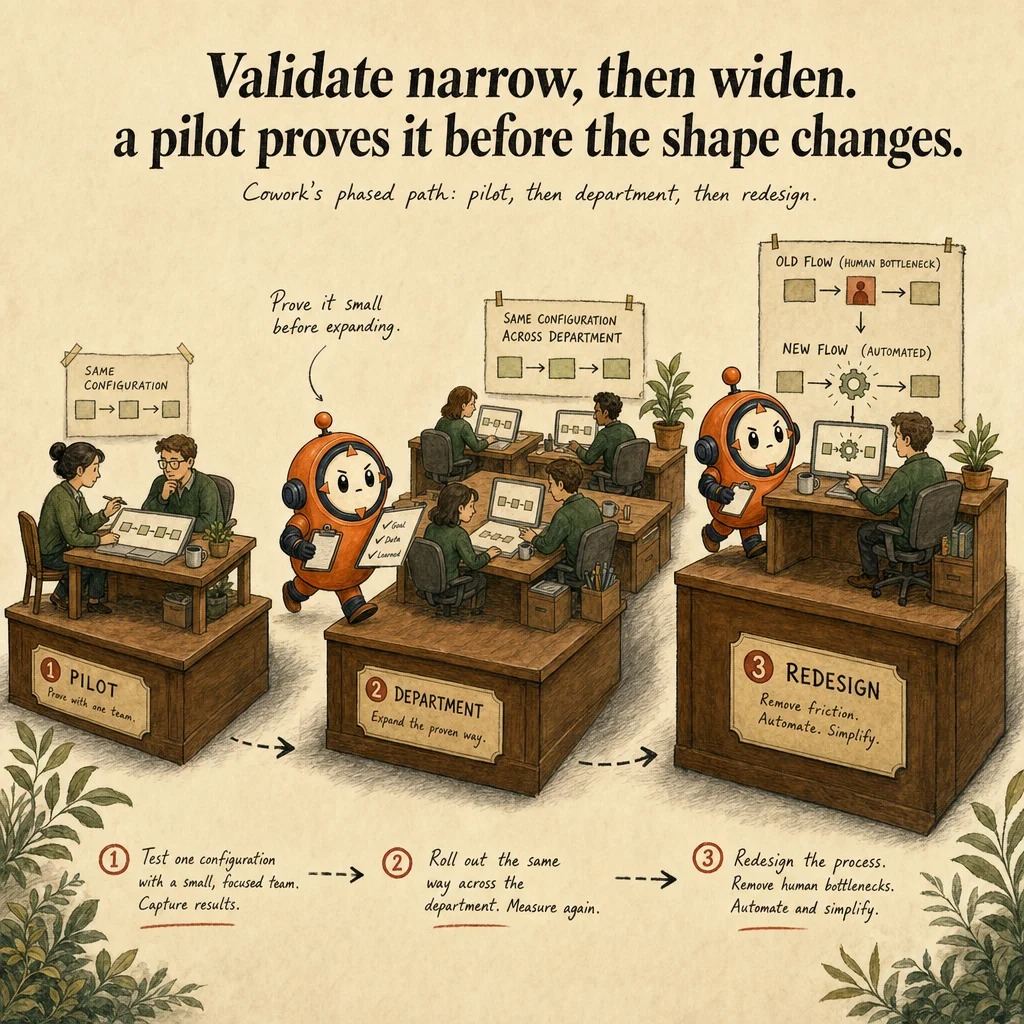
Anthropic's own rollout guidance favors starting narrow before redesigning. Its Claude Cowork playbook describes a phased adoption path, a small pilot group validates the configuration and proves repeatable use cases first, adoption then widens department by department, and only once a use case is proven does the workflow's shape actually change. The exam-relevant takeaway is the sequencing, validate through augmentation first, redesign once it's earned, not the specific phase names or numeric thresholds, which are Cowork rollout-program detail rather than the augment/redesign decision itself.
Connector and Project governance feed into the integration decision but aren't this page's focus. Which data sources Claude can reach, and how that access is scoped and approved, matters when deciding what a workflow integration can safely touch, but the mechanics (org-wide connector toggles, per-user permission bounds, required approval before actions execute) are covered in depth on the managing-knowledge-connectors and configuring-claude-projects pages. Treat this page as the augment-vs-redesign decision layer that sits above those mechanics, not a restatement of them.
In practice, augmentation starts narrow and expands, not the reverse. A Zapier case study of Claude Cowork usage cites first-draft homepage concepting delegated in minutes instead of days, and a single session synthesizing data across 15 SQL queries spanning 6 engineering systems - both are augmentation of an existing step (a person still directs and reviews the work), not a redesign of who owns the process.
Worked example: a weekly reporting workflow
Authored teaching example, not a bank question.
Each week an analyst collects numbers from three sources, writes a narrative, and a manager reviews it before it is sent on Friday.
| Option | What changes | Bottleneck moves to | Accountability |
|---|---|---|---|
| Augment the narrative step | Claude drafts, analyst edits | Review | Unchanged: analyst and manager |
| Redesign end to end | Claude collects, drafts and sends | Verifying inputs | At risk unless a named owner remains |
The team gains speed on a step it has verified, without losing a named owner. Check afterwards that the quality check ran every week and that review time did not become the new delay.
How this decision goes wrong
Redesigning before validating the task
Looks right: Claude is capable, so rebuild the whole workflow around it.
Why it fails: If the base step is unreliable, the larger design multiplies the errors and is hard to unwind.
Instead: Validate Claude on one step with real past examples, then expand.
Moving the bottleneck elsewhere
Looks right: Drafting is much faster, so the whole process is faster.
Why it fails: The reviewer now receives more than they can check, so the delay moves rather than disappears.
Instead: Look at the whole flow, and size the downstream checks before speeding up an upstream step.
Losing accountability
Looks right: Claude produced it, so no one needs to own the result.
Why it fails: When a wrong figure goes out, nobody is responsible for catching it.
Instead: Keep a named human owner and a documented quality check at the point Claude's output enters the process.
Where you'll see it
Marketing ops weekly pipeline review
Starts as augmentation (Claude drafts the pre-read digest, a person still runs the meeting) and can later become redesign (the digest auto-generates and posts on a schedule, freeing the meeting for decisions only) - augmentation proves the use case before the workflow's shape changes, the sequencing Anthropic's rollout guidance favors.
Zapier's Claude Cowork usage
First-draft homepage concepting delegated in minutes instead of days, and a single session synthesizing data across 15 SQL queries spanning 6 engineering systems - both augmentation of an existing step, with a person still directing and reviewing the output.
Side-by-side
| Dimension | Augment | Redesign |
|---|---|---|
| Who owns the process | A human still owns it end to end | The workflow's shape itself changes |
| What Claude does | Drafts, summarizes, or triages inside an existing step | Removes a bottleneck that used to require a human step |
| When to choose it | Default starting point; validates the use case narrowly | Once augmentation has proven the use case and surfaced the real bottleneck |
| Example | Claude drafts a pre-read digest; a person still runs the meeting | The digest auto-generates and posts on a schedule; the meeting shifts to decisions only |
The exam trap
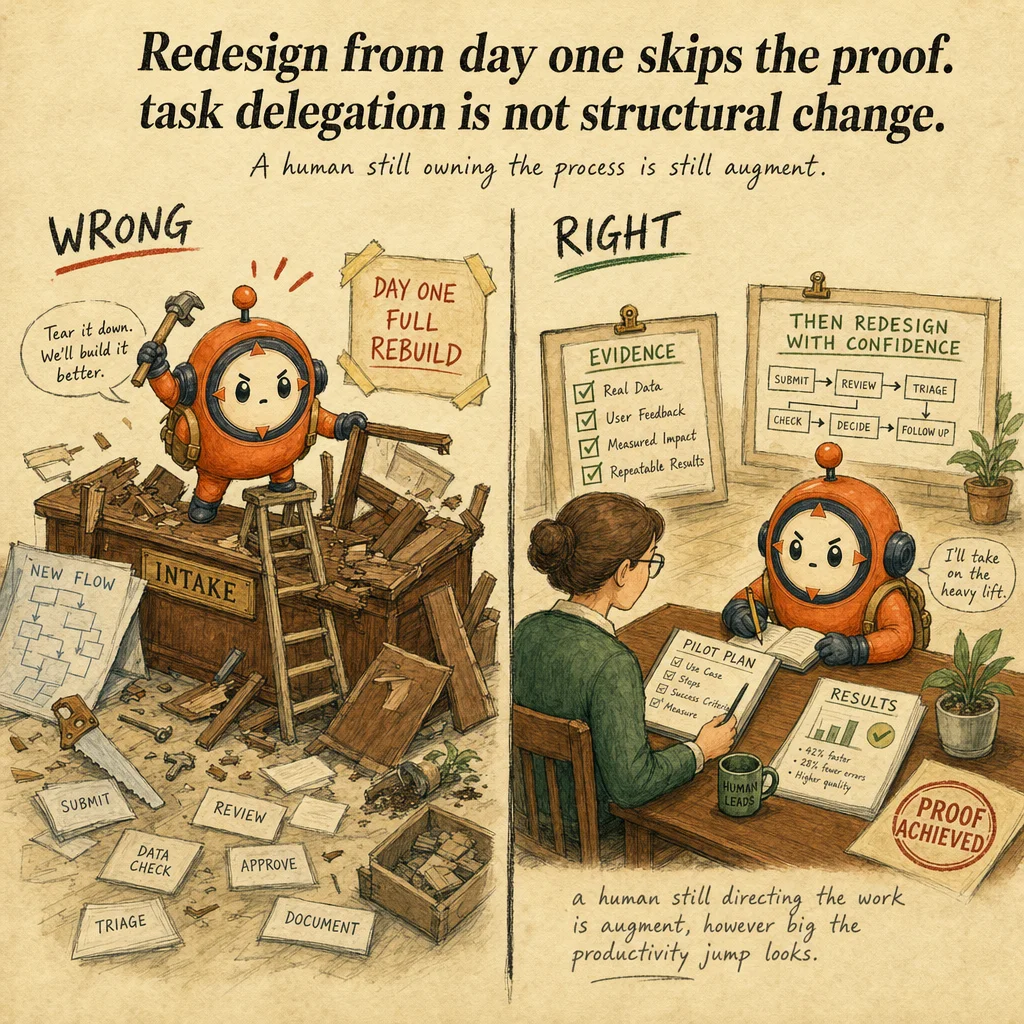
The trap is assuming "integrate Claude" always means a wholesale process redesign from day one. Anthropic's own rollout guidance favors starting narrow, a validated pilot, augmentation proven first, before any redesign. A related trap is conflating task delegation with structural change: Claude doing part of the work inside a step a human still owns is augment, not redesign, even if it looks like a big productivity jump.
Question patterns
CCA-A practice questions
4 approved CCA-A questions for this topic. Tap an answer to check it, then read the rationale for every option.
A team already runs a manual weekly pipeline review meeting. They start having Claude draft the pre-read digest from existing dashboards, while a person still owns and runs the meeting. What best describes this integration?
Frequently asked
Showing 4 of 4 questions
managing-knowledge-connectors page.Sources and next steps
- Claude Certified Associate - Foundations Exam Guide v1.0 (July 2026), PDF page 5, section: Domains 3 to 7, detailed objectives. Checked 2026-10-16.
- Building effective agents (Anthropic engineering), section: Prompt chaining; Parallelization; Orchestrator-workers; Agents. Checked 2026-10-16.
CCA-A exam guide: Domain 4, Workflow Integration and Solution Design